The Quiz Question
Which March 1945 action saw US troops of the 9th Armored Division capture an intact bridge over the Rhine River before German forces could destroy it, giving Allied forces their first bridgehead across the river?
- A. Capture of the Ludendorff Bridge at Remagen
- B. Operation Market Garden
- C. Crossing of the Moselle
- D. Battle of the Roer
The answer is A. Capture of the Ludendorff Bridge at Remagen. Here is the full story.
On the morning of 7 March 1945, a young American lieutenant crested a hill above a small German town and saw something that should not have been there. Across the grey waters of the Rhine, a steel railway bridge was still standing. In that moment, the war in Western Europe tilted on its axis.
The Bridge That Wasn't Supposed to Survive
By early March 1945, every senior Allied commander had accepted a grim assumption: the Germans would destroy every bridge across the Rhine before a single American or British soldier could set foot on the far bank. German military engineers had standing orders to demolish all Rhine crossings the moment enemy forces approached.
The Ludendorff Bridge at Remagen had stood since 1918, built during the First World War to move troops and supplies eastward at speed. It was a solid, double-tracked railway bridge — industrial, unglamorous, and utterly vital. Nobody at Allied headquarters was paying it particular attention in the first week of March.
When US reconnaissance spotted it still standing on 7 March 1945, the news stunned commanders up and down the chain of command. General Omar Bradley later called the capture of Remagen "one of the luckiest breaks we ever had" — a moment that genuinely compressed the Allied timetable into Germany's heartland by weeks, not days.
The Rhine: Hitler's Last Natural Barrier
The Rhine River stretches over 760 miles through the heart of Western Europe. By early 1945, it represented Germany's last major natural defensive line in the west — a barrier wide, deep, and fast-flowing enough to seriously slow any army trying to cross under fire.
Hitler had designated the Rhine a fortress boundary. Holding the river was essential to buying time, perhaps to negotiate, perhaps simply to prolong a war that Germany had already lost. German forces had successfully destroyed every other Rhine crossing ahead of Allied advances throughout February and into early March 1945.
Field Marshal Bernard Montgomery was methodically planning Operation Plunder, his set-piece crossing at Wesel, scheduled for 23 March — still more than two weeks away. Allied high command, including Supreme Commander Dwight D. Eisenhower, had largely resigned themselves to fighting for every river crossing the hard way: assault boats, pontoons, and men crossing under murderous fire.
The 9th Armored Division Closes In
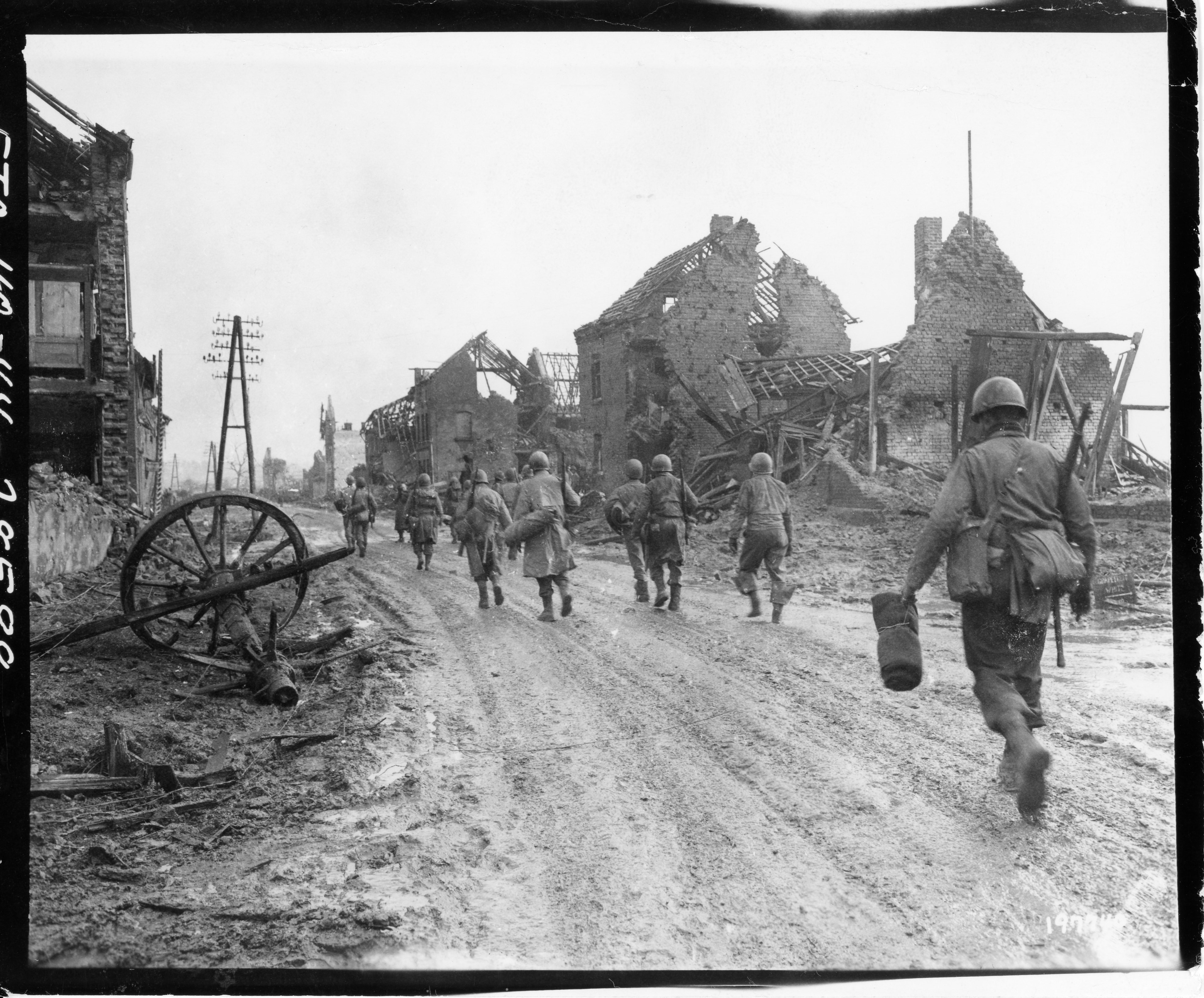
The US 9th Armored Division, part of General Courtney Hodges' First Army, was pushing rapidly eastward through the Rhineland in the first days of March 1945. Combat Command B, under Brigadier General William Hoge, drew the assignment of clearing the town of Remagen on the Rhine's west bank.
Leading the advance on the morning of 7 March was Lieutenant Karl Timmermann, commanding A Company of the 27th Armored Infantry Battalion. Timmermann was 22 years old, a Nebraska native, and had been in combat long enough to know that routine operations rarely stayed routine.
Around midday, as his soldiers crested the high ground above Remagen, they saw something that made them stop cold. The Ludendorff Bridge was still standing — its steel spans intact, the far bank tantalizingly visible. Word went up the chain instantly. Brigadier General Hoge made a snap decision on the spot: take the bridge now, before the Germans could finish the job.
The Desperate German Defence
Captain Willi Bratge commanded the German garrison defending Remagen. His force was a patchwork — fewer than 500 men, many of them elderly Volkssturm militia and teenage conscripts, supplemented by a small core of regular troops. It was not the force anyone would have chosen to hold back an armoured division.
The bridge had been wired with demolition charges well in advance. Bratge had unambiguous orders: the moment enemy forces reached the west bank, detonate the charges and drop the bridge into the Rhine. At approximately 15:50 on 7 March, German engineers triggered the first demolition charge. It blew a significant crater in the approach ramp — but left the bridge itself standing.
A second, larger charge was fired moments later. The bridge shuddered visibly, rose slightly, and then settled back down — battered and structurally weakened, but still in one piece. Post-war investigations pointed to faulty or moisture-damaged explosives as a contributing factor. Bratge and the engineer officer responsible were subsequently court-martialled by the Germans, and Bratge was sentenced to death in absentia — though he was already in American captivity and was never executed.
The Charge Across — Men Under Fire
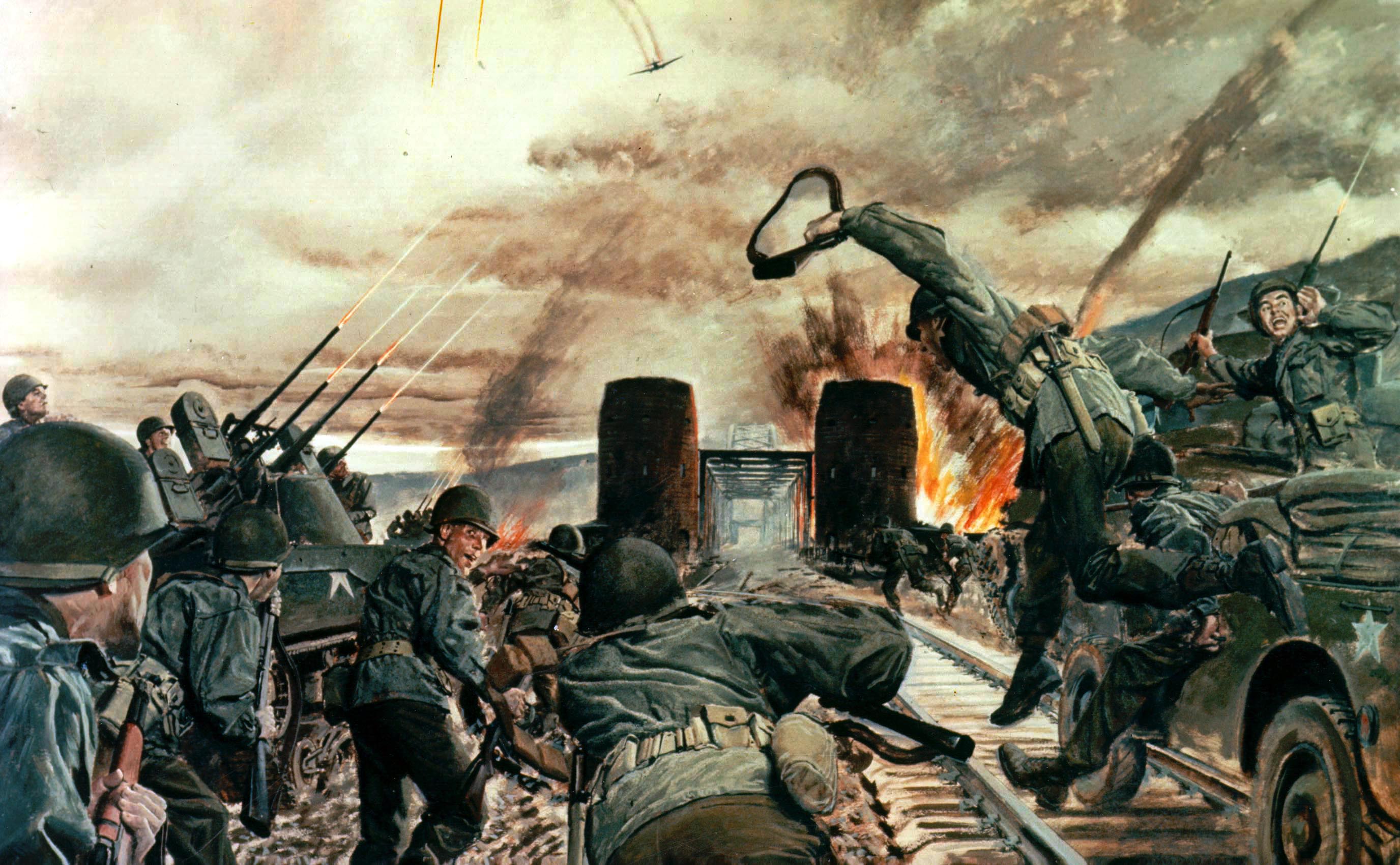
With the bridge still standing after both blasts, Timmermann did not hesitate. He led his men forward at a run across a 300-metre span of steel and timber while German riflemen and machine gunners opened fire from the eastern bank and from the towering Erpeler Ley cliff that dominated the far side.
Sergeant Alex Drabik, a butcher's son from Holland, Ohio, reached the east bank first — he is officially credited as the first American soldier to cross the Rhine. Sergeants Joseph DeLisio and Mike Chinchar were close behind. US Army engineers advanced with the infantry, frantically cutting additional demolition wires as they ran, knowing a further explosion could drop the entire span into the river with men on it.
Sherman tanks on the west bank poured suppressing fire into German positions on the Erpeler Ley, buying the men on the bridge precious seconds. By 16:00 on 7 March 1945, a US bridgehead east of the Rhine had been secured. It was the first Allied crossing of the Rhine in modern warfare since Napoleon's armies had crossed in 1805.
Eisenhower's Decision: Exploit the Miracle
General Hodges phoned General Bradley within the hour. Bradley immediately grasped what had fallen into Allied hands and authorised expanding the bridgehead without waiting for formal approval from Eisenhower's headquarters. When Eisenhower received the news, he reportedly gave a single word in response: "Exploit."
Eisenhower authorised diverting five divisions to push across at Remagen, dramatically accelerating the Allied timetable into central Germany. This was not a minor adjustment — it fundamentally disrupted German defensive planning across the entire Western Front.
Hitler's reaction was volcanic. He sacked Field Marshal Gerd von Rundstedt as Western Front commander on 10 March, partly in direct response to the Remagen disaster. Germany then threw everything available at the bridge in a desperate attempt to destroy it: Luftwaffe bombing raids, artillery, and — in a historically notable first — eleven V-2 ballistic missiles, fired at Remagen in the only combat use of V-2s against a tactical rather than strategic target. None brought the bridge down. German frogmen were also dispatched underwater to place charges against the bridge's piers; they were captured before reaching it.
The Bridge Falls — But the Door Is Already Open
The Ludendorff Bridge, weakened by the failed demolition attempts, near-constant combat traffic, artillery strikes, and structural stress, finally collapsed on 17 March 1945 — ten days after its capture. Twenty-eight US Army engineers working on repairs were killed when it fell, a tragedy that came at what should have been a moment of triumph.
But by the time the bridge went into the Rhine, it had already done its work. Over 25,000 Allied troops, along with massive quantities of armour, artillery, and supplies, were established on the east bank. Four pontoon bridges had been completed by US Army engineers alongside the original structure, ensuring the bridgehead was self-sustaining regardless of what happened to the Ludendorff span.
The Remagen bridgehead exerted a powerful strategic effect beyond its immediate geography. It drew German reserves away from Montgomery's crossing at Wesel on 23 March, making Operation Plunder considerably less costly than Allied planners had feared. Field Marshal Albert Kesselring, newly appointed as Western Front commander, later wrote that Remagen had torn a hole in Germany's western defences that could never be repaired.
The Men Behind the Moment
Lieutenant Karl Timmermann received the Distinguished Service Cross for leading the charge across the Ludendorff Bridge. He returned home to Nebraska after the war, but his health never fully recovered from his wartime service. He died in 1951 at just 29 years old — one of those quiet casualties that statistics rarely capture.
Sergeant Alex Drabik, the first man across the Rhine, went home to Holland, Ohio and resumed his life as a butcher. For decades he was modest to the point of reticence about his place in history, uncomfortable with the attention that occasionally found him. His matter-of-fact courage is characteristic of the generation.
Brigadier General William Hoge, who made the on-the-spot call that changed the strategic picture of the war, went on to a distinguished postwar career. He commanded US forces during the Korean War and retired as a full four-star General — one of the rare officers whose finest hour came from trusting his instincts in a moment of chaos rather than waiting for orders.
The story was captured in authoritative detail by Ken Hechler, a US Army historian who interviewed participants in the weeks immediately following the battle. His book The Bridge at Remagen, published in 1957, remains the definitive account of the action. It was adapted into a Hollywood film in 1969, introducing the story to a new generation.
Legacy: Why Remagen Still Matters
Military historians consistently rank Remagen among the most consequential tactical improvisations of the entire Second World War. It is a case study in how junior leadership — a 22-year-old lieutenant deciding to run forward without waiting for permission — can alter the strategic balance of a campaign.
The crossing demonstrated conclusively that Germany's western defence had irreversibly collapsed. It accelerated the Allied drive into the German heartland by an estimated two to four weeks, compressing the final phase of the war in Europe and, some historians argue, saving thousands of lives on both sides by shortening the campaign.
Today, only the two stone bridge towers on either bank of the Rhine survive. The Friedensmuseum Brücke von Remagen — the Peace Museum — opened in the surviving towers in 1980. It tells the story from both Allied and German perspectives, with particular attention to the ordinary soldiers on each side who found themselves at the centre of a moment none of them had planned for.
Remagen endures as a reminder that wars are not won by grand strategy alone. Sometimes, history turns on a single officer looking at a bridge that should not be standing, and choosing to run.
If you found this story as gripping as we did, share it with a fellow history enthusiast — and tell us in the comments: which other moments of wartime improvisation do you think deserve more attention? We'd love to hear from you.
Further Reading
- The National World War II Museum, New Orleans
- The Imperial War Museum, London
- The US National Archives and Records Administration (NARA)
- The Dwight D. Eisenhower Presidential Library and Museum, Abilene, Kansas
- The Friedensmuseum Brücke von Remagen (Peace Museum), Remagen, Germany