The Quiz Question
Which Royal Navy destroyer captured an intact Enigma machine from the German submarine U-110 in the North Atlantic on 9 May 1941?
- A. HMS Bulldog
- B. HMS Vanoc
- C. HMS Petard
- D. HMS Walker
The answer is A. HMS Bulldog. Here is the full story.
On the morning of 9 May 1941, in the freezing grey waters of the North Atlantic, a young British naval officer climbed down into a stricken German submarine with no idea whether it would explode or sink beneath him. What he carried back out would help change the course of the Second World War — and he wouldn't be allowed to tell a soul about it for thirty years.
The Secret the Allies Could Never Admit
For decades after the war ended, the full story of what happened to German submarine U-110 was locked away under the Official Secrets Act. The men involved — officers and ratings alike — were ordered never to speak of what they had done, not to journalists, not to historians, and not even to their own families.
Winston Churchill personally regarded the capture of U-110's intelligence materials as one of the most significant coups of the entire war. That judgement gives some sense of the stakes involved. It wasn't until F.W. Winterbotham published The Ultra Secret in 1974 that the British public began to understand what had really happened aboard that sinking U-boat.
Set the scene: May 1941, the North Atlantic. The sea is bitter cold, the skies grey and relentless. The Battle of the Atlantic is at its most savage — and Britain is losing.
The Battle of the Atlantic in Spring 1941: Britain on the Brink
By the spring of 1941, Admiral Karl Dönitz's U-boat fleet was sinking Allied merchant ships at a rate that terrified the British War Cabinet. April 1941 alone saw over 500,000 tons of Allied shipping sent to the bottom. Britain's survival depended entirely on those Atlantic supply lines — food, fuel, ammunition, the raw materials of war all crossed that ocean.
Churchill later wrote that the only thing that truly frightened him during the war was the U-boat menace. That admission, from a man who lived through the Blitz without flinching, says everything. Dönitz's Wolf Pack tactics were devastatingly effective: U-boats coordinated their attacks using encrypted radio signals routed through the Enigma cipher machine, and the Royal Navy had no reliable way to anticipate where they would strike next.
The 3rd Escort Group — which included HMS Bulldog and her sister ships — was tasked with protecting merchant convoys on the critical North Atlantic run. They were stretched dangerously thin. Breaking German naval Enigma, which Bletchley Park codebreakers called "Dolphin," had been the top priority since the war began. But naval Enigma had resisted every effort since September 1939.
What Was Enigma and Why Did It Matter So Much?
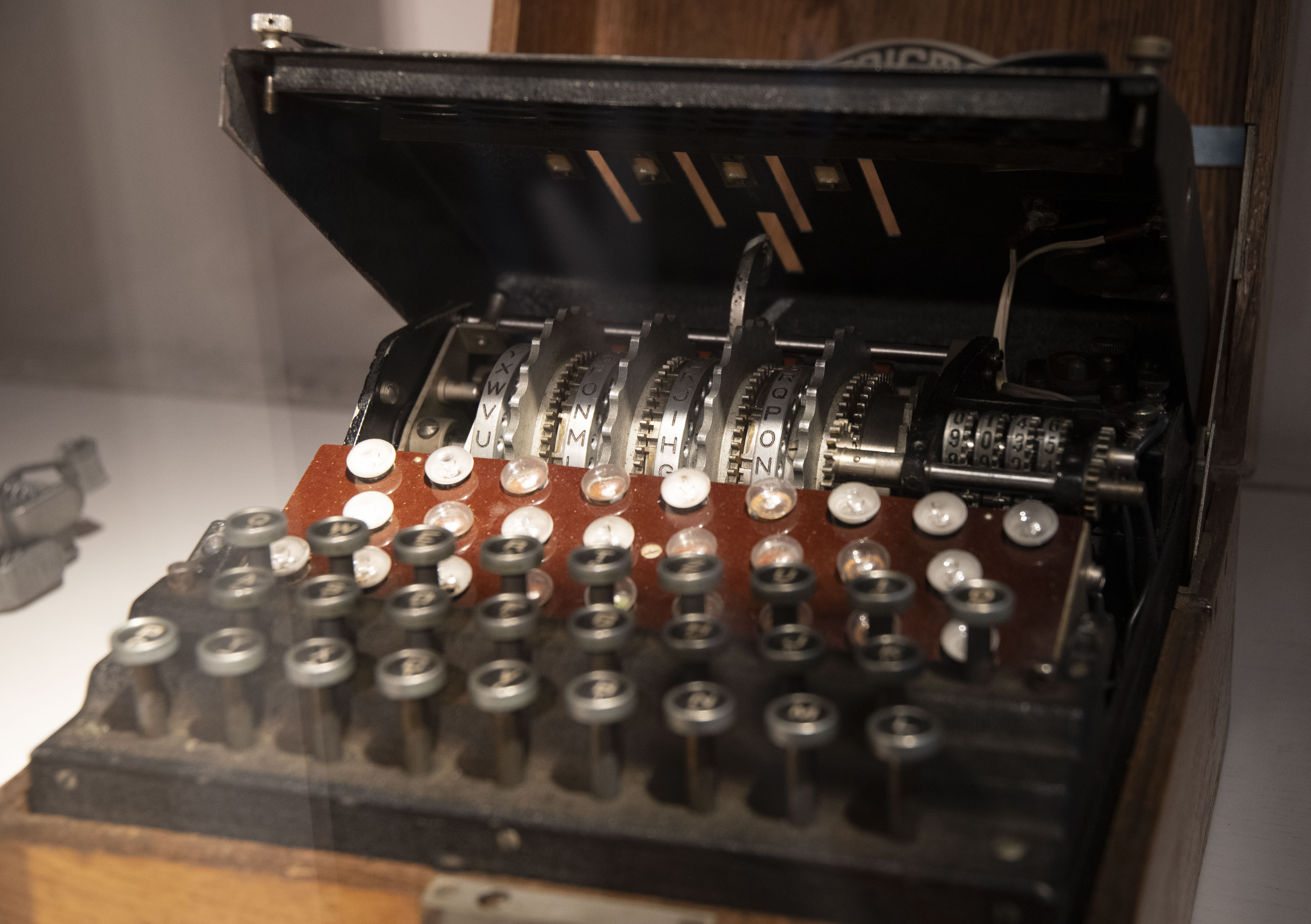
The Enigma machine was an electro-mechanical cipher device used across all branches of the German military, but the naval version — the M3, later upgraded to the four-rotor M4 — was significantly more complex than the army variants. Every day, German operators changed the machine's rotor settings, plugboard connections, and ground settings. That meant Bletchley Park's codebreakers had to crack the cipher fresh every single day, with a 24-hour window before the settings changed again.
German naval commanders were supremely confident in the system's security. Admiral Dönitz himself stated as late as 1943 that Enigma was unbreakable. That confidence was not entirely unfounded — the mathematics of the machine's possible configurations ran into the hundreds of quadrillions.
Bletchley Park's answer was the "bombe," an electromechanical decryption machine developed by Alan Turing and Gordon Welchman. But even the bombes needed a foothold — known plaintext passages called "cribs," or better still, captured physical materials. Captured Enigma rotors, settings sheets, and codebooks were worth more to British intelligence than almost any weapon of war. They could unlock months of U-boat communications and expose patrol positions across the entire Atlantic.
9 May 1941: Convoy OB-318 and the Hunting of U-110
U-110 was a Type IXB submarine with a notorious history. Her commander, Kapitänleutnant Fritz-Julius Lemp, was the officer who had controversially sunk the passenger liner SS Athenia on the very first day of the war in September 1939, killing 117 civilians. By May 1941, he was an experienced and dangerous commander operating as part of a Wolf Pack targeting westbound convoy OB-318, some 400 miles south of Iceland.
At around noon on 9 May, U-110 torpedoed and sank two merchant ships from the convoy: SS Esmond and SS Bengore Head. It was a routine kill for a veteran U-boat crew. What happened next was anything but routine.
HMS Aubretia, a Flower-class corvette in the escort group, gained a sonar contact and attacked with depth charges. The explosions drove U-110 to the surface in a badly damaged, uncontrolled state. HMS Broadway and HMS Bulldog — both B-class destroyers — raced to the scene. Bulldog's captain, Commander A.J. Baker-Cresswell, made a split-second decision that would shape the rest of the war: rather than ram and sink the stricken submarine, he ordered his men to prepare a boarding party.
The Boarding Party: Nine Men and a Sinking Submarine
Sub-Lieutenant David Balme was twenty years old when Baker-Cresswell ordered him to lead the boarding party. Nine men climbed into a wooden whaler and rowed across to U-110, not knowing whether the submarine was about to sink, explode, or was hiding armed crew waiting below. It was an act of extraordinary courage.
The German crew had already abandoned ship, believing U-110 was going down fast. Lemp himself died in the water — whether he was shot attempting to swim back to scuttle the boat, or drowned, remains disputed by historians to this day. What Balme and his team found when they climbed down the conning tower was astonishing: the submarine was largely intact, and the Enigma machine was sitting at the radio operator's station, rotors in place, as if the crew had simply stepped away mid-shift.
Working for several hours in a submarine that was slowly flooding, in near-darkness and with the constant threat of sudden sinking, Balme's men passed a haul of materials up through the conning tower to the waiting whaler. They recovered the Enigma machine itself, a complete set of spare rotors, current naval Enigma settings sheets for June and July 1941, the short signal codebook (Kurzsignalheft), the weather short signal book, and detailed grid reference charts covering the entire Atlantic. In later interviews, Balme described the eerie silence of the boat and the almost surreal calm he felt, focused entirely on the job at hand.
The Men Who Made It Happen: Baker-Cresswell and Balme
Commander Baker-Cresswell's decision not to ram U-110 was the hinge on which everything else turned. Ramming was standard procedure for a surfaced U-boat — it was the safest way to ensure the enemy vessel was destroyed and could not be recovered by the Germans. Baker-Cresswell recognised in seconds that this submarine might be taken intact. He was awarded the Distinguished Service Order for his actions.
David Balme received the Distinguished Service Cross. The crew of HMS Bulldog also pulled 32 survivors from U-110's complement of 58 out of the freezing water — and kept them strictly isolated below decks, ensuring no German sailor could see that his submarine had been boarded and stripped of its most precious contents.
The British went to extraordinary lengths to maintain the secret. German survivors were transferred ashore and held in isolation. Strict radio silence was maintained. Official reports were carefully managed. King George VI personally received both Baker-Cresswell and Balme at Buckingham Palace; the King reportedly told them their achievement might shorten the war. He was not wrong.
Bletchley Park's Windfall: What the Capture Unlocked
The materials from U-110 were rushed to Bletchley Park's Government Code and Cypher School (GC&CS) and the Naval Intelligence Division within days. The settings sheets and codebooks allowed codebreakers to read German naval Enigma traffic — retrospectively and in near real-time — for much of June and July 1941, months that had previously been impenetrable.
The capture contributed directly to the sustained breaking of "Dolphin," the main German naval Enigma key, which was read with increasing regularity from mid-1941 onwards. Admiral Sir Dudley Pound, the First Sea Lord, and his staff could now re-route convoys around known U-boat patrol lines. Allied shipping losses in the North Atlantic fell sharply in the months that followed the capture.
The Kurzsignalheft — the short signal codebook — proved particularly valuable. It allowed Bletchley Park analysts to identify the specific U-boat transmitting a signal, pinpointing submarine positions across the Atlantic with a precision that had previously been impossible. For convoy planners, that kind of intelligence was transformative.
U-110's Final Hours: The Submarine That Refused to Stay Secret
HMS Bulldog attempted to tow U-110 back to Britain. An intact German submarine arriving in a British port would have been an extraordinary intelligence prize in its own right. But U-110 was too badly damaged. She sank on the morning of 10 May 1941, slipping beneath the Atlantic before she could be brought home.
In a grim irony, British intelligence was almost relieved. A U-boat under tow would have been virtually impossible to hide from German agents, neutral shipping, and aerial reconnaissance. The submarine's sinking provided natural cover. Lemp's death was equally significant: the one officer most likely to suspect the boat had been boarded never returned to Germany to raise the alarm.
German Naval Intelligence did investigate whether U-110 might have been captured. B-Dienst, their signals intelligence arm, examined the evidence and eventually concluded that the submarine had gone down with all hands and that Enigma remained secure. Dönitz never learned the truth during the war. British deception operations — including the careful, disciplined management of how Ultra intelligence was actually used in the field — prevented the Germans from ever suspecting their cipher had been cracked.
Legacy: How One Boarding Party Helped Turn the Tide
Historians today rank the capture of U-110's Enigma materials among the most important single intelligence events of the entire Second World War. It was not the only Enigma seizure — earlier pinch operations at the Lofoten Islands in February 1941 and from the weather ship München in May 1941 had also contributed crucial pieces — but the U-110 haul was by far the most complete and consequential.
David Balme lived until 2016, dying at the age of 95. In his final years he became the last surviving officer of the boarding party, and he spoke movingly about the weight of the secret he had carried through his thirties, forties, and fifties — unable to explain to anyone why what he had done in those few hours mattered so much.
The story's postwar life has had its controversies. The 2000 Hollywood film U-571 depicted American sailors capturing an Enigma machine, a fictional account that drew formal protests from the British government and outrage from veterans who had lived through the real events. The film was eventually released with a disclaimer acknowledging that it was British sailors who had actually performed these operations. It was a small concession, but an important one.
As for the original Enigma machine recovered from U-110, it is believed to have been retained by GCHQ — the successor organisation to Bletchley Park — and has never been publicly displayed. It remains, fittingly, a secret kept in the dark: a symbol of the extraordinary things ordinary men did in extraordinary times, and of the silence they were asked to carry for the rest of their lives.
If this story moved you as much as it moves us, share it with someone who loves real history — and tell us in the comments: did you know the full story of HMS Bulldog before today? We'd love to hear from you.
Further Reading
- The National Archives, Kew — holds declassified Admiralty records and signals intelligence files relating to the Battle of the Atlantic and U-110
- Imperial War Museum, London — collections covering Royal Navy operations, the Battle of the Atlantic, and personal testimonies from veterans including David Balme
- Bletchley Park Trust — the official heritage organisation preserving the history of GC&CS and the Ultra intelligence programme
- The National Museum of the Royal Navy, Portsmouth — covers Royal Navy destroyer operations and convoy escort actions in the Second World War
- The National WWII Museum, New Orleans — holds extensive research collections on Allied intelligence operations and the Battle of the Atlantic