The Quiz Question
In April 1942, King George VI awarded the George Cross to an entire population for their courage under siege. Which place received it?
- A. Gibraltar
- B. Malta
- C. Cyprus
- D. Tobruk
The answer is B. Malta. Here is the full story.
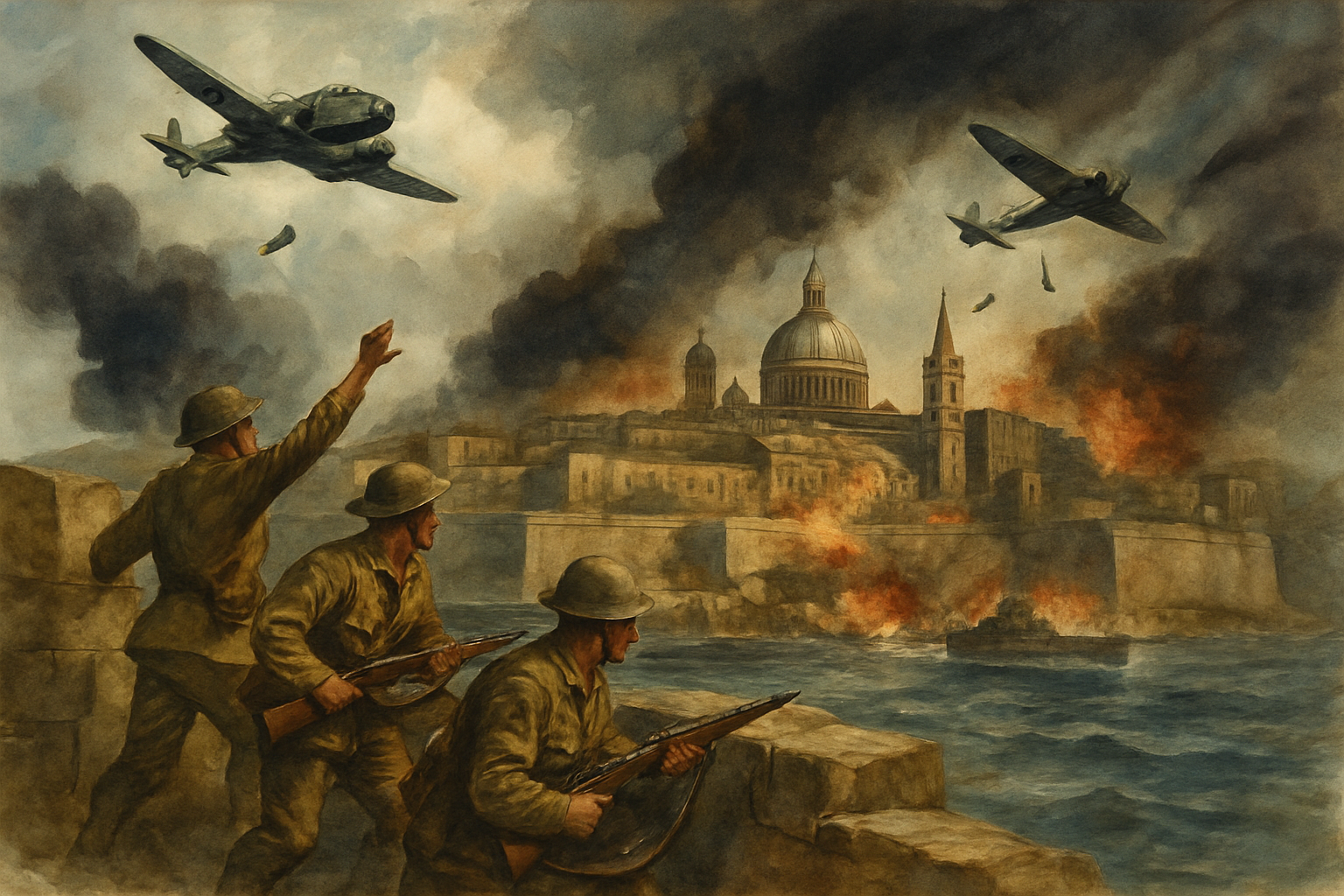
By the spring of 1942, a small island in the middle of the Mediterranean had become the most heavily bombed place on Earth. Malta — just 17 miles long and 9 miles wide — had already endured more than 3,000 air raids. Its 270,000 civilians had nowhere to run. Its harbours were being pulverised daily. And yet, it did not fall. On 15 April 1942, King George VI did something he had never done before, and has never been done since: he awarded the George Cross to an entire population.
The Island That Stood Alone
To understand what Malta's people endured, consider this single statistic: in the month of March 1942 alone, over 4,800 tonnes of bombs fell on the island — more than dropped on London during the entire Blitz. London had room to spread the damage across a vast city. Malta had nowhere. Every bomb that missed a harbour wall landed on a street, a church, or a home.
King George VI's letter to the island's Governor, Lieutenant-General Sir William Dobbie, cut straight to the point. It read: "To honour her brave people I award the George Cross to the Island Fortress of Malta." It was a rare moment of wartime clarity — an acknowledgement that courage was not only shown on the battlefield, but lived every single day by ordinary men, women, and children who simply had no choice but to endure.
Why Malta Mattered: The Strategic Picture
Malta's position made it irreplaceable. Sitting at the crossroads of the Mediterranean, just 60 miles south of Sicily and roughly midway between Gibraltar and Suez, it controlled the sea lane that both sides desperately needed. For the Allies, it was the base from which the Royal Navy's submarines and surface ships hunted Axis convoys supplying Rommel's Afrika Korps in North Africa. For Hitler and Mussolini, neutralising it was essential.
The numbers tell the story starkly. In some months of 1941, Malta-based forces sank or damaged over 70% of all Axis supplies bound for Libya. Rommel was brilliant, but even he could not fight without fuel, ammunition, and reinforcements. As long as Malta held, those supplies bled away in the Mediterranean.
The German High Command drew up Operation Herkules — a detailed plan for an airborne and amphibious assault on Malta, modelled partly on the costly capture of Crete in 1941. It was never launched. The reasons remain debated by historians, but the result was that Malta was never directly invaded — only besieged and bombed into near-submission.
Italy Opens the Attack: June 1940
Italy declared war on 10 June 1940, and the first air raid on Malta came the very next morning, on 11 June. What met the Italian bombers was almost absurdly thin. Malta's entire fighter defence at that moment consisted of three Gloster Sea Gladiator biplanes — fabric-covered, fixed-undercarriage relics facing modern monoplane bombers. The press affectionately named them Faith, Hope, and Charity, and the name stuck.
The Gladiators flew against Savoia-Marchetti SM.79 bombers and Fiat CR.42 biplane fighters with remarkable tenacity, but the mismatch was severe. Hurricanes began arriving from August 1940, but never in sufficient numbers. Through the remainder of 1940 and into 1941, Malta's defenders were outnumbered, outgunned, and perpetually short of spare parts, fuel, and pilots.
That the island survived the Italian phase of the siege at all owed as much to the determination of its anti-aircraft gunners and the resilience of its civilian population as to its handful of fighters.
The Luftwaffe Arrives: The Darkest Days of 1942
In January 1942, Hitler transferred Luftflotte 2 — more than 400 aircraft — to Sicily under Field Marshal Albert Kesselring, with orders to destroy Malta as a fighting base. The escalation was immediate and overwhelming. Grand Harbour, the dockyards at Valletta, the airfields at Luqa, Hal Far, and Ta' Qali — everything was targeted, relentlessly, day and night.
Raids came sometimes every hour. The harbour became a graveyard of sunken ships. To try to restore Malta's air defences, the Royal Navy mounted desperate ferry runs. The carrier USS Wasp — loaned by President Roosevelt — flew off 47 Spitfires in April 1942. Within days of landing, most had been destroyed on the ground by renewed bombing. Churchill famously signalled Roosevelt: "Who said a wasp couldn't sting twice?" — and Wasp returned for a second run in May.
By April 1942, food, fuel, and ammunition were at critically low levels. British military planners were calculating, in cold terms, how many weeks remained before Malta would be forced to surrender.
The Civilians Who Endured: Life Under the Bombs
For the Maltese people, the siege was not a distant military event — it was the texture of daily life. Families sheltered in ancient catacombs and rock-cut tunnels beneath Valletta and the Three Cities of Vittoriosa, Senglea, and Cospicua. Some of these shelters held hundreds of people for days at a time, lit by candles, with little sanitation and no guarantee of safety.
Food rationing was brutal. By 1942, the daily calorie allowance had fallen to around 1,500 calories — well below the minimum an adult needs to function properly. To address the collapse of normal cooking and food supply, the government established "Victory Kitchens" — communal food centres that served basic meals to thousands of families who had no fuel, no intact kitchen, and no food to cook anyway.
Through all of it, Maltese dockyard workers kept going back. In January 1941, the aircraft carrier HMS Illustrious limped into Grand Harbour severely damaged after a German air attack. Dockyard workers repaired her under live bombing raids — the Germans specifically targeted the ship while she was in harbour. She was made seaworthy and sailed to safety. That spirit ran through every level of Maltese society.
The island's deep Catholic faith was not incidental to its survival. Priests led prayers in the shelters. Bombed churches held services in the ruins. Faith — in every sense — was a practical sustaining force, not merely a sentiment.
King George VI's Award: The Letter That Made History
The George Cross had been instituted by King George VI himself in September 1940, designed as the highest award for civilian gallantry — second only to the Victoria Cross in Britain's honours system. It was created specifically because the Blitz had made clear that civilians were facing dangers as great as any soldier.
On 15 April 1942, the King wrote personally to Governor Dobbie, awarding the George Cross to the Island Fortress of Malta and to its people. The award was — and remains — the only time in history that the George Cross has been given to an entire population rather than an individual.
The announcement was made publicly, and its effect on morale — both in Malta and across Britain — was immediate and significant. For an island that had been enduring in near-isolation, it was confirmation that the world had not forgotten them. The original George Cross medal presented to Malta is displayed at the Palace of the Grand Masters in Valletta, where it remains a treasured national symbol to this day.
Operation Pedestal: The Convoy That Saved Malta
By the summer of 1942, Malta was genuinely on the brink. British planners estimated that without a major resupply convoy arriving by early September, the island would have no choice but to negotiate surrender. Operation Pedestal, launched in August 1942, was the answer — fourteen merchant ships escorted by one of the largest Royal Navy task forces ever assembled in the Mediterranean, including four aircraft carriers and two battleships.
The cost was catastrophic. Nine of the fourteen merchant ships were sunk. The carrier HMS Eagle was torpedoed on 11 August by U-73 and went down in eight minutes. The cruiser HMS Manchester was lost. The convoy fought its way through bombers, submarines, E-boats, and everything the Axis could throw at it.
But the most extraordinary moment came on 15 August 1942, when the American tanker SS Ohio — crewed by British Merchant Navy sailors after US neutrality rules made the original crew step aside — limped into Grand Harbour. She had been hit by bombs and torpedoes and was barely afloat, held up by two destroyers lashed to her sides. Her cargo of kerosene and fuel oil was precisely what Malta's aircraft and power stations needed to survive. The island's population lined the harbour walls, cheering and weeping, as she arrived. That date, 15 August, is now known in Malta as the Feast of Santa Marija — its religious significance fused permanently with the memory of deliverance.
Turning the Tide: Malta Strikes Back
The decisive turning point for Malta's air defences had come slightly earlier, on 9 May 1942, when 61 Spitfires were flown in simultaneously — this time with ground crews and ammunition pre-positioned and ready, so the aircraft could be rearmed and refuelled within minutes of landing. The Luftwaffe's next mass raid was met by fighters already airborne. The balance shifted almost overnight.
With fuel secured by Pedestal and air superiority gradually restored, Malta returned to its offensive role. Air Vice-Marshal Hugh Pugh Lloyd oversaw the campaign that used Malta's aircraft and submarines to strangle Rommel's supply lines. By November 1942, more than 70% of supplies sent to Rommel were being lost at sea. The victories at El Alamein in October and November 1942, and the Allied Operation Torch landings in North Africa, removed the immediate threat to Malta — but the island had already played its part in making those victories possible.
Kesselring himself later acknowledged that the failure to neutralise Malta was one of the most costly strategic errors the Axis made in the Mediterranean theatre.
Legacy and Memory: What the George Cross Means Today
Malta gained independence from Britain in 1964 and became a republic in 1974. But the George Cross did not disappear into history — it remained on the Maltese national flag, where it appears to this day. Malta is the only nation in the world whose flag carries the George Cross, a permanent reminder of what its people endured and refused to surrender.
Every year on 8 September — Victory Day — Malta holds national commemorations marking the arrival of the Pedestal convoy and the broader memory of the siege. The day carries the weight of living memory even as the survivors grow fewer.
Historians including Correlli Barnett have credited Malta's resistance as a pivotal factor in the Allied victory in North Africa and the subsequent invasion of Sicily in July 1943. Without Malta, Rommel might well have reached the Suez Canal. Without Suez, the entire strategic picture of the war shifts into darker territory.
For anyone who cares about the Second World War, Malta stands as something rare and important: proof that courage under fire was not only a military virtue. It was lived, every hour of every bombed and hungry day, by an entire civilian population who simply refused to give in.
If this story moved you, share it with someone who deserves to know it — and let us know in the comments: did you have family who served in the Mediterranean, or who remember the siege? We'd love to hear your stories.
Further Reading
- Imperial War Museum (IWM), London — extensive collections on the Siege of Malta, including personal testimonies and photographic archives
- The National Archives, Kew — official British government and military records covering the Mediterranean Campaign and Malta's defence
- National War Museum, Valletta, Malta — dedicated collections on the George Cross award and the Maltese experience of the siege
- National Museum of the Royal Navy, Portsmouth — records and artefacts relating to Royal Navy operations in the Mediterranean, including Operation Pedestal
- The Second World War Experience Centre, Leeds — oral history collections including testimonies from veterans of the Malta convoys and Mediterranean theatre