The Quiz Question
Which requisitioned P&O liner, nicknamed the Great White Whale, carried troops into the Falklands war zone in 1982 while her Cunard counterpart QE2 was kept back as too great a loss to risk?
- A. Norland
- B. SS Canberra
- C. Elk
- D. SS Uganda
The answer is B. SS Canberra. Here is the full story.
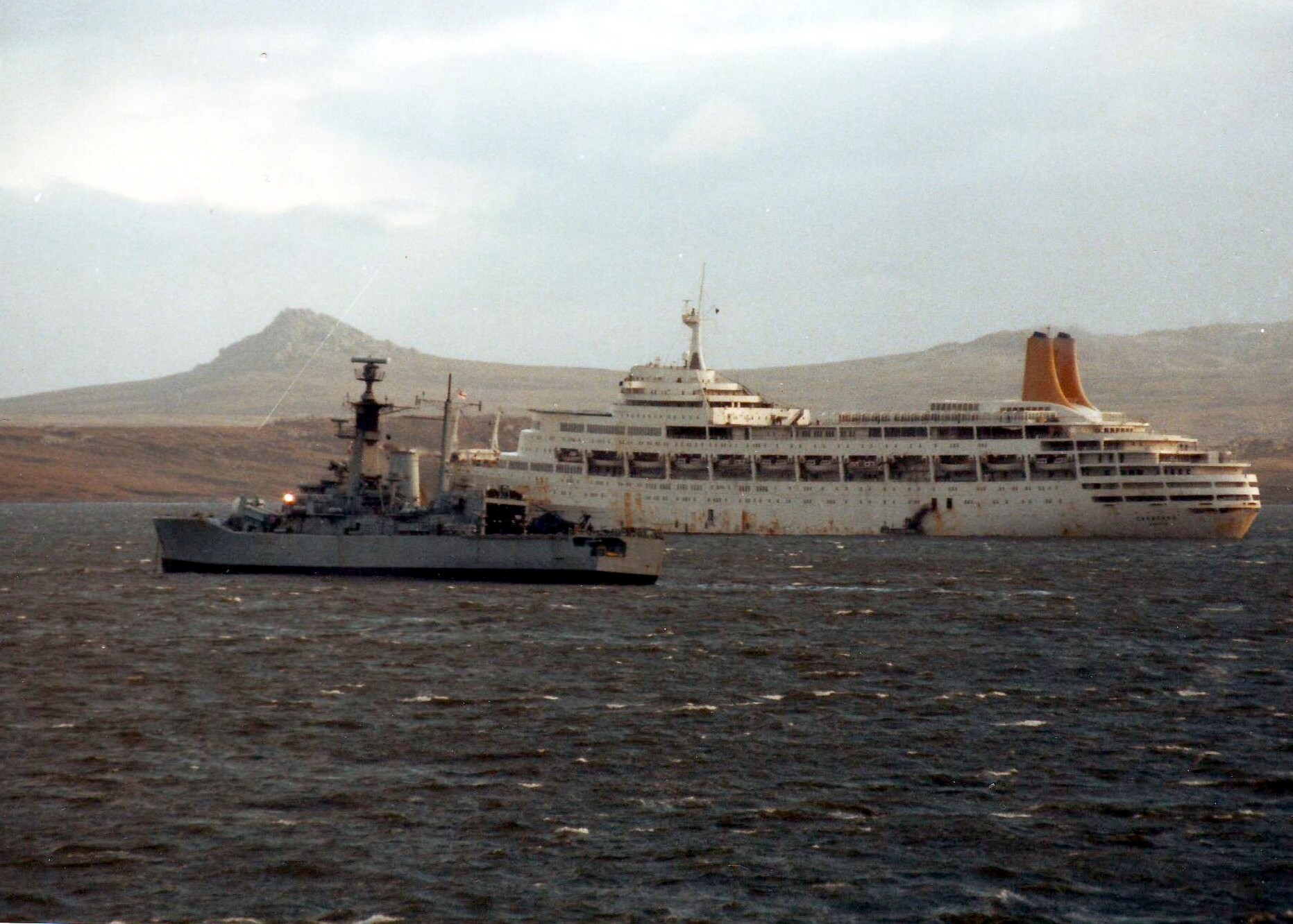
In the spring of 1982, a gleaming white cruise liner — better known to her fans as the Great White Whale — was pulled from her peaceful Mediterranean itinerary and sent to war. The story of SS Canberra is one of the most remarkable chapters of the entire Falklands conflict: a floating holiday destination transformed in eight days into a troopship, sailed into one of the most dangerous anchorages of the campaign, and crewed throughout by civilians who had every right to go home but chose to stay.
A Cruise Ship Goes to War: The Call That Changed Everything
On 2 April 1982, Argentine forces invaded the Falkland Islands, a British overseas territory in the South Atlantic. The British government responded with astonishing speed, assembling a naval Task Force within days. But the Royal Navy faced an immediate logistical crisis: it simply did not have enough military transport vessels to move the thousands of troops needed some 8,000 miles south.
The solution lay in the Merchant Shipping Act, which granted the British government powers to requisition civilian vessels in a national emergency. Within 48 hours of the invasion, those powers were being exercised. SS Canberra received her requisition order on 4 April 1982, while she was docked at Southampton between voyages. Passengers mid-itinerary were disembarked, their holiday abruptly ended, and the ship was handed over to the Ministry of Defence with the kind of bureaucratic speed that wartime necessity tends to produce.
Meet the Great White Whale: SS Canberra Before the War
SS Canberra was no ordinary vessel. Built by the legendary Belfast shipyard Harland and Wolff — the same yard that produced RMS Titanic — she was launched in 1960 and entered P&O service in 1961. At 44,807 gross tons and 820 feet in length, she was among the largest British liners of her era.
Her distinctive all-white hull and superstructure led sailors and passengers to christen her the Great White Whale, a nickname she wore with affection. Originally designed for both passenger and cargo operations on the UK-Australia route, she was converted to full-time cruising in 1974 as the economics of long-haul sea travel shifted. By 1982 she was a beloved fixture of British holiday culture, carrying thousands of passengers annually on Mediterranean and round-the-world voyages. Her sudden departure for the South Atlantic was a shock to everyone who knew her.
Why Canberra and Not QE2? The Strategic Decision Behind the Choice
Cunard's Queen Elizabeth 2 was also requisitioned in April 1982, and her eventual participation in the campaign is well documented. But military and government planners made a deliberate decision to keep QE2 away from the most dangerous waters, at least initially. The reasoning was straightforward: losing the QE2 to Argentine attack would have been a propaganda catastrophe of the first order, as well as an economic one. She was, in practical terms, irreplaceable.
Canberra, though also a significant vessel, was judged more operationally suitable for the sharp end of the campaign. Her shallower draught made her better suited to inshore operations, and she was considered more expendable in the cold calculations of military planning. QE2 was eventually deployed in May 1982, used primarily to transfer troops between Ascension Island and South Georgia — important work, but well clear of the most dangerous waters around the Falklands themselves. Canberra, by stark contrast, was sailed directly into San Carlos Water at the height of the Argentine air assault.
Eight Days of Transformation: Converting a Cruise Ship into a Troopship
The conversion of Canberra from luxury liner to military transport was one of the engineering feats of the campaign. Royal Engineers and civilian dockworkers laboured around the clock from 4 April, and the transformation was completed in just eight days. Two helicopter landing pads were welded to her decks — one forward, built over the swimming pool area, and one aft — requiring significant structural work at extraordinary speed.
Luxury carpets, furnishings and fittings were stripped out and replaced with ammunition stores, military equipment and expanded medical facilities. The ship that had once pampered holidaymakers was reconfigured for the harsh demands of an amphibious operation in the South Atlantic winter. Canberra sailed from Southampton on 9 April 1982 carrying approximately 2,000 troops, among them 3rd Battalion the Parachute Regiment (3 Para) and 40 Commando Royal Marines — two units that would write their own histories in the battles ahead.
Sailing South: The Voyage to Ascension Island and Beyond
Canberra's first stop was Ascension Island, the British territory sitting roughly midway between the UK and the Falklands in the mid-Atlantic. The island served as the Task Force's primary staging post and logistics hub, and the anchorage around it became one of the busiest patches of ocean in the world during those weeks.
The long voyage south was not idle time. Troops trained on deck, conducted weapons drills, cleaned and prepared equipment, and readied themselves mentally for what was coming. Conditions were cramped — a cruise ship is not designed to house 2,000 soldiers — and the South Atlantic winter made for rough, cold seas. Veterans who made the voyage have described the atmosphere as a complex blend of grim determination, dark humour and deep camaraderie. Canberra rendezvoused with other Task Force vessels, including the aircraft carriers HMS Hermes and HMS Invincible, as the fleet assembled. She crossed into the Total Exclusion Zone — the 200-mile military cordon declared around the Falklands — in late May 1982.
Into the Fire: San Carlos Water and D-Day
The amphibious landings began in the early hours of 21 May 1982, and Canberra was there. She entered San Carlos Water on the western coast of East Falkland in darkness, part of the largest British amphibious operation since the Second World War. What followed would earn the anchorage a name that has stuck ever since: Bomb Alley.
Argentine Air Force Skyhawk and Mirage jets launched repeated low-level attack runs against the ships gathered in San Carlos Water. The raids were ferocious and effective. HMS Ardent was sunk on 21 May. HMS Antelope was hit on 23 May and sank the following day. HMS Coventry was struck and sunk on 25 May. The threat to every vessel in those waters was very real, and Canberra — enormous, white and unmissable — was an obvious target.
She survived, through a combination of fortune, the effectiveness of British air defences, and the speed with which she was moved out of the anchorage after disembarking her troops. Approximately 2,000 soldiers from 3 Para and 40 Commando were successfully landed. Those men went on to fight some of the defining engagements of the campaign — the Battle of Goose Green, the Battle of Mount Longdon, and the final push on Stanley.
The Crew Who Stayed: Civilians in the Combat Zone
One of the least-told stories of the entire Falklands campaign is what happened with Canberra's civilian crew. Around 650 P&O crew members — stewards, chefs, engineers, deck officers — chose to remain aboard the ship throughout the operation. They had no military training and no obligation to sail into a war zone. They stayed anyway.
Captain Dennis Scott-Masson commanded Canberra throughout the campaign and was praised by senior military figures for his calm, professional leadership under extraordinarily difficult conditions. The contribution of the civilian crew did not go entirely unrecognised: several crew members were subsequently awarded the Merchant Navy Medal for Meritorious Service. Their quiet decision to remain at their posts while Argentine jets attacked ships around them represents one of the most understated acts of collective courage in modern British military history.
Coming Home in Triumph: The Return to Southampton
Argentina's forces surrendered on 14 June 1982, after 74 days of conflict. Canberra began her return voyage shortly after, this time carrying a very different kind of passenger manifest — Argentine prisoners of war and British wounded alongside the troops coming home. It was a sombre, complex return journey that reflected the full human cost of the campaign.
She arrived back in Southampton on 11 July 1982, and what greeted her became one of the most emotionally charged homecomings in post-war British history. Hundreds of small boats flooded the Solent to escort her in. Thousands of people lined the shores. Families who had spent weeks living with fear and uncertainty were reunited on the dockside. The BBC and ITV broadcast the arrival live, and the images of soldiers crowding her decks, waving and calling out to the crowds below, became among the most iconic of the entire Falklands conflict. Prime Minister Margaret Thatcher was among the dignitaries present to welcome the ship home.
Legacy of the Great White Whale: What Canberra's Story Means Today
SS Canberra was returned to P&O after refurbishment and continued her cruising career until 1997, when she was finally retired and sold for scrapping. She ended her days in Pakistan, broken up for steel — a fate that felt, to many who loved her, entirely unworthy of what she had been and done. She was 36 years old.
Her Falklands service cemented her place in British popular memory far beyond anything that peacetime cruising could have achieved. The campaign also exposed something uncomfortable about British military logistics: by 1982, the armed forces' own transport capacity was so depleted that requisitioning civilian ships was not a contingency plan but an operational necessity. The loss of the container ship Atlantic Conveyor — struck by an Exocet missile on 25 May 1982 with significant loss of life and critical cargo — underscored just how exposed civilian vessels and their crews were throughout the campaign.
Veterans of the Falklands still gather each year at commemorations, and Canberra features prominently in their shared memories and conversations. She represents something that goes beyond military hardware: the moment when a ship beloved by ordinary British holidaymakers went to war, crewed by civilians who chose duty over safety, and came home carrying the men who had fought and won at the bottom of the world.
If the story of SS Canberra resonates with you, we'd love to hear your memories — whether you served aboard her in peacetime or in 1982, or simply remember watching her come home on the television. Share this article with someone who was there, or leave a comment below and join the conversation.
Further reading
- Imperial War Museum — holds extensive collections related to the Falklands War, including oral history recordings from veterans and merchant seafarers
- The National Archives, Kew — holds official government and Ministry of Defence records from the 1982 Falklands campaign
- National Museum of the Royal Navy, Portsmouth — covers British naval history including the Falklands conflict and the role of requisitioned vessels
- Falklands Conservation and the Falkland Islands Government — maintain records and commemorative resources relating to the 1982 conflict
- P&O Heritage Collection — documents the history of P&O ships including SS Canberra's design, service history and wartime role