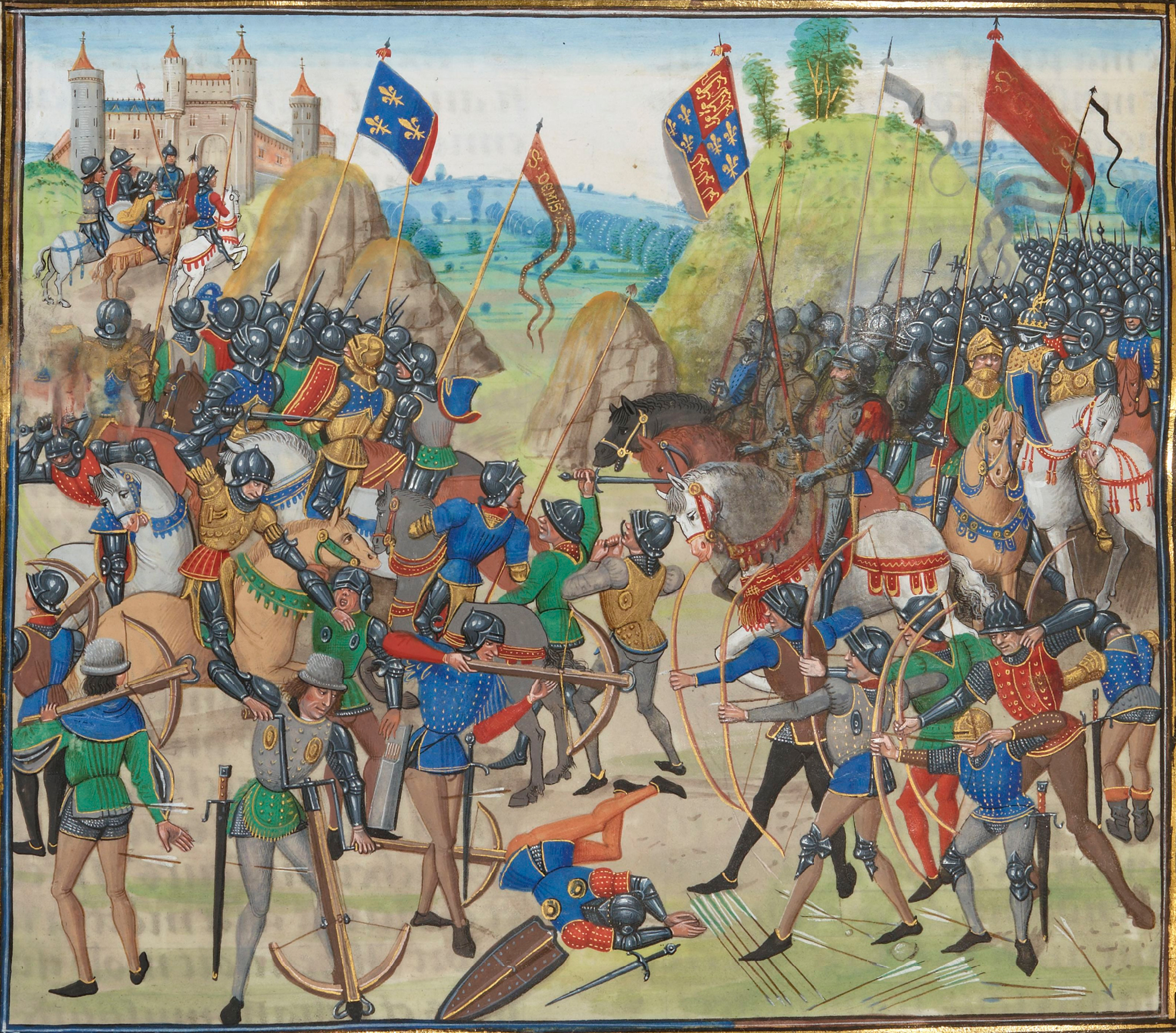
On a cold October morning in 1415, thousands of French knights and men-at-arms advanced across a muddy, freshly ploughed field near the village of Agincourt in northern France. What met them was not a wall of steel — it was a wall of arrows. Within minutes, the flower of French chivalry lay dying in the mud, cut down by exhausted English and Welsh archers wielding a weapon of wood and goose feather. It remains one of the most extraordinary battlefield upsets in European history, and the longbow remains one of the most consequential weapons ever made.
The Arrow That Shook Europe: Why the Longbow Still Captivates Us
At Agincourt in 1415, roughly 6,000 English troops — the vast majority of them archers — defeated a French force estimated at somewhere between 12,000 and 36,000 men. The numbers alone are staggering. The longbow could pierce armour at 200 yards and, in the hands of a trained man, deliver up to 12 arrows per minute — a rate of fire that would not be matched by firearms for centuries.
Welsh and English archers were so feared that the French allegedly threatened to cut off the two fingers of captured bowmen — a story, disputed by historians, said to be the origin of the V-sign gesture. Whether true or legend, the tale speaks to the weapon's fearsome reputation. The longbow's dominance stretched nearly 200 years, from the late 13th century through to the mid-16th century, reshaping European warfare and English national identity alike.
A Weapon Born in Wales: The Origins of the Longbow
The longbow did not begin on English soil. It originated in Wales, with the first recorded use against English forces documented in the 1180s during the reign of Henry II. Gerald of Wales — the chronicler Giraldus Cambrensis — wrote around 1188 of Welsh archers driving arrows through four inches of solid oak door. These were not exaggerations for dramatic effect; they reflected a weapon of genuine, terrifying power.
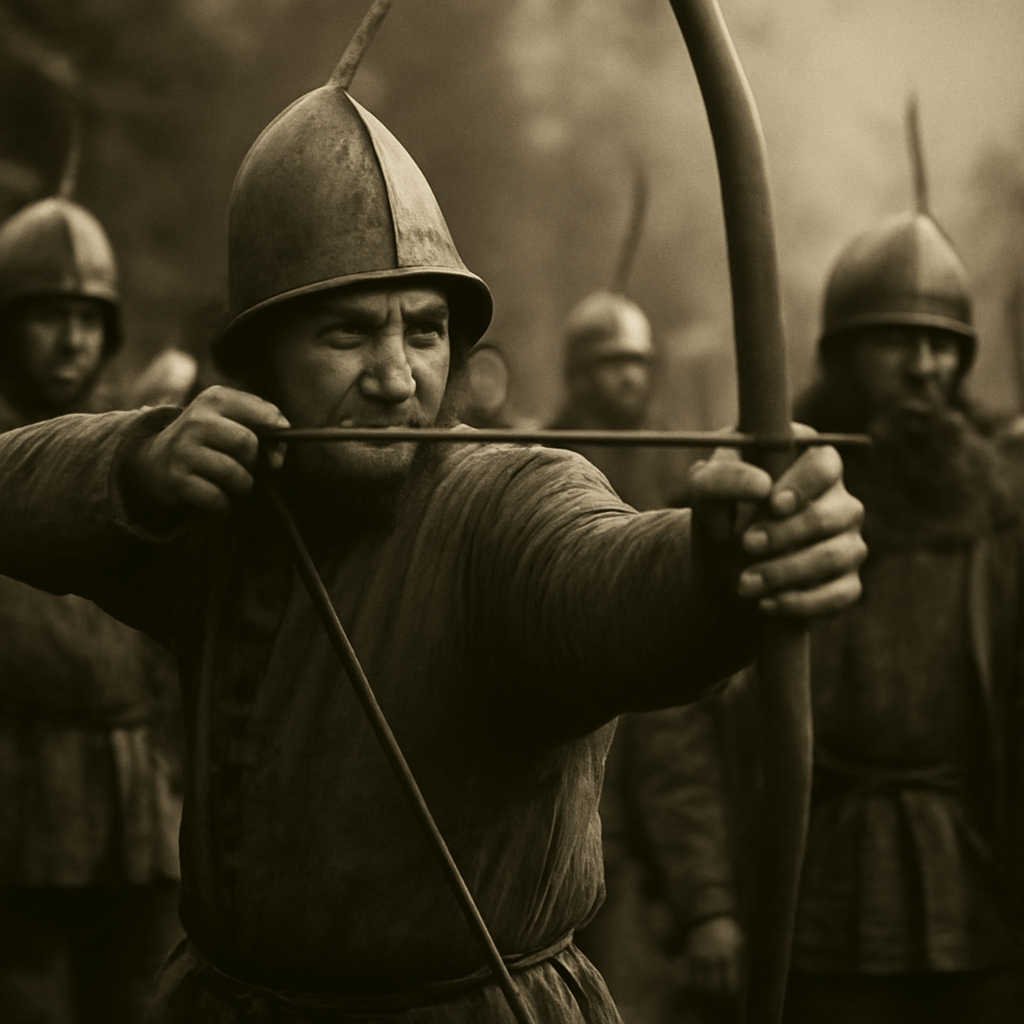
Edward I recognised what he was dealing with after his Welsh campaigns and began recruiting Welsh archers into his own armies from the 1280s onwards — a cannily pragmatic decision that would shape English military strategy for generations. A standard war bow stood approximately 6 feet 2 inches tall, crafted from a single stave of yew, ideally English or imported Spanish yew (Taxus baccata). Draw weights ranged from 100 to an extraordinary 185 pounds — demanding years of physical conditioning that left permanent marks on the men who wielded them.
Training, Toil, and the Making of a Longbowman
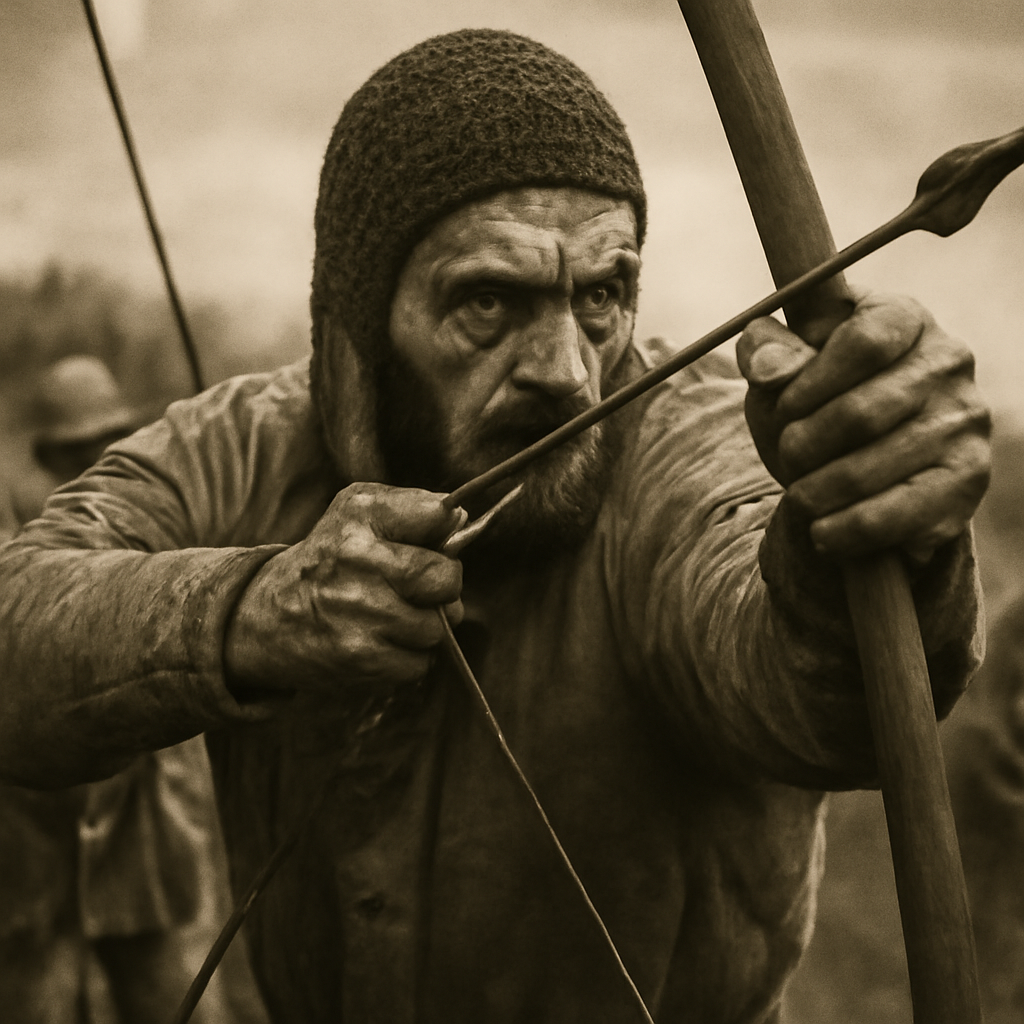
Producing a skilled longbowman was not a matter of weeks. It was a matter of years — sometimes a lifetime. Edward III's legislation of 1363 required all English men aged 15 to 60 to practise archery on Sundays and feast days, with ball games specifically banned to keep men at the butts. This was not mere encouragement; it was national military policy enforced by law.
The physical cost was extraordinary. Skeletal analysis of archers recovered from the wreck of the Mary Rose — Henry VIII's flagship, sunk in 1545 — revealed overdeveloped left arm bones, spinal asymmetry, and enlarged shoulder joints consistent with a lifetime of drawing heavy bows. These men were physically transformed by their craft in ways visible 500 years later.
A skilled archer could loose 10 to 12 aimed arrows per minute, compared to a crossbowman's 2 to 4 bolts. Each man typically carried 24 arrows into battle — called 'shafts' — with supply wagons carrying hundreds of thousands of spares. Master bowyers and fletchers were organised into London trade guilds by the 14th century, supplying the Crown with industrial quantities of war bows and arrows for each campaign.
Crécy 1346: The Day the Longbow Announced Itself to Europe
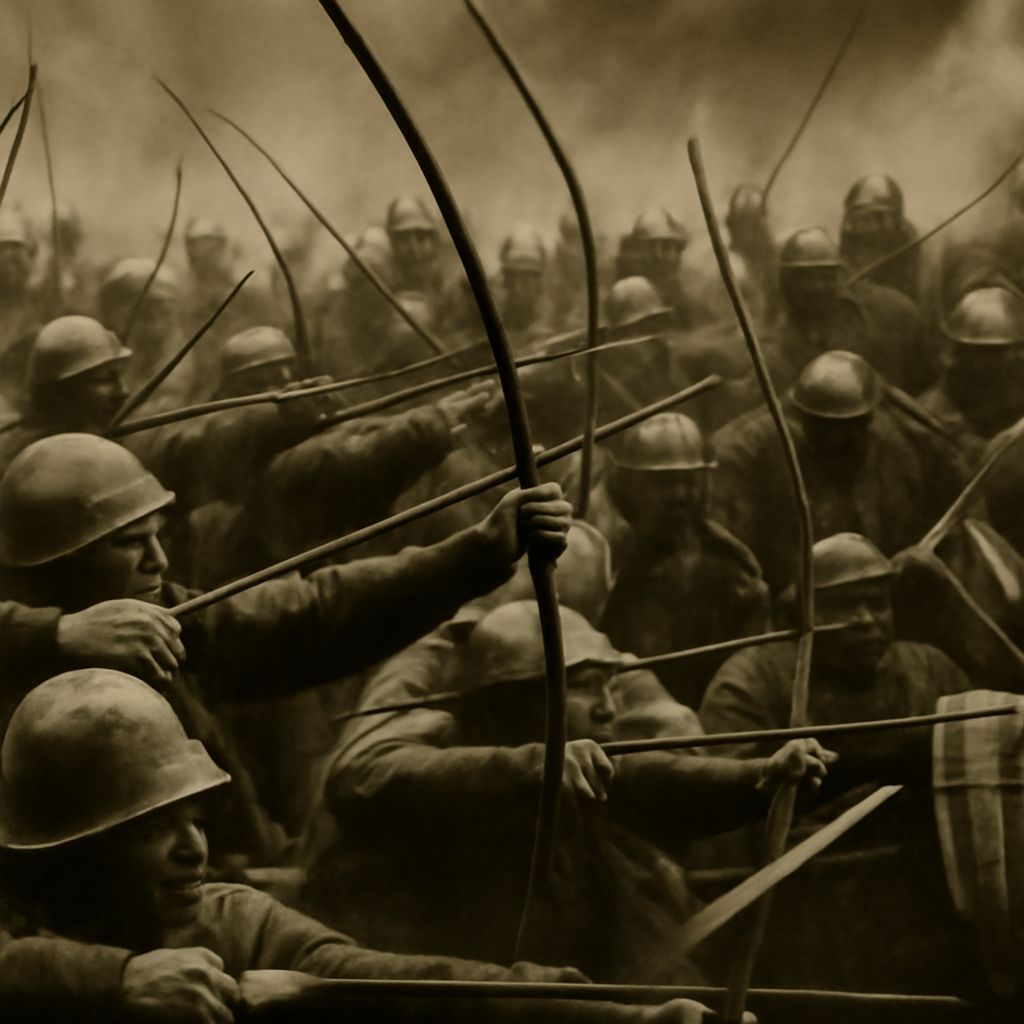
On 26 August 1346, Edward III's army of roughly 12,000 men faced a French force of 30,000 to 40,000 under Philip VI at Crécy-en-Ponthieu in northern France. Around 7,000 English and Welsh longbowmen formed the core of the English line, positioned on a ridge to maximise their field of fire. The tactical thinking was already sophisticated — ground, elevation, and concentration of missile power all carefully calculated.
Philip VI had hired Genoese crossbowmen as his opening strike force. They fired first — and their bolts fell short. The English volleys tore through them, triggering a chaotic retreat that the advancing French knights then rode down in fury. The chaos that followed was catastrophic for France. French knights charged the English line 15 to 16 times and were broken each time. An estimated 1,500 French knights and lords were killed alongside thousands of foot soldiers — a slaughter of the nobility that stunned Europe.
Edward, the Black Prince, was just 16 years old and commanded the right wing at Crécy. He held his position under severe pressure, reportedly refusing his father's offer of reinforcements. He earned his spurs that day in the most literal sense. Crécy was not just a battle — it was a declaration that the age of the mounted knight was under threat.
Poitiers 1356: The Black Prince Captures a King
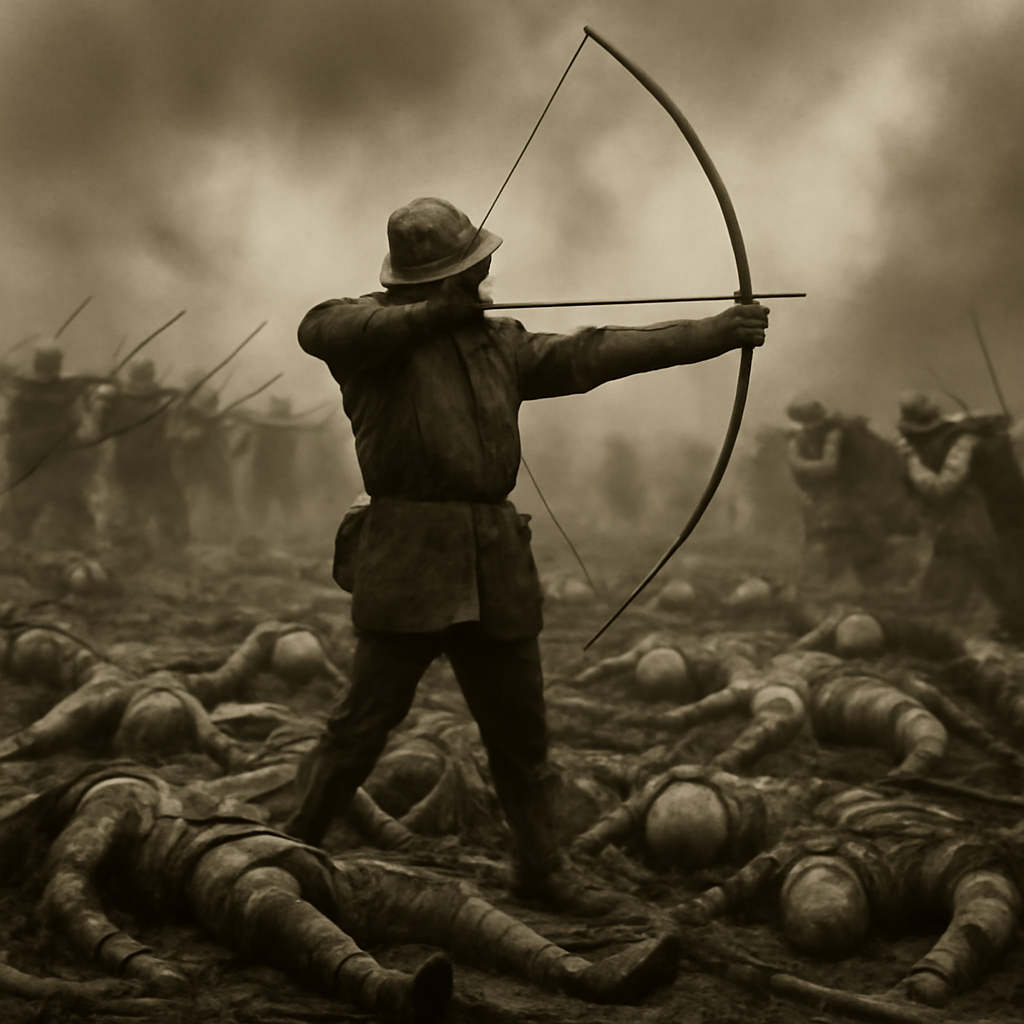
Ten years after Crécy, the Black Prince refined the formula. On 19 September 1356, he led roughly 8,000 men — including around 3,000 archers — against a French army of approximately 11,000 near Poitiers. The English positioned their archers on the flanks, behind hedgerows and vineyards, channelling French cavalry into killing grounds from which there was no easy escape.
The French, having learned painful lessons at Crécy, ordered their knights to dismount and advance on foot. It made little difference. English archers targeted the horses of those who still rode, breaking charges before they could close, and the dismounted men struggled forward exhausted and disordered into waiting English men-at-arms.
The prize of Poitiers was almost beyond belief: King John II of France was captured on the battlefield itself. His ransom — 3 million gold écus, roughly £500,000 at the time — nearly bankrupted the French Crown. Poitiers confirmed what Crécy had suggested: disciplined archers anchoring a defensive line, with men-at-arms ready to exploit disorder, was a tactical combination that French chivalry simply could not counter.
Agincourt 1415: Henry V and the Most Famous Longbow Victory
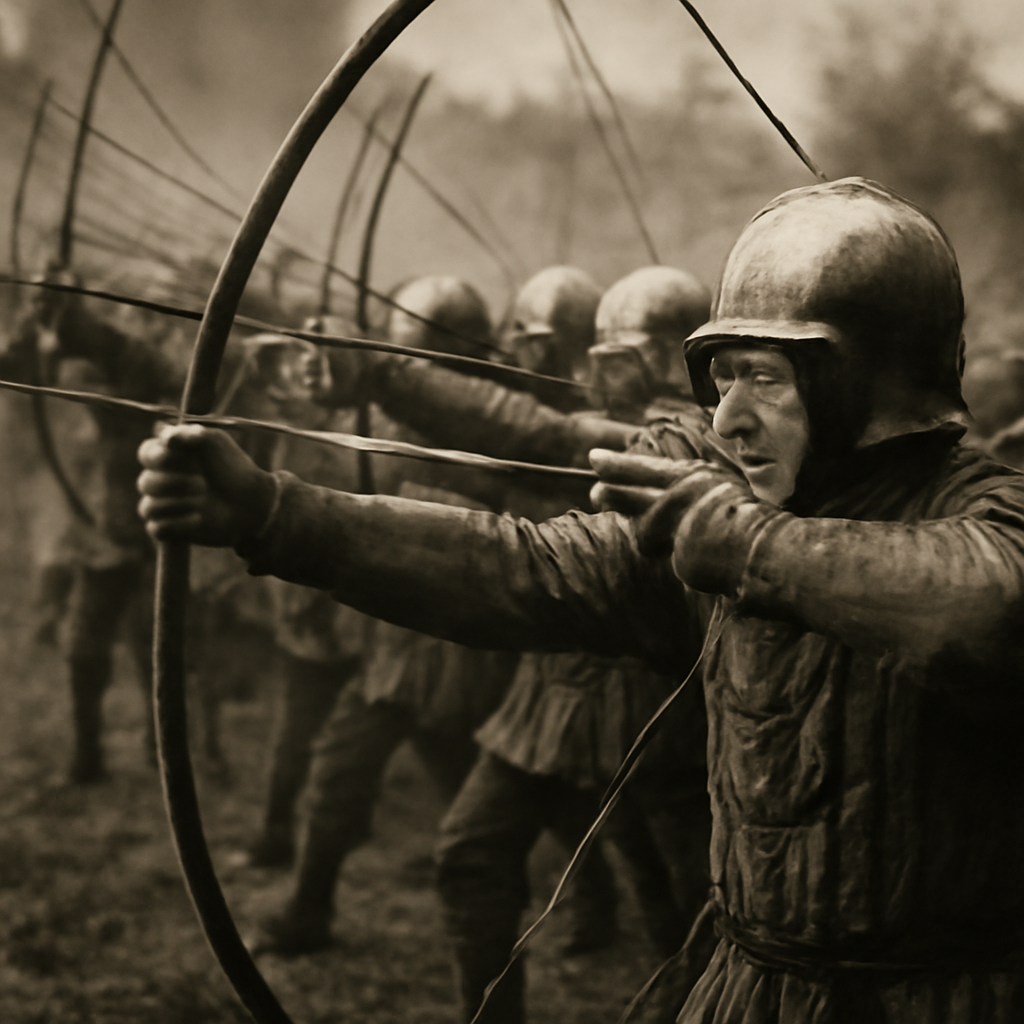
On 25 October 1415 — St Crispin's Day — Henry V's exhausted, disease-weakened army of approximately 6,000 men faced a French force of between 12,000 and 36,000 at Agincourt. Around 5,000 of Henry's men were archers. The English had marched hundreds of miles through hostile territory and were in no condition for a prolonged campaign. What happened next defied military logic.
Henry ordered his archers to cut and carry sharpened stakes, hammered into the ground as a protective palisade — an innovation that blunted French cavalry charges before they could close with the English line. When the French finally advanced, the narrow field, freshly ploughed and churned to mud by autumn rain, funnelled them into dense, struggling masses. They could barely move. They could barely swing a weapon.
Estimates suggest English archers loosed up to 60,000 arrows in the opening minutes of the French advance. The carnage was catastrophic. French dead included three dukes, five counts, and around 90 lords. English casualties were remarkably low — possibly as few as 112 killed, though some historians argue the figure was higher. Shakespeare immortalised the day in Henry V, but the reality needed no poetic embellishment. Just mathematics: arrows, mud, and disciplined men.
The Men Behind the Bows: Faces of the Archer Class
It is tempting to imagine medieval archers as faceless peasant masses. They were not. Many longbowmen were yeomen — free men of the lower gentry who took genuine pride in their skill and were paid a daily wage of 3 pence in Edward III's era. Archery was a mark of status and identity, not mere servitude.
Sir Robert Knolles, born around 1325, rose from relatively humble origins through military service — including archery campaigns — to become one of the wealthiest knights in England. Welsh contingents were crucial throughout this period; at Agincourt, a significant portion of archers were Welsh, recruited from Cheshire, Flint, and Merioneth. These were not anonymous men. Indenture rolls and muster records preserved in what is now the National Archives at Kew record named individuals — men like Thomas Hostell, who petitioned Henry V for a pension after Agincourt, citing wounds sustained in the king's service.
The fictional Robyn Hode tradition, recorded from the 1370s onwards, reflected genuine social pride in the yeoman archer class. The longbowman was a cultural hero as much as a military tool — a man who, with skill and strength, could stand against mounted nobility and win. Just as the M1 Garand became the defining weapon of the American infantryman in the 20th century, the longbow defined the English fighting man of the medieval age.
The Decline of the Longbow: Gunpowder Takes the Field
By the early 16th century, the handwriting was on the wall — or rather, the smoke was in the air. Arquebuses and early muskets were spreading through European armies, and crucially, they required a fraction of the training time that longbow mastery demanded. A musketeer could be made in weeks. A longbowman took a decade or more.
England clung to the longbow longer than most nations. The Mary Rose, sunk in 1545, was recovered carrying 137 longbows and 3,500 arrows — evidence of remarkable institutional loyalty to the weapon. A famous debate in 1595 saw Sir Roger Williams arguing for the musket while Sir John Smythe counter-argued passionately for the longbow's superior rate of fire. Smythe was right about the rate of fire. He was wrong about the future.
The longbow was formally removed from English militia requirements by the end of Elizabeth I's reign, around 1595 to 1600, replaced entirely by firearms. The physical demands of producing a skilled bowman — ten or more years of dedicated training — made the weapon strategically unsustainable as armies grew in scale and ambition.
Legacy: Why the Longbow Still Matters 700 Years Later
Crécy, Poitiers, and Agincourt are foundational events in English national identity. They appear in Shakespeare, in school curricula, and in the self-image of a nation that has always taken quiet pride in punching above its weight. The longbow is woven into that story at the deepest level.
Modern archaeology continues to reveal new layers of this history. A 2012 study of Mary Rose skeletal remains confirmed that archers' bone deformities matched the stress patterns expected from the draw weights of surviving bows — physical evidence connecting the men to their weapons across five centuries. The battlefield site near Azincourt, France, hosts the Centre Historique Médiéval, which draws thousands of British visitors every year.
The Worshipful Company of Fletchers and the Worshipful Company of Bowyers — both founded in medieval London to regulate the trades of arrow-making and bow-making — still exist today as City of London livery companies. The craft guilds of Agincourt's arrow-makers survive into the 21st century. That is a remarkable continuity. For anyone passionate about British military history, the longbow represents something rare and precious: a weapon that combined indigenous craft tradition, gruelling human discipline, and inspired tactical use to change the course of European warfare — and it was wielded by ordinary men whose names, in some cases, we can still read.
Did you have a favourite detail from this story — the skeletal evidence from the Mary Rose, the capture of a French king at Poitiers, or the sheer mathematics of Agincourt? And if you found this piece fascinating, please share it with a fellow history enthusiast.
Further reading
- The National Archives, Kew — holds medieval muster rolls, indenture records, and royal warrants relating to longbow campaigns and named archers
- The Royal Armouries, Leeds and London — the national collection of arms and armour, including surviving medieval war bows and associated archery equipment
- The Mary Rose Museum, Portsmouth — dedicated to the recovery and study of Henry VIII's flagship, including the largest surviving collection of Tudor longbows and skeletal remains of archers
- The British Museum, London — holds medieval manuscript illuminations, chronicle sources, and material culture relevant to the Hundred Years War period
- Centre Historique Médiéval, Azincourt, France — the dedicated Agincourt battlefield museum, holding artefacts, maps, and interpretive material on the 1415 campaign