The Quiz Question
At Agincourt in 1415, Henry V's army of roughly 6,000 men faced a French force most historians estimate at how many?
- A. 12,000 to 15,000
- B. 50,000 to 60,000
- C. 20,000 to 30,000
- D. 8,000 to 10,000
The answer is C. 20,000 to 30,000. Here is the full story.
On the morning of 25 October 1415 — the feast day of Saints Crispin and Crispinian — a cold, mud-soaked English army stood in a rain-sodden field in northern France and prepared to die. They were outnumbered by at least three to one, possibly five to one. Many were sick. All were exhausted. And yet, by early afternoon, they had shattered the flower of French chivalry in one of the most astonishing upsets in military history.
This is the story of Agincourt — not the Shakespeare version, though that came later — but the real thing, in all its brutal, muddy, desperate detail.
One Morning in October: The Odds Were Impossible
Henry V's army numbered roughly 6,000 men, the great majority of them longbowmen. They had marched nearly 260 miles from Harfleur in just over two weeks, short on food and weakened by dysentery that had been gutting the force since the summer siege. Facing them was a French army that modern historians estimate at between 20,000 and 30,000 combatants — some scholarly assessments lean toward the higher end of that range.
The French commanders were so confident of victory that they reportedly spent the night before the battle arguing over who would have the honour of taking Henry prisoner. The question of whether they would win apparently did not enter the discussion. It was a catastrophic misreading of the situation they were about to walk into.
Why Was Henry V Even in France? The Road to Agincourt
Henry V came to the English throne in 1413, young, ambitious, and determined to press England's long-dormant claim to the French crown. The legal basis stretched back through the Treaty of Brétigny of 1360 and further still through Edward III's claim to the Capetian succession. Negotiations with the French court of King Charles VI — whose bouts of severe mental illness left France politically fractured — collapsed in 1415 over disputed territories and a proposed marriage to Princess Catherine of Valois.
Henry launched his invasion in August 1415, landing at the mouth of the Seine with around 12,000 men. His first objective was Harfleur, a strategically vital port town at the mouth of the Seine. The siege ran from 18 August to 22 September — six grinding weeks that cost thousands of men to disease, particularly dysentery, before the town finally surrendered.
With Harfleur secured but his army badly reduced, Henry made a decision that his own commanders considered reckless. Rather than winter safely in the captured port, he would march north to Calais — England's garrison town on the Channel coast — a journey of roughly 300 miles through hostile French territory. It was a statement of defiance as much as a military manoeuvre.
The March to Calais: An Army on Its Knees
Henry set out from Harfleur around 8 October 1415 with approximately 6,000 men — around 5,000 archers and 1,000 men-at-arms. The plan was to move fast and reach Calais before the French could concentrate enough force to stop him. It didn't go to plan.
The River Somme, which the army needed to cross, proved a serious obstacle. French forces had blocked or destroyed most of the obvious fords, forcing Henry's column on a long, exhausting detour inland — adding days and miles to an already desperate march. Food was desperately scarce. Soldiers were reduced to eating nuts, berries, and whatever they could forage from the French countryside. Dysentery continued to ravage the ranks throughout the journey.
By the time a massive French army finally moved to block the road near the small village of Agincourt — known today as Azincourt — Henry's men had been marching for 17 consecutive days. They were, by any rational military assessment, finished.
The French Army: Power, Politics, and Overconfidence
The French force assembled to destroy Henry was formidable on paper. Command was held by the Constable of France, Charles d'Albret, alongside Marshal Jean II le Meingre (known as Boucicaut) and senior nobles including the dukes of Orléans and Bourbon. Estimates of total French strength vary considerably — contemporary chronicles suggest anywhere from 12,000 to 36,000 — but the modern scholarly consensus centres on 20,000 to 30,000 combatants.
The army was dominated by heavily armoured men-at-arms, the elite of French nobility, who expected to fight in the traditional chivalric manner — mounted knights and armoured infantry deciding battles through shock and weight of metal. The French drew up in three massive divisions known as 'battles', arranged across the only road to Calais, with English forces effectively bottled up between them and the village behind.
Crucially, French commanders spent the evening before the battle in heated dispute over positioning and tactics. That disorganisation at the very top would prove costly. The English, meanwhile, confessed their sins, sharpened their stakes, and waited for dawn.
The Battlefield: Mud, Narrow Ground, and a Fatal Funnel
The ground at Agincourt was, in a very real sense, Henry's greatest weapon. The field chosen for battle lay between two areas of woodland — the forests of Tramecourt and Agincourt — which formed natural walls on either flank. At its widest, the battlefield was perhaps 1,000 yards across; it narrowed to around 750 yards toward the English position. For an army of 6,000 facing 20,000 or more, that mattered enormously.
Heavy overnight rain had turned the newly ploughed field into deep, clinging mud. For English longbowmen in lighter equipment, this was uncomfortable. For French men-at-arms wearing 50 to 60 pounds of plate armour, it would prove lethal. Henry positioned his archers on the flanks and had them drive sharpened wooden stakes into the ground at an angle — a simple, effective defence against cavalry charges that would prove decisive.
Henry then did something unexpected: he ordered his entire line to advance toward the French, closing the gap to within effective longbow range — roughly 250 yards — before halting. The movement provoked exactly the response he needed. The French began their advance into the funnel.
The Battle Itself: Arrows, Mud, and Melee
English longbowmen opened fire at around 11 in the morning. Each experienced archer could loose 10 to 12 arrows per minute — meaning Henry's 5,000 archers were putting somewhere approaching 60,000 arrows a minute into the advancing French at peak rate. It was a storm of iron-tipped shafts unlike anything the battlefield had seen at such concentration.
French cavalry charges on both flanks — intended to sweep away the English archers — were shattered by arrow fire and the defensive stakes before they reached the English line. The wounded, panicked horses wheeled back into their own advancing infantry, adding chaos to carnage. The French men-at-arms on foot pressed forward but sank deeper with every step, their heavy armour working against them in the sucking mud.
At the front of the French advance, men began piling up — unable to advance, unable to retreat, many falling and unable to rise in their armour. Contemporary accounts describe men literally suffocating or drowning in mud, crushed under the weight of those pressing behind them. When the English men-at-arms waded into the melee, they found thousands of opponents who could barely lift their arms.
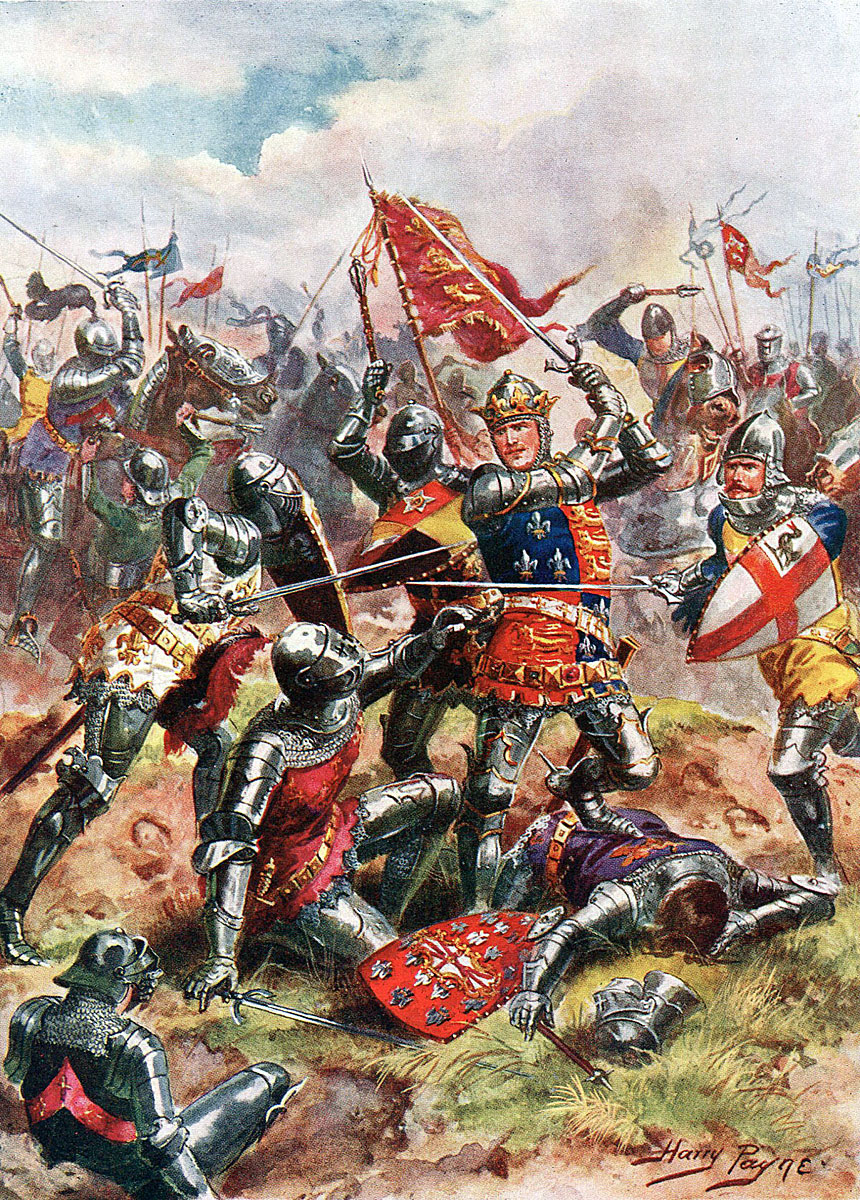
Henry V fought in the front line himself. His helmet was struck by an axe during the fighting, and a group of French knights made a direct attempt to kill or capture him — every one of them was cut down. The king's personal courage was not in question.
The Controversial Order: Henry V and the French Prisoners
As the battle appeared to be won, Henry received reports that a French force was attacking the English baggage train to the rear. Whether the threat was as serious as reported remains debated by historians — some suggest the attack was real but limited; others question whether it was exaggerated in the moment.
Henry's response was the darkest decision of his military career. Fearing his troops would be caught between a renewed French attack and the thousands of prisoners they had already taken, he ordered the captives killed. The order horrified his own commanders. Prisoners represented enormous ransom value under the laws of war, and killing them violated the chivalric codes both sides nominally upheld. Most of his knights flatly refused to carry out the command. Henry had to send a small detachment of archers to do it instead.
The killings remain deeply controversial. Modern historians continue to debate whether Henry's decision was militarily justified or a war crime by the standards of his own era — most lean toward the latter, even accounting for the chaos and fear of the moment.
The Butcher's Bill: Victory Beyond All Expectation
English dead numbered somewhere between 100 and 500 — the exact figure is disputed, but was extraordinarily low for a battle of this scale. French losses were catastrophic. Contemporary sources record between 7,000 and 10,000 French dead, including three dukes, five counts, and the Constable of France, Charles d'Albret, himself. Among the prisoners were the Duke of Orléans and Marshal Boucicaut — two of the kingdom's most senior commanders.
The battle lasted only a few hours. By early afternoon it was over. Reports of what had happened at Agincourt stunned Europe. Some English commanders had reportedly made their confessions the night before, expecting to die. The scale of the victory — and the scale of the French disaster — was genuinely difficult to comprehend.
Legacy: Agincourt's Long Shadow Over England and France
The military and political consequences of Agincourt reverberated for decades. The victory dramatically strengthened Henry's hand in France, leading ultimately to the Treaty of Troyes in 1420, by which Henry was recognised as heir to the French throne and married Princess Catherine of Valois — the very match that had been refused him five years earlier.
Henry V died in August 1422, aged just 35, almost certainly of dysentery — the same disease that had weakened his army at Harfleur and throughout the Agincourt campaign. He never lived to claim the French throne. His infant son, Henry VI, inherited an impossible position that eventually unravelled into decades of military and political disaster.
Shakespeare immortalised the battle in Henry V, written around 1599, and the St Crispin's Day speech he put into Henry's mouth became one of the most quoted pieces of rhetoric in the English language — a speech about outnumbered men fighting for something larger than themselves. It has never gone out of fashion.
Agincourt became, and remains, a cornerstone of English national mythology: evidence that discipline, skill, and the right terrain could overcome overwhelming odds. The tactical lessons — the use of terrain to negate numerical superiority, the devastating firepower of the longbow, the importance of understanding your enemy's weaknesses — are still studied at military staff colleges today. The Imperial War Museum in London holds significant collections relating to medieval English warfare and the broader context of the Hundred Years War, reflecting the battle's enduring place in British cultural and military memory.
Twenty-five October 1415 was a Thursday. By sunset, roughly 6,000 hungry, sick, exhausted Englishmen had broken an army four times their size — and changed the course of European history in an afternoon.
If the story of Agincourt moves you — the courage, the odds, the controversies — we'd love to hear your thoughts in the comments below. And if you know someone who would enjoy this piece of history, please share it with them.
Further Reading
- Imperial War Museum, London
- The National Archives, Kew (holds medieval state papers and records relating to the Hundred Years War)
- The British Library (home to medieval manuscripts including chronicles of the Agincourt campaign)
- The National Army Museum, London
- Musée de l'Armée, Paris (French national military museum with collections covering the medieval period and the Hundred Years War)