In the annals of military history, few stories challenge our understanding of heroism quite like that of Desmond Doss. Here was a man who refused to carry a weapon yet saved more lives in a single battle than most soldiers could in an entire war. His story begins not on the blood-soaked cliffs of Okinawa, but in the quiet faith of a young Seventh-day Adventist who believed killing was always wrong.
The Unlikely Soldier Who Changed Everything
Desmond Doss grew up in Lynchburg, Virginia, where his Seventh-day Adventist faith shaped every aspect of his worldview. The Sixth Commandment—"Thou shalt not kill"—wasn't just scripture to young Desmond; it was an unbreakable covenant with God. When Pearl Harbor thrust America into World War II, Doss faced an impossible choice: serve his country or honor his beliefs.
The Army initially classified him as unfit for combat due to partial deafness in one ear. But Doss was determined to serve, just not with a rifle in his hands. He volunteered as a medic, believing he could save lives without taking them. His drill sergeants weren't impressed with this "Bible-thumping" conscientious objector who refused Saturday duty and wouldn't touch a weapon.
Fellow soldiers mocked him mercilessly. They called him a coward, questioned his patriotism, and made his training a living hell. Some even threatened physical violence. Yet Doss endured it all, never wavering in his conviction that he could serve his country without compromising his faith.
The Hell of Okinawa: Setting the Stage
By spring 1945, the Pacific war had reached Japan's doorstep. Okinawa, the largest of the Ryukyu Islands, stood as the final major obstacle before an invasion of the Japanese mainland. American planners knew it would be brutal, but nothing could prepare them for the 82-day nightmare that followed.
Hacksaw Ridge, officially known as Maeda Escarpment, rose 400 feet from the surrounding terrain like a natural fortress. Japanese forces had turned it into a killing machine, honeycombing the cliff face with caves, tunnels, and hidden gun positions. Every approach was covered by interlocking fields of fire.
For the soldiers of the 77th Infantry Division, including Doss and his 1st Battalion, the ridge represented everything they feared about the Pacific war. The Japanese defenders weren't just fighting for territory—they were fighting for their homeland, and they intended to make every yard cost American blood.
When Heroes Are Made: The Battle Begins
On May 5, 1945, Doss's unit launched their assault on Hacksaw Ridge. What should have been a coordinated attack quickly devolved into chaos as Japanese machine guns and mortars raked the American positions. Men fell by the dozens, their screams echoing across the escarpment.
Enemy fire pinned down the survivors on the exposed cliff face. There was no cover, no escape route, and no hope of reinforcement. The order came down: retreat. Pull back and regroup for another assault. But as his comrades began their desperate withdrawal, Doss made a decision that defied every military principle and human instinct.
He stayed behind. Alone on that hellish ridge, with only his medical supplies and an unshakeable faith, Doss began the most extraordinary rescue mission in American military history.
Armed Only with Faith and Bandages
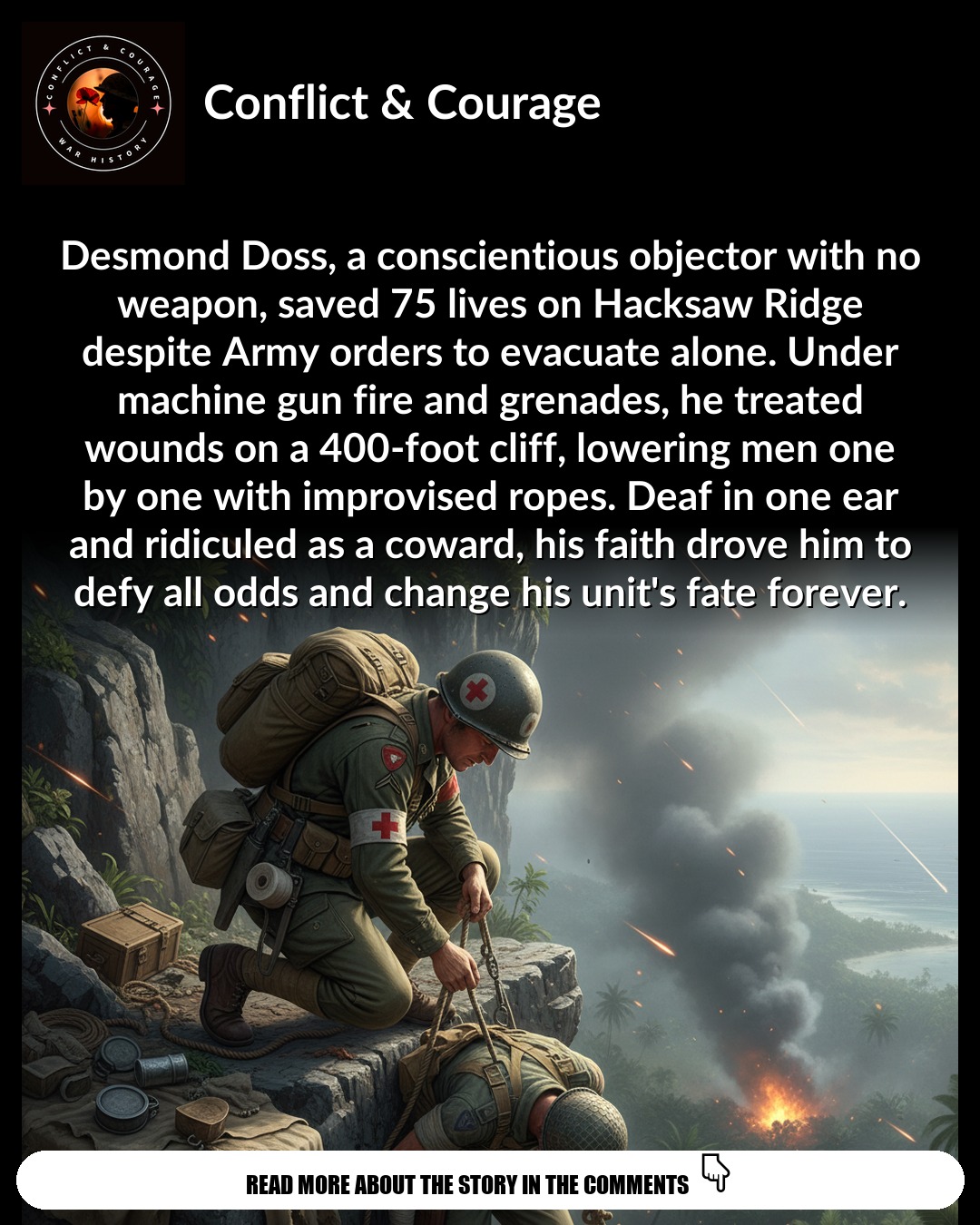
Under withering enemy fire, Doss crawled from wounded man to wounded man. He treated sucking chest wounds while mortar rounds exploded nearby. He applied tourniquets as bullets whined overhead. Each soldier he reached received the same whispered words: "I'm gonna get you out of here."
Using rope and an improvised sling system, Doss lowered each wounded man down the cliff face one by one. The process was agonizingly slow and dangerous—any moment could bring a sniper's bullet or an artillery shell. Yet he continued, sustained by a simple prayer that became his mantra: "Please Lord, help me get one more."
Hour after hour, Doss repeated this deadly routine. His hands grew raw from the rope, his uniform soaked with blood—some his own, most belonging to the men he'd saved. Still he pressed on, driven by a faith that seemed to shield him from the violence surrounding him.
Against All Odds: 75 Lives Saved
By the time Doss finally descended that cliff, he had lowered 75 wounded American soldiers to safety. The number was later verified through military records and eyewitness testimony, though some survivors insisted it was even higher. Each man represented a family that would welcome their son, husband, or father home.
Even after being wounded himself by shrapnel, Doss continued his rescue efforts. His own comrades begged him to abandon the mission, to think of his own safety. But for Doss, there was no choice—as long as American boys lay wounded on that ridge, he would find a way to bring them home.
The stories from survivors paint a picture of a man who seemed protected by divine intervention. Bullets that should have found their mark somehow missed. Artillery shells that landed nearby failed to detonate. It was as if his faith had become a physical shield.
From Outcast to Medal of Honor
Doss's actions that day transformed him from company pariah to company hero. The same soldiers who had mocked his beliefs now recommended him for America's highest military decoration. His commanding officers, initially skeptical of his pacifist convictions, became his strongest advocates.
On October 12, 1945, President Harry Truman personally presented Desmond Doss with the Medal of Honor, making him the first conscientious objector to receive this recognition. Truman reportedly told him, "I'm proud of you. You really deserve this. I consider this a greater honor than being President."
Legacy of an Unarmed Warrior
Doss's story has inspired generations of military medics and soldiers, proving that courage comes in many forms. His example shows that one can serve with honor while maintaining personal convictions, a lesson particularly relevant for today's diverse military.
The Hollywood portrayal in "Hacksaw Ridge" brought his story to a new generation, though no film could fully capture the quiet faith that drove this extraordinary man. Like other Medal of Honor recipients such as Clarence Sasser and Sammy Davis, Doss demonstrated that true heroism often emerges from the most unlikely places.
Desmond Doss passed away in 2006, but his legacy endures. He proved that the greatest weapon in any soldier's arsenal might not be made of steel—it might be faith, compassion, and an unwavering commitment to saving rather than taking lives.