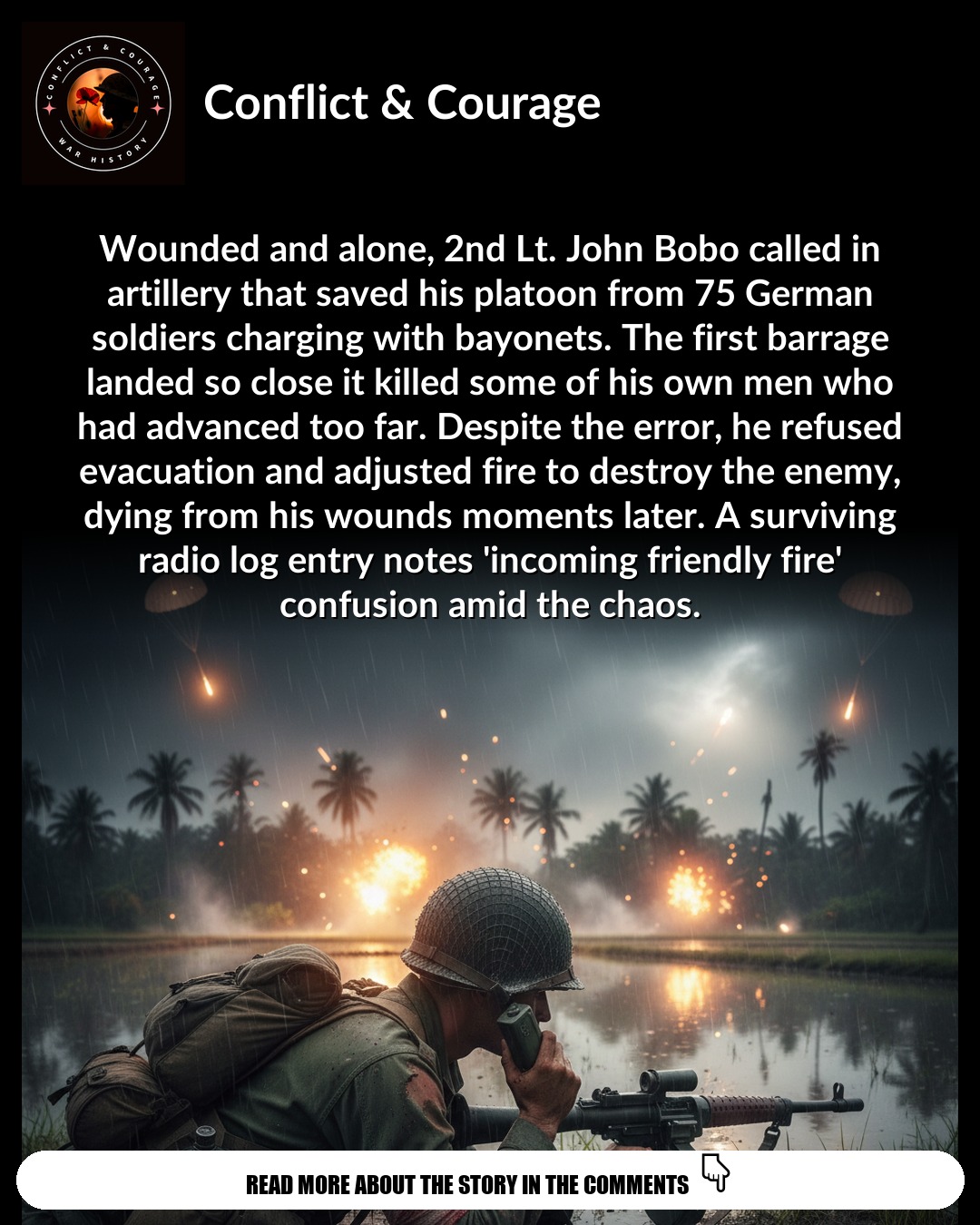
On the night of 30 March 1967, in the Quang Tri Province of the Republic of Vietnam, Company I of the 3rd Battalion, 9th Marines, was setting up night ambush positions when its command group came under a sudden, heavy assault. A reinforced North Vietnamese Army company struck the Marines with automatic-weapons and mortar fire. Among the men in the command group was Second Lieutenant John Paul Bobo, the company's weapons platoon commander. What he did over the next several minutes would earn him the Medal of Honor, awarded posthumously.
Bobo was 24 years old. Born in Niagara Falls, New York, on 14 February 1943, he had joined the Marine Corps Reserve and been commissioned as an officer. By the spring of 1967 he was serving in northern I Corps, close to the Demilitarized Zone, one of the most heavily contested areas of the war.
The Attack
When the enemy opened fire, the command group was outnumbered and in immediate danger of being overrun. According to his Medal of Honor citation, Bobo organized a hasty defense and moved from position to position, steadying the Marines under what the citation describes as "murderous enemy fire." He recovered a rocket launcher from among the casualties, formed a new launcher team, and directed its fire against the enemy machine-gun positions that were pinning the Marines down.
During the fighting, an exploding enemy mortar round severed Bobo's right leg below the knee. The wound was catastrophic, and by any ordinary measure he was out of the fight. He refused to be evacuated. Instead, he insisted on being placed in a firing position so that he could cover the movement of the command group as it withdrew to more defensible ground.
The Stand
With a web belt cinched around his thigh as a tourniquet, and with the stump of his leg jammed into the dirt to slow the bleeding, Bobo held his position and continued to fire into the attacking enemy. His citation records that he "delivered devastating fire into the ranks of the enemy attempting to overrun the marines." He was firing his weapon into the main point of the enemy attack when he was mortally wounded.
His stand was not symbolic. The delay he imposed on the North Vietnamese assault allowed the command group to reach a protective position, from which it repulsed the attack. The men he covered survived because he did not leave the line.
There was nothing secret or classified about the action. It was witnessed by the Marines around him, documented in the official citation, and recognized through the nation's highest award for valor. Bobo did not call artillery down on his own position, and there was no final radio transmission. The record is a straightforward account of a wounded officer who chose to cover his men rather than be carried to safety.
Recognition and Legacy
Second Lieutenant John P. Bobo's Medal of Honor was presented to his family on 27 August 1968 at Marine Barracks, Washington, D.C., by Secretary of the Navy Paul R. Ignatius. He is buried at Gate of Heaven Cemetery in Lewiston, New York.
His name endures in the fleet. The Military Sealift Command maritime prepositioning ship USNS 2nd Lt. John P. Bobo (T-AK-3008) was named in his honor, carrying his memory into service decades after his death. The citation's closing line is unadorned: "He gallantly gave his life for his country."