The Quiz Question
Which US Navy cook manned an anti-aircraft gun aboard USS West Virginia during the Pearl Harbor attack and became the first African American awarded the Navy Cross?
- A. Doris Miller
- B. Benjamin Davis
- C. Wesley Brown
- D. Carl Brashear
The answer is A. Doris Miller. Here is the full story.
On a quiet Sunday morning in Hawaii, a 22-year-old cook from Waco, Texas, climbed through smoke and chaos to man an anti-aircraft gun he had never been trained to fire. What Doris "Dorie" Miller did in those fifteen minutes on 7 December 1941 would earn him the Navy Cross, make him a national symbol, and expose the deep contradictions at the heart of a nation asking Black men to die for freedoms they did not fully enjoy at home.
A Sunday Morning That Changed Everything
At 7:55 a.m. local time on 7 December 1941, the first wave of Japanese aircraft swept in over Pearl Harbor, Hawaii, catching the US Pacific Fleet almost entirely by surprise. The attack had been meticulously planned by the Imperial Japanese Navy and would unfold in two devastating waves over the course of roughly two hours.
USS West Virginia (BB-48), a Colorado-class battleship, was moored at Battleship Row on the eastern side of Ford Island alongside seven other American battleships. Within the first minutes of the attack, she was struck by at least seven torpedoes and two armour-piercing bombs. She began listing heavily to port before counter-flooding efforts helped settle her upright onto the harbour floor.
Across Pearl Harbor that morning, over 2,400 Americans were killed and nearly 1,200 wounded. USS West Virginia alone lost 106 officers and enlisted men. For one young cook below decks when the bombs began to fall, those catastrophic minutes would define not just his own life, but a chapter of American civil rights history.
Who Was Doris Miller? A Texas Boy Joins the Navy
Doris Miller was born on 12 October 1919 in Midway, Texas, the third of four sons born to sharecropper parents Connery and Henrietta Miller. His mother had expected a girl and named him accordingly. He was known to friends, family, and shipmates simply as "Dorie" for the rest of his life.
He grew up to be a powerful, broad-shouldered young man — the starting fullback on his high school football team in Waco. He was physically formidable in a way that would matter enormously on the morning of 7 December.
Miller enlisted in the US Navy on 16 September 1939, aged 19. For Black men in Depression-era America, the Navy represented one of the few paths to steady employment and a measure of stability. But the institution he entered was rigidly segregated. Navy policy barred African Americans from virtually all combat and specialist ratings, restricting them almost exclusively to the Mess Attendant branch — serving food, cleaning officers' quarters, and performing steward duties. Miller was assigned as a Mess Attendant Third Class.
Life Aboard USS West Virginia: Segregation in the Pacific Fleet
In 1941, African Americans made up roughly 2.3 percent of US Navy enlisted personnel. Despite that small number, their role was tightly prescribed. White sailors received training in gunnery, damage control, and navigation. Black sailors like Miller received none of that. The assumption embedded in Navy regulations was that African Americans were suited to service roles and nothing more.
Miller reported aboard West Virginia in January 1940 and rose to Mess Attendant First Class. He also earned a reputation as the ship's heavyweight boxing champion — a detail that speaks to both his physical capability and the esteem in which his shipmates, regardless of colour, held him.
Although he received no formal weapons training, Miller had spent months watching gunnery drills from the margins. He was familiar, at least by observation, with the Browning .50-calibre anti-aircraft machine guns mounted on the ship. That informal knowledge, gleaned from a position the Navy never intended him to hold, would save lives on 7 December 1941.
Under Fire: What Miller Did on the Morning of 7 December 1941
Miller was below decks collecting laundry when the attack began. He rushed topside into a scene of fire, smoke, and the deafening roar of explosions and aircraft engines. The ship was already taking on water and listing badly.
One of his first acts was to help carry the mortally wounded commanding officer, Captain Mervyn Bennion, away from the exposed bridge. Bennion had been struck by shrapnel from a bomb that hit the neighbouring USS Tennessee — a wound that would prove fatal. Moving him was an act of courage in itself, performed under continuous attack.
With no orders and no official authority to do so, Miller then took position behind an unmanned Browning .50-calibre anti-aircraft gun on the bridge and opened fire on incoming Japanese aircraft. He had never been trained on the weapon. He fired for approximately fifteen minutes, until ordered to abandon ship as West Virginia settled onto the harbour floor. As he withdrew, he helped move additional wounded sailors to safety.
The ship's executive officer, Lieutenant Commander Doir C. Johnson, was among the witnesses who later reported that Miller appeared to have shot down between one and four Japanese aircraft. Historians have debated the precise figure ever since — the chaos of the attack made accurate claims difficult — but the fact of his sustained fire under extraordinary conditions was never in dispute.
Recognition Delayed: The Fight to Award Miller the Navy Cross
In the immediate aftermath of Pearl Harbor, Miller's actions went largely unacknowledged in official channels. Early Navy after-action reports referred only to an unnamed "Negro mess attendant" who had manned a gun. His identity was not publicised.
It was the Black press that forced the issue. The Pittsburgh Courier, one of the most influential African American newspapers in the country, launched an investigative campaign in early 1942 to identify the unnamed hero and demand proper recognition. Civil rights organisations and community leaders joined the call, with some arguing that Miller deserved the Medal of Honor.
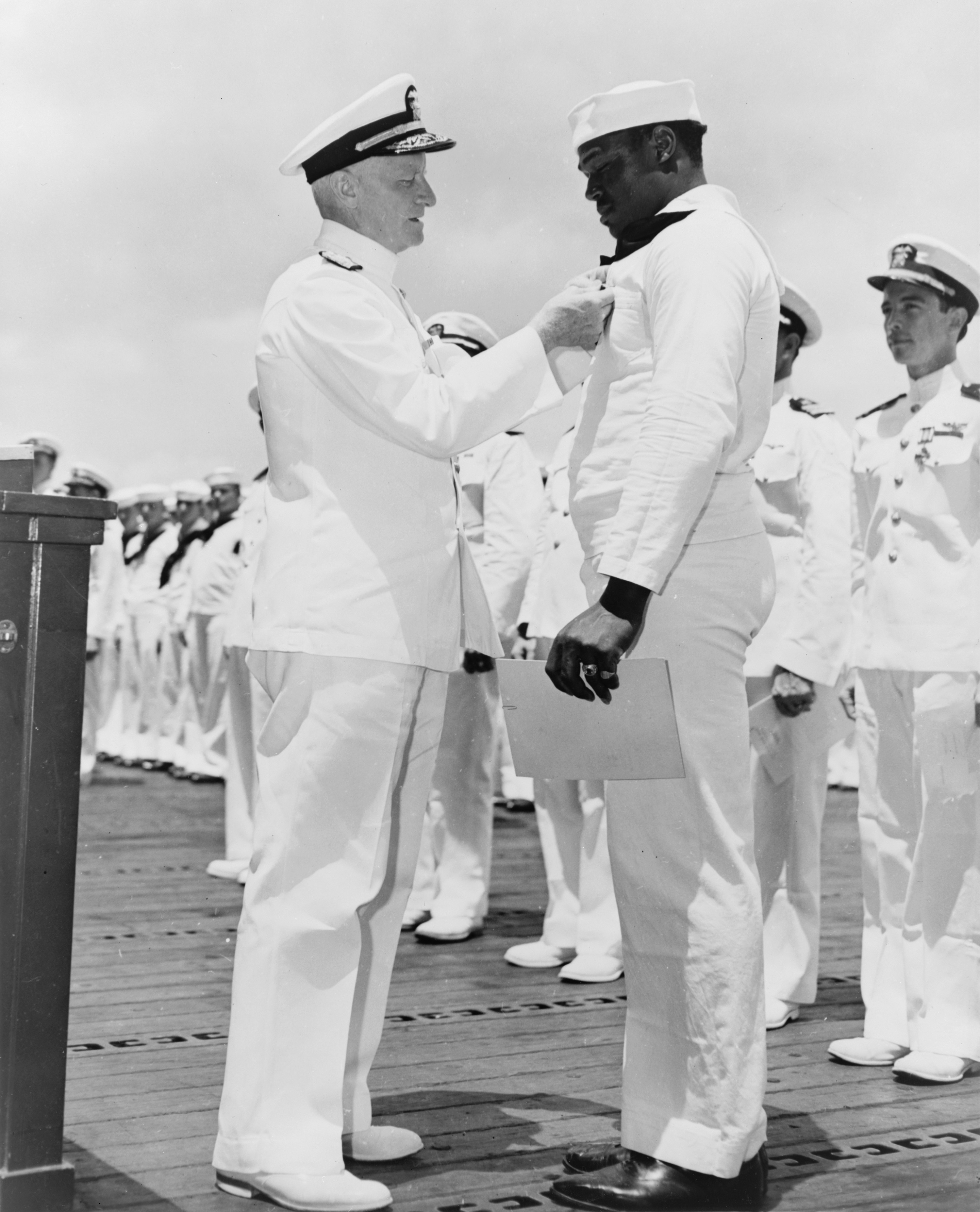
The Navy ultimately agreed to the Navy Cross. On 27 May 1942, Admiral Chester W. Nimitz personally pinned the medal on Miller aboard the aircraft carrier USS Enterprise (CV-6) at Pearl Harbor. Nimitz's citation praised Miller's "distinguished devotion to duty, extraordinary courage and disregard for his own personal safety." Doris Miller became the first African American ever to receive the Navy Cross.
A Nation's Reluctant Hero: The War Bonds Tour and Public Profile
Following the ceremony, the Navy permitted Miller to participate in a war bonds recruitment tour across the United States in mid-1942. His face appeared on Navy recruitment posters and across the pages of African American publications. He became the most visible Black serviceman in the country — a living argument that the racial barriers of the pre-war Navy were both unjust and militarily irrational.
The NAACP and the Black press used Miller's example relentlessly, pointing out that a man celebrated as a national hero remained barred from combat roles and had not been promoted beyond Cook Third Class. The contradiction was difficult to argue against.
Miller himself, by most contemporary accounts, was quietly modest about what he had done. He reportedly told interviewers that he had simply done "what any man would have done." That modesty made him more beloved, not less — and more useful as a symbol of the broader cause for equality.
The Final Voyage: Miller's Death in the Pacific
After the war bonds tour, Miller was assigned to the newly commissioned escort carrier USS Liscome Bay (CVE-56) in 1943. He would not survive the year.
On 24 November 1943, USS Liscome Bay was operating near Butaritari Atoll in the Gilbert Islands as part of Operation Galvanic — the US assault on the Gilbert Islands chain. At 5:10 in the morning, she was struck by a single torpedo fired by the Japanese submarine I-175. The torpedo detonated the ship's bomb storage magazine.
The explosion was catastrophic. USS Liscome Bay sank in just 23 minutes. Of the 916 men aboard, 642 were killed — one of the single worst loss-of-life events for any US Navy vessel during the entire war. Doris Miller was among the dead. He was 24 years old. His body was never recovered.
He is commemorated today on the Honolulu Memorial at the National Memorial Cemetery of the Pacific — known as the Punchbowl — along with thousands of other Pacific War dead who have no known grave.
Legacy and the Long Road to Full Recognition
Recognition came slowly, but it came. In 1973, the US Navy commissioned USS Miller (FF-1091), a Knox-class frigate named in his honour — one of the first US Navy ships ever named after an African American. A statue was erected in Waco, Texas, and his childhood home was listed as a Texas State Historical Site.
For decades, historians, veterans' groups, and civil rights advocates argued that Miller's actions warranted the Medal of Honor rather than the Navy Cross. A formal Congressional review was undertaken in the 1990s, examining whether racial bias had influenced the original decoration decision. It did not result in an upgrade, though the debate has never fully closed.
The most significant act of posthumous recognition came in 2020, when the US Navy announced that a Gerald R. Ford-class aircraft carrier — USS Doris Miller (CVN-81) — would be named in his honour. It would be the first aircraft carrier in US Navy history named after an African American and the first named after an enlisted sailor. The keel was laid on 19 August 2022 at Newport News Shipbuilding in Virginia, with President Biden attending a naming ceremony. Biden described Miller as "a hero who served his country even when his country didn't fully serve him." When CVN-81 enters service, a warship bearing his name will sail the same Pacific waters where he gave his life.
Why Dorie Miller Still Matters: Courage, Equality, and History
Miller's story sits at the precise crossroads of two defining struggles in American history: the war against fascism abroad and the war for racial equality at home. He is not a footnote to either story — he is central to both.
His actions, and the public campaign that followed them, helped build the momentum that contributed to President Truman's Executive Order 9981 in July 1948, which formally desegregated the US armed forces. That order did not come from nowhere. It came, in part, from years of accumulated evidence — Doris Miller among the most compelling examples — that the segregation of Black servicemen was indefensible on both moral and practical grounds.
He also represents the tens of thousands of African American men and women who served with distinction in World War Two under conditions of systematic inequality, many of whom were never properly recognised during their lifetimes. Miller's visibility made him the face of a much larger and largely invisible cohort.
For students of the Pacific War, Pearl Harbor, and American social history alike, his story is a lens through which to examine heroism, institutional racism, and the slow, contested progress of equality. Eight decades on, the man who was never supposed to fire a gun — and who fired one anyway, under fire, in defence of a country that had not yet decided to fully defend him — remains one of the most resonant and important figures of the entire Second World War.
If Dorie Miller's story moved you, we'd love to hear your thoughts in the comments below. And if you think this history deserves to be more widely known, please share this article with someone who'd want to read it.
Further Reading
- National World War II Museum, New Orleans
- Naval History and Heritage Command, Washington, D.C.
- Smithsonian National Museum of African American History and Culture
- National Archives and Records Administration (NARA)
- National Memorial Cemetery of the Pacific (Punchbowl), Honolulu