The Quiz Question
Which British short range surface to air missile system, dug in around San Carlos Water in May 1982, fired 14 missiles at attacking Argentine jets but was confirmed after the war to have scored just one direct hit?
- A. Sea Cat
- B. Sea Wolf
- C. Sea Dart
- D. Rapier
The answer is D. Rapier. Here is the full story.
On 21 May 1982, British forces waded ashore at San Carlos Water on East Falkland, hoping they had found a sheltered anchorage safe enough to build a beachhead. Within hours, they discovered how wrong that hope was. Argentine jets came in so low and so fast that sailors on the ships could look the pilots in the eye. It became one of the most ferocious air battles since the Second World War — and the system Britain had trusted to hold the sky above those beaches was about to face the harshest examination of its existence.
Under Fire: The Skies Above San Carlos Water, May 1982
Operation Sutton, the amphibious landing at San Carlos Water, was the hinge on which the entire Falklands campaign turned. Get troops ashore successfully, and Britain had a fighting chance. Lose ships in the anchorage, and the task force might unravel before a land battle could be won.
Argentine Air Force A-4 Skyhawks and IAI Daggers — Israeli-built Mirage 5s — attacked in coordinated waves, often flying at 50 feet above the water to avoid radar detection. The bay earned a grim nickname among the sailors who endured it: "Bomb Alley." The intensity of the air assault shocked even experienced officers who had studied modern warfare closely.
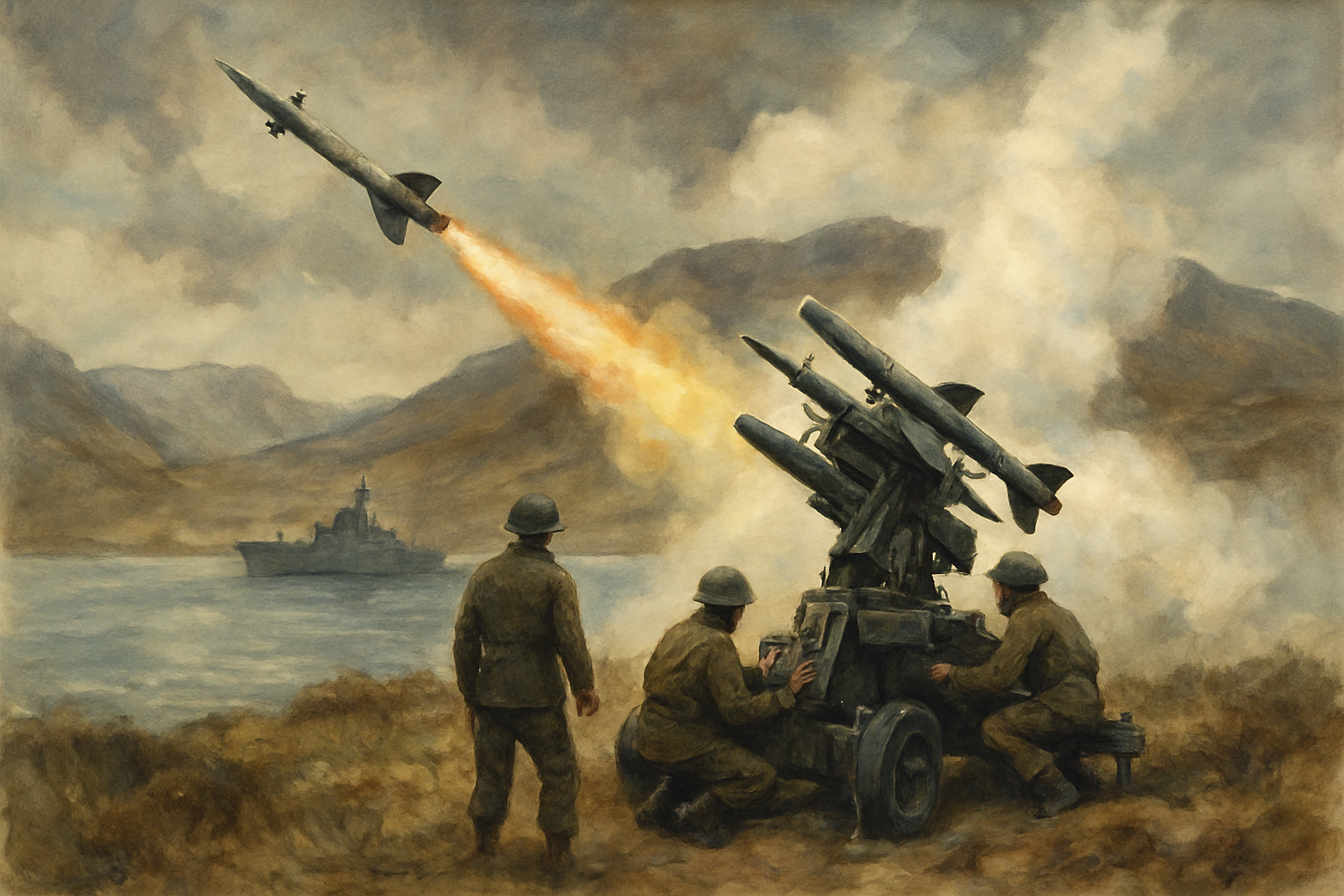
Britain's primary ground-based answer to this threat was the Rapier surface-to-air missile system, deployed by 12 Air Defence Regiment, Royal Artillery. What followed was a brutal collision between Cold War technology and hot, fast, chaotic reality. Fourteen Rapier missiles were fired during the San Carlos engagements. Post-war analysis confirmed only one direct hit — a statistic that sent shockwaves through the British defence establishment.
What Was the Rapier? Britain's Ground-Based Air Defence in 1982
The Rapier was developed by the British Aircraft Corporation from the mid-1960s and entered service with the British Army in 1971. It was purpose-built for exactly the kind of threat Argentina posed: fast jets flying at low altitude beneath conventional radar coverage.
Each fire unit comprised a launcher loaded with four ready missiles, a surveillance radar, and a tracker unit. A trained crew of three operated the system, with one operator responsible for keeping a manual optical sight on the target while a computer guided the missile to intercept. The method demanded extraordinary precision — and extraordinary nerves.
On NATO exercises across the flat plains of West Germany, Rapier had demonstrated kill probabilities of around 50–70 percent against simulated targets. Those results made it one of the most respected short-range air defence systems in the Western alliance. The Falklands would reveal how much of that confidence had been built on controlled conditions.
Getting Rapier to the Falklands: A Race Against Time
After Argentina's invasion on 2 April 1982, the Ministry of Defence moved quickly to assign air defence assets to the task force. T Battery and 43 Air Defence Battery, 12 Air Defence Regiment, Royal Artillery were among the units committed, with their Rapier equipment loaded aboard the container ship Atlantic Conveyor for the journey south.
Atlantic Conveyor was struck by an Argentine Exocet missile on 25 May 1982, sinking with a devastating loss of stores, including helicopters that had been earmarked for moving troops across the islands. The Rapier equipment, however, had already been offloaded before the strike — a matter of timing that likely saved the air defence mission.
But the transit itself had caused serious problems. The sensitive optical and electronic tracking components of the Rapier system had not been designed for weeks of vibration and salt air aboard a container ship in the South Atlantic. When equipment was landed by helicopter and manhandled into position across the boggy, rock-strewn Falklands terrain, alignment and calibration tolerances were already degraded. Some units were compromised before they fired a single round.
The Battle of San Carlos Water: What the Rapier Crews Faced
The geography of San Carlos Water worked brutally against the defenders. Steep ridgelines and narrow inlets created radar shadow, masking incoming Argentine aircraft until they were almost overhead. Jets that appeared on a radar screen one moment were over the anchorage the next.
Argentine pilots had studied their attack profiles carefully. Flying at near sea-level, they minimised their exposure time over the anchorage to just a few seconds. A Skyhawk crossing at 500 knots was in and out of a Rapier crew's engagement window in under three seconds. There was almost no margin for hesitation.
Crews also faced the constant danger of fratricide. British Sea Harriers and helicopters were operating in the same airspace, and in the noise and confusion of battle, radio coordination between Rapier units, ships, and air controllers was frequently fragmentary. Firing at an unidentified fast mover carried real risk of killing a friendly aircraft. That uncertainty cost precious seconds.
Fourteen Missiles, One Hit: Unpacking the Numbers
Post-war analysis by the Ministry of Defence and British Aerospace confirmed that 14 Rapier missiles were fired at San Carlos, with only one aircraft destroyed as a directly confirmed kill. Several other Argentine aircraft losses were attributed to possible Rapier proximity detonations or contributed damage, but none could be definitively credited to the system.
The confirmed kill is generally accepted to have occurred during the intensive air battles between 21 and 25 May 1982, when Argentine sorties were at their highest tempo. The exact aircraft type and precise engagement details have been the subject of continued historical discussion, but the single-hit figure itself has never been seriously disputed.
For context, Royal Navy Sea Wolf and Sea Cat missiles also struggled against the fast, low-level Argentine attack profiles, though Sea Wolf achieved a better relative performance. The scale of the Argentine air effort — and the extreme conditions of the campaign — tested every air defence asset the task force possessed.
The gap between Rapier's trials performance and its combat record became one of the defining controversies of the Falklands air war, triggering immediate questions in Parliament and within the defence procurement community.
Why Did Rapier Underperform? The Causes Behind the Statistics
Transit damage to the tracking equipment was a primary factor. The delicate electro-optical systems required careful calibration before use, and the rough voyage south had introduced errors that field teams struggled to fully correct under operational pressure.
Training had prepared crews for set-piece deployments with time to establish, align, and test their equipment. At San Carlos, detachments were sometimes operational within minutes of landing, in terrain they had never seen, with attacks already incoming. The gap between exercise conditions and combat reality was enormous.
The optical tracking method placed an extraordinary burden on individual operators. Keeping a manual sight locked onto a jet crossing the sky at 500 knots and 50 feet of altitude, while simultaneously under air attack, demanded a level of physical and psychological performance that live-fire exercises had never truly replicated. Post-war interviews with operators described the tracking task as nearly impossible under those conditions.
Software and radar limitations added to the problem. The system struggled to separate fast low-level targets from ground clutter in the broken Falklands landscape — a terrain profile very different from the flat European battlefields for which Rapier had been optimised.
The Men Behind the Missiles: Rapier Crews at San Carlos
The soldiers of 12 Air Defence Regiment endured some of the most relentless air attack of the entire campaign, manning exposed positions around the beachhead through the peak battle days of 21–25 May. Crews rotated through shifts under air raid warning red — attack imminent — for hours at a stretch.
Despite everything the statistics recorded, the morale and determination of Rapier detachments was consistently praised by ground force commanders. Their visible presence on the hillsides around San Carlos Water provided reassurance to troops ashore, who understood they had at least some protection, even if that protection was imperfect.
Several operators later spoke about the near-impossibility of the tracking task in real combat — a candidness that proved invaluable to the MoD's post-war review process. Their firsthand accounts became central evidence in the case for urgent system upgrades, and their experience directly shaped revised training doctrine for air defence crews across the British Army.
Aftermath: What the Falklands Taught Britain About Air Defence
The Falklands conflict triggered an immediate MoD review of short-range air defence capabilities, with Rapier's combat performance at the centre of the inquiry. The results drove British Aerospace to fast-track development of the Rapier Field Standard B — an upgraded variant featuring improved radar, automated tracking, and all-weather capability that directly addressed the failures at San Carlos.
Later developments, including the Rapier 2000, went further still, replacing the system's dependence on optical tracking with radar-guided engagement that removed the single most demanding human element from the firing sequence. The lesson from San Carlos — that asking an operator under fire to manually track a supersonic jet was asking too much — had been heard clearly.
The Argentine air campaign also drove investment in electronic warfare, better air picture compilation, and improved joint service coordination across the task force. The Falklands became a benchmark case study at the Royal Military College of Science and within NATO air defence doctrine throughout the 1980s, used to stress-test assumptions about SHORAD system performance that had previously gone unchallenged.
Legacy: Rapier, San Carlos, and the Lessons of Modern Air War
There is a compelling historical irony in Rapier's story at San Carlos. The system's hit rate was poor — but its presence may still have changed the outcome of the battle. Military historians including Max Hastings and Admiral Sandy Woodward have argued that Rapier forced Argentine pilots to fly lower and faster than they intended, reducing the time available for accurate bomb release and contributing to a significant number of Argentine bombs failing to arm before impact.
Several British ships were struck by bombs that did not explode. Had Argentine pilots been able to fly higher, steadier attack profiles without fear of Rapier engagement, the fusing problem might not have recurred with such frequency. The psychological deterrent effect of a missile system — even an imperfect one — is a dimension of air defence that the Falklands brought into sharp relief.
Rapier remained in British Army service for three decades after the Falklands, deploying in the Gulf War of 1991 and remaining in the inventory until 2012. San Carlos Water stands today as one of the most studied air defence engagements of the late 20th century — a real-world stress test that exposed the gap between trials room confidence and battlefield performance, and changed how Western militaries thought about protecting troops from air attack.
The soldiers of 12 Air Defence Regiment who operated those missile systems under fire in May 1982 belong to a generation whose combat experience quietly reshaped British military technology and doctrine for the following 30 years. Their story deserves to be better known.
If you found this article valuable, please share it with a fellow history enthusiast — and leave a comment below. We'd love to hear your thoughts on the Falklands air war, or any personal connections you have to those who served in the campaign.
Further Reading
- Imperial War Museum, London — holds significant Falklands War collections including personal accounts, equipment records, and photographic archives
- The National Archives, Kew — contains declassified MoD documents, after-action reviews, and official correspondence from the Falklands conflict
- Royal Artillery Museum (Firepower) — holds records and artefacts relating to 12 Air Defence Regiment and Rapier deployments
- National Army Museum, London — Falklands War collections covering ground forces, equipment, and personal testimony
- Fleet Air Arm Museum, Yeovilton — documents the air war dimension of the 1982 campaign, including air defence operations over San Carlos Water