The Quiz Question
Which US reconnaissance aircraft, first flown in December 1964, still holds the record as the fastest air-breathing manned aircraft ever?
- A. SR-71 Blackbird
- B. U-2 Dragon Lady
- C. F-15 Eagle
- D. XB-70 Valkyrie
The answer is A. SR-71 Blackbird. Here is the full story.
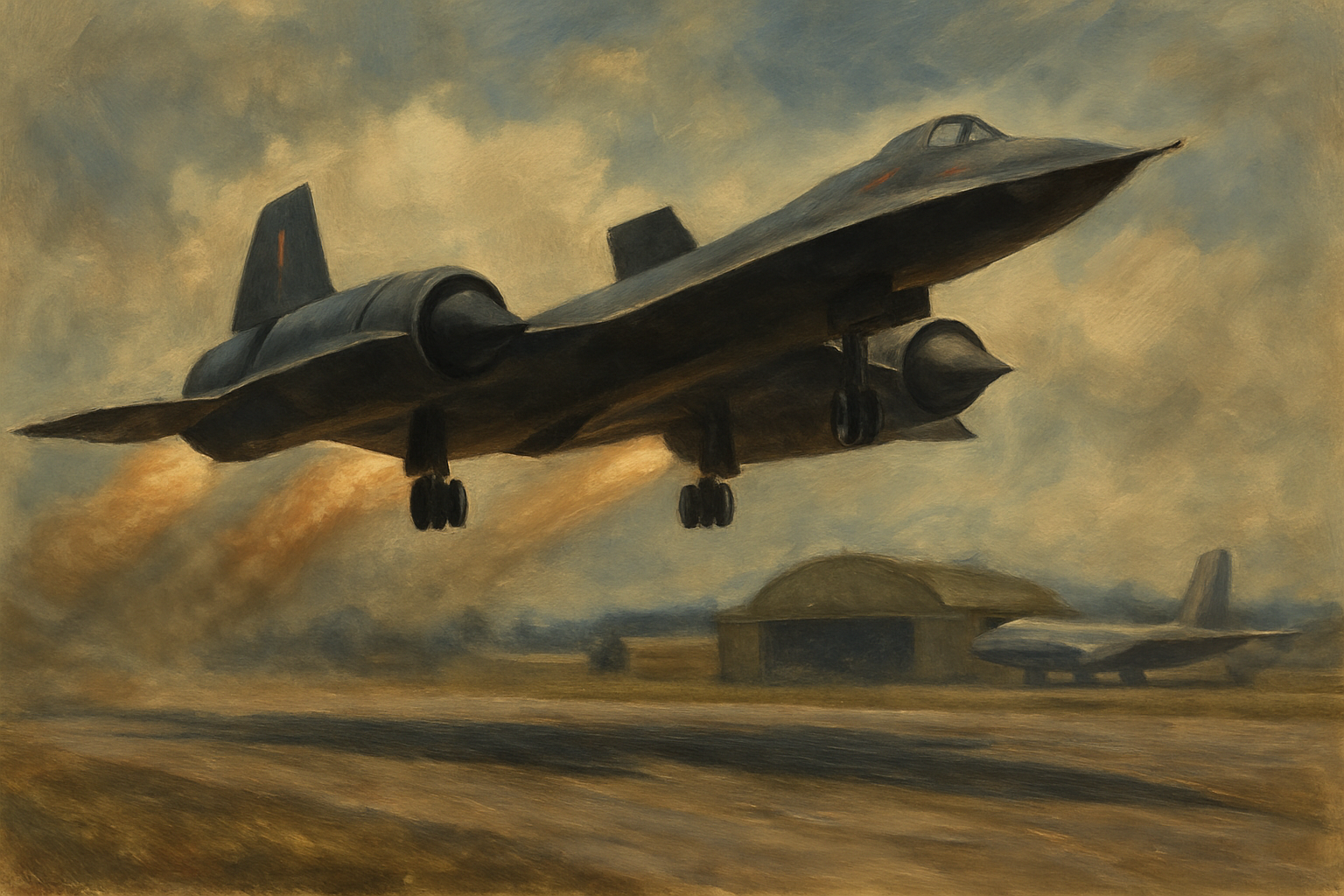
On 22 December 1964, a sleek black aircraft lifted off from Air Force Plant 42 in Palmdale, California, and quietly shattered the boundaries of what anyone believed possible. The SR-71 Blackbird had arrived — and nothing built since has ever caught it.
The Plane That Could Outrun a Missile
The SR-71 Blackbird cruised at Mach 3.3 — roughly 2,200 miles per hour — fast enough to cross the Atlantic in under two hours. That isn't a boast. It's a verified speed record that has stood, unbroken, for nearly half a century.
Its standard defence against enemy surface-to-air missiles was breathtakingly simple: accelerate and fly away. Over its 24-year operational career, more than 4,000 missiles were fired at SR-71s. Not one found its mark. Not one came close.
Flying above 80,000 feet, crews had to wear full pressure suits — the same kind worn by NASA astronauts — just to survive the near-space environment. The aircraft's existence was so tightly guarded that many senior US military officers had no idea it was flying operational missions overhead.
Cold War Skies: Why America Needed the Blackbird
To understand why the SR-71 was built, you have to go back to 1 May 1960 — the day Francis Gary Powers was shot down over the Soviet Union in a U-2 spy plane. The diplomatic fallout was catastrophic. It wrecked the Paris Summit, humiliated President Eisenhower, and exposed the limits of America's existing reconnaissance programme.
The CIA and US Air Force urgently needed something that flew higher and faster than any missile could reach. Soviet advances in radar technology and the SA-2 Guideline surface-to-air missile system had made slower aircraft dangerously vulnerable. The cold, hard lesson of the Powers incident was that altitude alone was no longer enough protection. Speed would have to be part of the answer.
The Korean War, the Berlin crises, and the growing confrontation over Cuba had made real-time intelligence on enemy movements a matter of national survival. President Eisenhower had actually authorised development of a U-2 successor as early as 1957, under the classified 'Oxcart' programme run by the CIA. History, and the events of 1960, gave that programme a desperate new urgency.
Kelly Johnson and the Skunk Works Miracle
Clarence 'Kelly' Johnson was already a legend when the contract landed on his desk. Lockheed's chief engineer had designed the U-2 that Powers had been flying. Now he was being asked to build something that flew twice as fast and twice as high — in secret, on a tight schedule, with technology that didn't yet exist.
Johnson ran his team from the 'Skunk Works' — Lockheed's famously secretive advanced development facility in Burbank, California. His management philosophy was radical for the era: small, empowered teams, minimal bureaucracy, fast decisions. It worked in ways that still astonish engineers today.
The A-12 Oxcart, the SR-71's direct CIA-operated predecessor, emerged first and flew from 1963. But the engineering problems the team faced were almost incomprehensible. At Mach 3 and above, skin temperatures on the airframe exceed 300°C. Aluminium — the standard material for aircraft construction — would simply melt. Johnson's team turned to titanium.
Over 85% of the SR-71's structure was ultimately built from titanium. The irony, well documented in aviation history, is striking: the United States had to covertly source much of that titanium from the Soviet Union itself — the very nation the aircraft was built to spy on.
Building the Unbuildable: Engineering the SR-71
The aircraft's famous black paint wasn't just for aesthetics, though it certainly contributed to the name. It was a special iron ball radar-absorbent coating that also served a practical thermal function, helping radiate heat away from the fuselage at extreme temperatures. Every design choice on the SR-71 solved multiple problems simultaneously.
The fuel was unlike anything used in conventional aviation. JP-7 had such a high flash point that it couldn't be ignited with a standard ignition system — or even a match. A chemical called triethylborane, or TEB, was required to start the engines. Each engine had a limited number of TEB shots, which meant engine restarts in flight were a carefully rationed resource.
Because the airframe expanded by up to 15 centimetres in flight as the metal heated up, the aircraft actually leaked fuel while sitting on the ground. This was an intentional design feature, not a flaw — but it meant every SR-71 had to take on additional fuel immediately after take-off, via aerial refuelling, before it could begin its mission.
The two Pratt & Whitney J58 engines were engineering marvels in their own right. They transitioned dynamically between turbojet and ramjet operating modes depending on airspeed — a propulsion concept of such complexity that it has not been repeated in any production aircraft since. The SR-71 carried no weapons. Its only tools were its cameras, sensors, and the ability to photograph 100,000 square miles of territory in a single operational hour.
22 December 1964: First Flight
Lockheed test pilot Robert J. 'Bob' Gilliland took the controls of SR-71A serial number 61-7950 on that December morning in Palmdale. What happened next set the tone for the entire programme. Gilliland pushed the aircraft to Mach 1.5 on the very first flight — reportedly well beyond the speeds authorised for an initial test outing.
The aircraft was immediately classified at the highest levels. Lockheed employees working on the project had code names. They could not tell their families what they were building, where they worked, or why they sometimes came home with scorched clothing or strange chemical burns from the exotic materials involved.
President Lyndon B. Johnson had publicly acknowledged the SR-71 programme's existence in February 1964 — an unusual decision, driven partly by a desire to manage Soviet concerns and partly to pre-empt leaks. The 1st Strategic Reconnaissance Squadron at Beale Air Force Base in California received its first operational SR-71 in January 1966, and the programme was fully underway.
The Men Who Flew It: Life at the Edge of Space
Every SR-71 carried two crew members: the pilot and a Reconnaissance Systems Officer, or RSO. Both had to be among the most experienced aviators in the entire US Air Force. Selection was rigorous, and training took between 12 and 18 months. Crews had to master high-altitude physiology, advanced navigation systems, and emergency procedures for a machine where any mistake at Mach 3 was instantly and absolutely fatal.
The pressure suits — first the S1030, later suits developed by the David Clark Company — were effectively personalised spacesuits, similar in concept to those worn by NASA astronauts during the Gemini programme. At 85,000 feet, the sky above turned a deep blue-black, and pilots could see the curvature of the Earth with the naked eye.
Major Brian Shul, one of the SR-71's most celebrated pilots and a decorated Vietnam veteran, described how the aircraft's speed created an almost surreal experience — ground controllers sometimes struggled to track its position accurately because it moved across their radar screens so quickly. The jet wasn't just fast. It existed, in some practical sense, at the edge of the physical world that conventional aviation occupies.
Operational History: From Vietnam to the Cold War Front Lines
SR-71s flew their first reconnaissance missions over North Vietnam in 1968, under the operational name 'Giant Scale.' Their role was primarily battle damage assessment — flying over targets after bombing raids to photograph what had actually been destroyed and what remained operational. At Mach 3, they were gone before North Vietnamese radar operators could do much more than register their presence.
When Egypt and Syria launched their surprise attack on Israel on 6 October 1973, beginning the Yom Kippur War, SR-71s were over the Middle East within hours. The intelligence they gathered went directly to US decision-makers and was shared with Israeli commanders — a real-world demonstration of the aircraft's ability to reach any point on the globe at short notice.
Routine missions throughout the 1970s and 1980s covered North Korea, Libya, and Soviet naval exercises in both the Atlantic and Pacific. On 1 September 1974, an SR-71 flew from New York to London in 1 hour, 54 minutes, and 56 seconds — a transatlantic speed record that still stands today. On 28 July 1976, the aircraft set its official absolute records: 3,529.56 km/h (Mach 3.3) and an altitude of 25,929 metres. Both remain unbroken.
Retirement, Revival, and the End of an Era
The US Air Force officially retired the SR-71 in January 1990. The stated reasons were financial — operating costs ran between $200 million and $300 million annually — and technological, as reconnaissance satellites were increasingly cited as capable replacements. Many in the intelligence community disagreed, and said so loudly.
Congressional backlash was immediate and fierce. Lawmakers argued that satellites couldn't replicate the SR-71's ability to respond quickly to breaking situations and image specific targets on demand. Under political pressure, three aircraft were reactivated between 1995 and 1997, flying operational missions before a second and this time final retirement was imposed.
NASA continued operating two SR-71s as research platforms until 1999, studying aerodynamics and high-speed flight phenomena. One served as a chase plane for the experimental X-33 spacecraft programme. The final SR-71 flight took place on 9 October 1999 — a quiet end to a chapter that many aerospace engineers believe simply cannot be repeated with a crewed aircraft.
Legacy: Why the Blackbird Still Matters
No aircraft — manned or unmanned, military or civilian — has surpassed the SR-71's speed record in the nearly 50 years since it was set. That fact alone is extraordinary. In an era of rapid technological change, the Blackbird sits untouched at the top of its category, like a monument.
The materials science, propulsion engineering, and aerodynamic principles pioneered at the Skunk Works fed directly into the stealth aircraft that followed — most notably the F-117 Nighthawk and the B-2 Spirit. Kelly Johnson's management philosophy — small teams, clear authority, fast decisions — became a case study taught in business schools worldwide, long after the aircraft itself was grounded.
Of the 32 SR-71s built, 12 were lost in accidents over the years. None was ever lost to enemy action. The surviving airframes are displayed at institutions including the Smithsonian National Air and Space Museum in Washington DC, the National Museum of the United States Air Force at Wright-Patterson, and the RAF Museum Cosford in the United Kingdom.
The Blackbird remains something more than a machine. It is proof of what a small group of brilliant, driven people can build when the stakes are high enough and the bureaucracy gets out of their way. More than half a century after it first flew, nothing has come close to replacing it — and that, perhaps, says everything.
If the SR-71 Blackbird has always captured your imagination, we'd love to hear why. Drop a comment below and share this article with a fellow aviation enthusiast — stories like this deserve to be told and retold.
Further reading
- Smithsonian National Air and Space Museum
- National Museum of the United States Air Force, Wright-Patterson Air Force Base
- CIA Freedom of Information Act Reading Room (Oxcart Programme declassified files)
- RAF Museum Cosford
- NASA Technical Reports Server (SR-71 aerodynamic and propulsion research)