The Quiz Question
Which Type 22 frigate had an unexploded bomb pass clean through her hull on 25 May 1982, the same attack in which HMS Coventry was sunk nearby?
- A. HMS Boxer
- B. HMS Brilliant
- C. HMS Battleaxe
- D. HMS Broadsword
The answer is D. HMS Broadsword. Here is the full story.
On the morning of 25 May 1982, Argentine naval aviators climbed into their cockpits knowing the date mattered. It was Argentina's National Day — a day of deep patriotic significance — and for the pilots of the 3rd Naval Fighter-Attack Escuadrilla, a successful strike against the British task force would carry a symbolism beyond mere military value. By that afternoon, they had sunk a Royal Navy destroyer and punched a bomb clean through a frigate's hull. That the frigate survived is one of the most astonishing stories of the entire South Atlantic conflict.
A Day the Royal Navy Will Never Forget
25 May 1982 opened with the British amphibious force consolidating its position around San Carlos Water following the landings that had begun on 21 May. The Argentine air force and naval aviation had already shown extraordinary aggression, sinking HMS Sheffield and HMS Ardent in the days prior. But 25 May would prove the worst single day of the war for the Royal Navy.
Two British warships were deployed northwest of West Falkland as a protective picket: HMS Coventry, a Type 42 destroyer, and HMS Broadsword, a Type 22 frigate. Together they formed what naval planners called a 'Type 64 combo' — a carefully designed anti-air pairing intended to create layered, overlapping missile coverage. By the end of the afternoon, one was sinking to the seabed and the other had a hole through her hull large enough to wreck a helicopter.
The events of that afternoon exposed uncomfortable truths about British weapons technology, tactical coordination, and the razor-thin margins that separate survival from catastrophe at sea. Naval officers still study them today.
The Ships and the Strategy: What Were They Doing There?
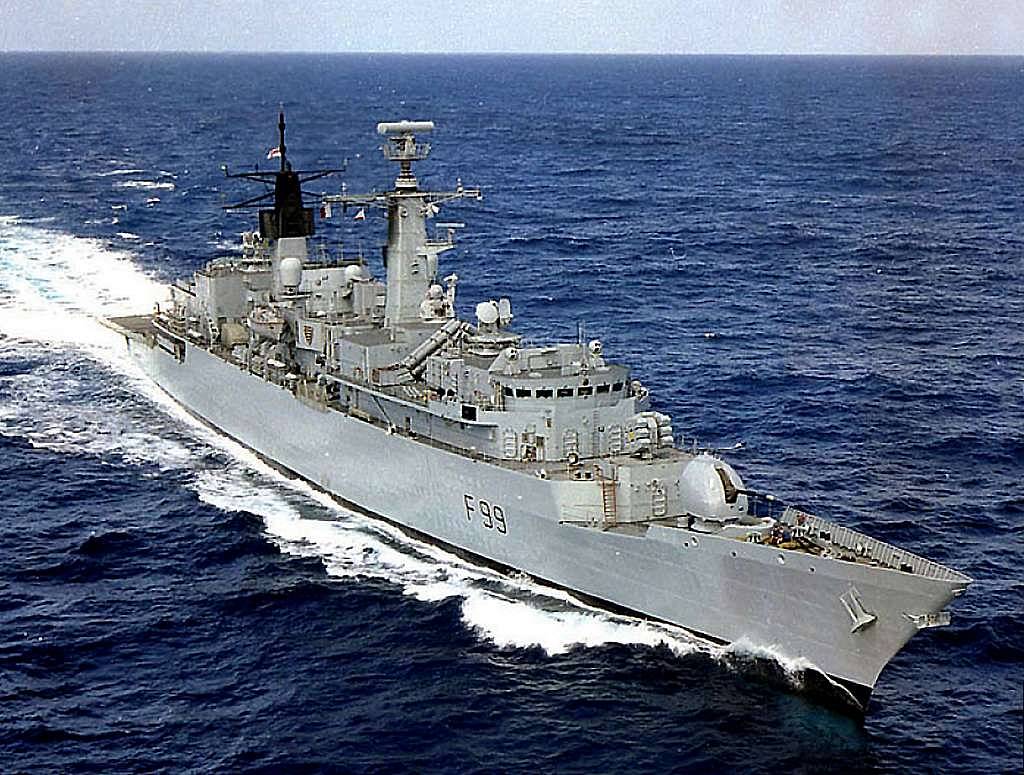
HMS Coventry (D118) was a Type 42 destroyer commissioned in 1978. Her primary weapon was the Sea Dart surface-to-air missile — a long-range system designed to engage aircraft at distances that gave the fleet genuine breathing room. HMS Broadsword (F88) was a Type 22 frigate commissioned in 1979, built around the Sea Wolf close-in defence missile — at the time one of the most sophisticated point-defence systems afloat.
The Type 64 combination placed Coventry forward as the long-range interceptor, using Sea Dart to engage threats before they reached the amphibious ships. Broadsword sat closer to the fleet, her Sea Wolf ready to destroy anything that broke through. The two ships were meant to complement each other's blind spots and create a seamless defensive envelope.
The tactic had already proved itself. On 24 May, the pair had shot down two Argentine aircraft, demonstrating genuine tactical effectiveness. Their positioning northwest of West Falkland was deliberate but dangerous — they were a forward picket, exposed so that the vital amphibious ships unloading troops and supplies in San Carlos Water might survive.
The Argentine Pilots: Who Came to Fight?
The aircraft that came for Coventry and Broadsword were A-4 Skyhawks of the Argentine Navy's 3rd Naval Fighter-Attack Escuadrilla, flying from Rio Grande airbase on Tierra del Fuego — a punishing round trip across the South Atlantic. Argentine pilots had already suffered serious losses during the campaign, yet continued to press home attacks with a tenacity and courage that earned reluctant respect from their British opponents.
By this stage of the war, Argentine tactics had adapted to the British defences. Flying at wave-top height — sometimes as low as 50 feet — the Skyhawks used the sea surface itself to stay below radar coverage for as long as possible. It was brutally demanding flying that pushed aircraft and pilots to their absolute limits.
The Argentine aviators were well aware that Sea Wolf posed a lethal threat. Their response was to attack in multiple waves from different directions, attempting to saturate the British systems. Lieutenant Commander Philippi led one of the attack groups. For these men, 25 May carried the full weight of Argentine national identity — success would mean something far beyond a military box ticked on a planning chart.
Sea Wolf Fails at the Critical Moment
The first wave of Skyhawks came in low and fast. Broadsword's Sea Wolf system acquired the targets and locked on — then the system reset without firing. The targeting computer, confronted with multiple aircraft flying in close formation, lost its solution and effectively started again from scratch. In the seconds that followed, the aircraft were past the engagement window.
This was not a random malfunction. Sea Wolf's fire control software struggled when targets flew in tight formation, creating a situation the computer could not resolve cleanly. The flaw had not been fully identified before the war began. The Falklands became a brutally live proving ground for British weapons technology, exposing limitations that peacetime exercises had never surfaced.
Coventry, realising Sea Wolf had not engaged, manoeuvred to bring her own weapons to bear. In doing so she moved across Broadsword's firing arc, masking Sea Wolf's line of sight and making any engagement by Broadsword impossible. The breakdown in coordination between the two ships in those final seconds proved fatal for Coventry and very nearly fatal for Broadsword.
The Strike: A Bomb Through the Hull of HMS Broadsword
During the attack, an Argentine 1,000 lb bomb struck Broadsword at the waterline on her port side. It did not detonate. Instead it tore clean through the hull and exited through the starboard side — passing through the ship in a trajectory that, had it detonated, would almost certainly have broken her apart and killed many of her crew.
As the bomb exited, it destroyed Broadsword's Lynx helicopter — tail number XZ736 — on the flight deck, blowing the aircraft's nose completely off. The helicopter was unmanned at the moment of impact. Every member of the aircrew who would normally have been with that aircraft survived.
The reason the bomb failed to detonate is one of the defining technical stories of the Falklands War. Argentine aircraft were dropping ordnance from such low altitudes that the fuses did not have sufficient time and distance to arm before impact. It was a consistent problem throughout the campaign, and British analysts were keenly aware that had Argentine bombs been correctly fused for low-level delivery, the Royal Navy's losses would have been catastrophic. Broadsword would almost certainly have been among them.
With flooding threatening to worsen and her flight deck wrecked, Broadsword's crew moved with remarkable speed and discipline. Damage control teams contained the flooding, the ship remained operational, and — in an act of collective courage that defines what naval service means — they turned immediately to the task of rescuing the men now struggling in the South Atlantic alongside them.
HMS Coventry Goes Down: The Tragedy Alongside
HMS Coventry was not so fortunate. She was struck by three 1,000 lb bombs during the same attack sequence, and these detonated. The internal explosions and fires they caused were catastrophic. Coventry capsized and sank in under 20 minutes — a chilling demonstration of how quickly a warship can be lost when bombs go off inside her.
Nineteen men from Coventry's crew were killed. 170 survivors were rescued from the freezing South Atlantic, many of them pulled to safety by Broadsword's boats and helicopters — a remarkable feat given that Broadsword herself had just taken a bomb through her hull. Captain David Hart Dyke survived and later wrote with great candour about the experience in his memoir 100 Days: The Memoir of the Falklands Battle Group Commander, providing one of the most vivid personal accounts of the war at sea.
The same afternoon, the Atlantic Conveyor — a merchant vessel requisitioned as a container ship carrying vital Chinook and Wessex helicopters — was struck and sunk by an Exocet missile. The loss of both Coventry and Atlantic Conveyor on the same day made 25 May 1982 the darkest single day of the Falklands War for Britain.
The Men of HMS Broadsword: Courage Under Fire
Captain William Canning commanded HMS Broadsword throughout the campaign. His leadership in the minutes and hours following the strike — managing simultaneous damage control and rescue operations — was widely praised at the time and afterwards. He held the ship together when lesser command might have faltered.
Broadsword's damage control teams — ordinary sailors, many in their late teens and twenties — worked in flooded, damaged compartments to contain the flooding and keep their ship fighting. These were not specialists acting alone; they were young men following training and instinct in conditions of genuine danger, while simultaneously knowing that shipmates from Coventry were dying in the water nearby.
The ship's company had been at action stations for extended periods in the brutal conditions of the South Atlantic winter. Physical and mental exhaustion were real factors. That they performed as they did speaks to both the quality of Royal Navy training and the character of the individuals involved. Several crew members received decorations for their actions that day, including Distinguished Service Medals for damage control and rescue efforts.
Lessons Learned: How the Falklands Changed the Royal Navy
The Sea Wolf software failure was investigated with urgency after the war. The system was upgraded to handle multiple simultaneous targets more reliably — a direct consequence of what happened off West Falkland on 25 May. The Falklands proved that weapons technology must be tested against realistic tactical scenarios, not just idealised ones.
The Type 64 combo tactic itself was revised. The communication and coordination protocols between paired ships were tightened to prevent the kind of fatal hesitation — the moment when Coventry manoeuvred across Broadsword's arc — from happening again. A tactic that had worked well on 24 May had broken down catastrophically on 25 May, and the Royal Navy was determined to understand exactly why.
Argentine bomb fusing problems were catalogued in detail by British analysts. The assessment was stark: had Argentine ordnance performed as designed, additional ships — HMS Broadsword, HMS Arrow, and others that took bomb hits that failed to explode — would likely have been lost. The task force survived partly because of British courage and partly because of Argentine technical misfortune.
More broadly, the Falklands War accelerated Royal Navy investment in close-in weapon systems. The American-designed Phalanx CIWS cannon was adopted for major surface vessels — a direct consequence of the campaign's lessons about the inadequacy of point defence at close range. The 1981 Nott Review, which had proposed severe cuts to the surface fleet and had even suggested scrapping HMS Invincible, was seen in a very different light once the war demonstrated how much those ships actually mattered.
HMS Broadsword's Legacy: The Ship That Survived
After temporary repairs were made in the South Atlantic, HMS Broadsword returned to the United Kingdom and underwent full restoration at Devonport Dockyard, returning to service later in 1982. She went on to serve the Royal Navy for over a decade more, finally leaving service in 1995. She was then sold to the Brazilian Navy, where she was renamed NaS Greenhalgh (F46) and served until 2015 — over thirty years of active naval service for a ship that nearly had her career ended by a 1,000 lb bomb in the South Atlantic.
The wreck of HMS Coventry rests on the seabed off the Falkland Islands. She is designated a war grave and is protected under the Protection of Military Remains Act 1986 — a recognition that she is the final resting place of nineteen of her crew.
Every year on 25 May, veterans of both ships gather to remember those who did not come home. The bond between Coventry and Broadsword survivors — forged in the worst afternoon either ship's company ever faced — remains extraordinarily strong. They shared something that no one who was not there can fully understand.
The story of the bomb that passed clean through HMS Broadsword without detonating has become one of the most striking survival stories of the entire Falklands War. It is a story about fortune — because the margin between that bomb missing and it detonating was measured in engineering tolerances and fusing timers. But it is also a story about courage, discipline, and the men who refused to let their ship die even when they had every reason to believe she might.
If this story moved you, share it with someone who should know it — and leave a comment below telling us your connection to the Falklands War, whether as a veteran, a family member, or simply someone who has never forgotten 1982.
Further Reading
- Imperial War Museum — collections and oral histories relating to the Falklands War
- The National Archives, Kew — official Royal Navy operational records and post-war assessments from the Falklands campaign
- National Museum of the Royal Navy, Portsmouth — Falklands War exhibits and warship histories
- Fleet Air Arm Museum, Yeovilton — records relating to Royal Navy aviation and helicopter operations during the Falklands conflict
- Falklands Conservation and the Falkland Islands Government — resources on protected wrecks and war graves in Falkland waters