The Quiz Question
The RAF and USAAF bombing raids on which German city in February 1945 created a devastating firestorm and became one of the most controversial Allied bombing operations of the war?
- A. Hamburg
- B. Dresden
- C. Cologne
- D. Berlin
The answer is B. Dresden. Here is the full story.
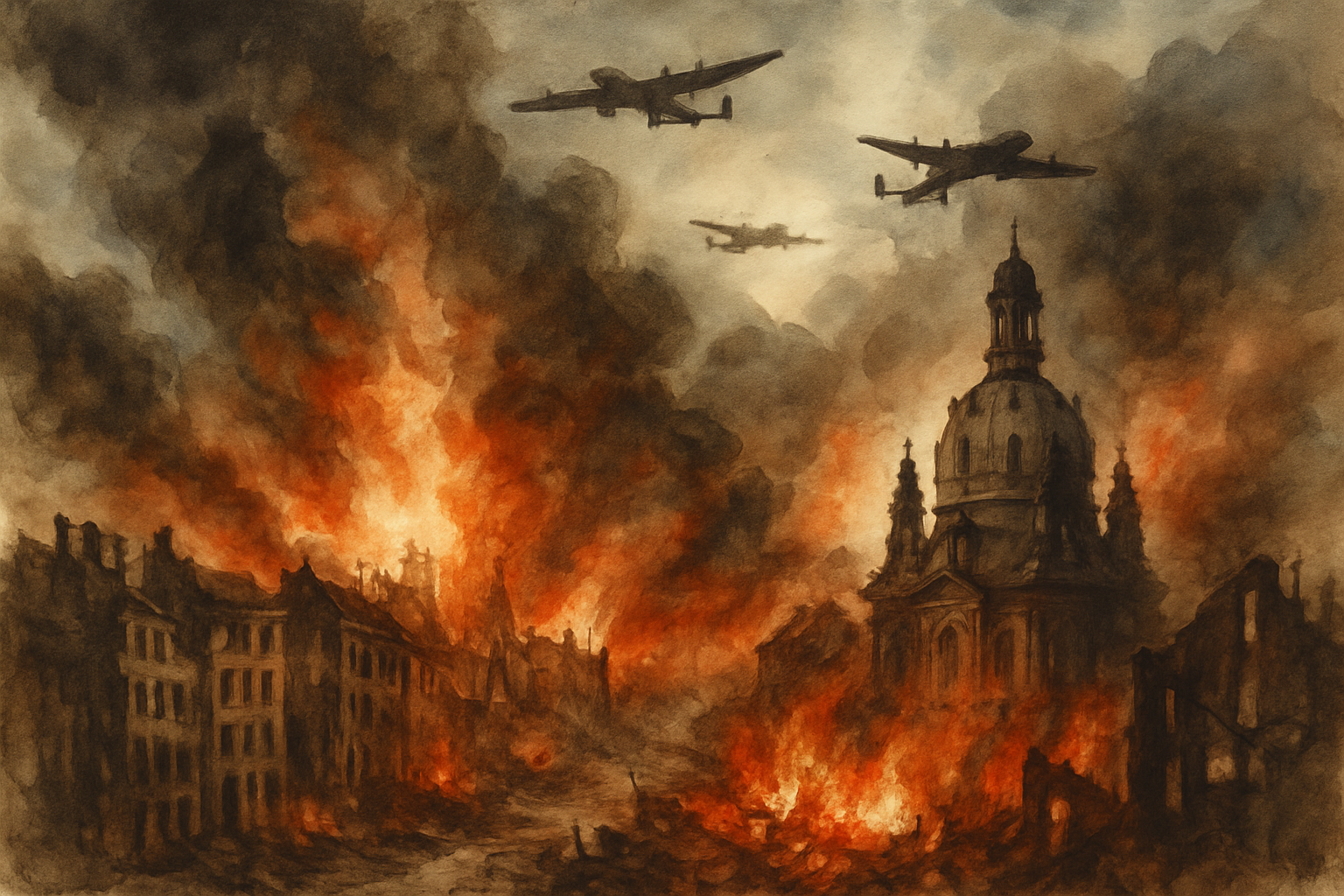
On the night of 13 February 1945, the skies over Dresden turned orange. Within hours, one of Germany's most beautiful cities — a baroque jewel known across Europe for its art, its architecture, and its culture — was reduced to a smouldering wasteland. The raids that followed over the next two days killed tens of thousands of people and ignited a controversy that has never fully died down. Eighty years on, Dresden remains one of the most debated events of the Second World War.
Dresden Before the Bombs: A City at the Edge of War
By early 1945, Dresden was the capital of Saxony and Germany's seventh-largest city. Its pre-war population of around 640,000 had swollen considerably — historians estimate an additional 200,000 to 300,000 refugees had flooded in, fleeing the Soviet Red Army's rapid advance from the east. By February, the Eastern Front was barely 70 miles away.
Dresden was no purely civilian backwater. The city housed significant railway infrastructure, military hospitals, and war industries producing optical instruments and communications equipment. But it had largely escaped Allied bombing until 1945, leading civilians and refugees alike to regard it as a relative sanctuary. That false sense of safety meant the city was dangerously crowded when the bombers arrived.
The geopolitical context mattered too. At the Yalta Conference, running from 4 to 11 February 1945, Allied commanders were under pressure from Stalin to disrupt German communications and troop movements in support of the Soviet offensive. Dresden sat squarely in the crosshairs of that strategic demand.
The Strategic Case: Why Dresden Was Targeted
The bombing of Dresden did not emerge from nowhere. Operation Thunderclap, first proposed in August 1944, called for concentrated attacks on major German cities to shatter civilian morale as the war neared its end. Dresden was identified as a prime candidate.
A British Air Ministry directive dated 27 January 1945 listed Dresden alongside Berlin and Leipzig as cities whose destruction would cause what planners described as 'great confusion' to German troop and refugee movements. The Combined Strategic Targets Committee approved Dresden as a target that same month. Air Marshal Sir Arthur 'Bomber' Harris, Commander-in-Chief of RAF Bomber Command, was a firm advocate of area bombing and needed little persuasion.
Winston Churchill himself requested the 'basting' of eastern German cities to demonstrate Allied air power to the Soviets during the Yalta period. Military planners also emphasised Dresden's role as a major rail junction — a critical node for moving men and materiel between fronts. The case was built on both strategic logic and political calculation.
A City on Fire: The Night Dresden Burned
The first wave struck at 22:14 on 13 February. Some 249 RAF Lancasters from 5 Group dropped mainly high-explosive bombs, deliberately designed to blow off rooftops and expose the timber structures beneath — setting the stage for what was to follow. RAF pathfinder aircraft, using Oboe navigation systems and H2S radar, marked targets with flares to guide the main force.
Just three hours later, at 01:23 on 14 February, a second wave of 529 RAF Lancasters swept in. This time the payload was a devastating combination of incendiary bombs and 4,000-lb 'Cookie' blast bombs. The result was catastrophic. A self-sustaining firestorm erupted across the city centre, reaching temperatures estimated at over 1,500°C. The fire was visible from more than 200 miles away.
Survivors described hurricane-force winds generated by the inferno, sucking people and debris towards the flames as the fire consumed the surrounding oxygen. Cellars and shelters — where thousands had taken refuge — became lethal traps. Tarmac melted in the streets. Lothar Metzger, a child survivor, later described emerging from a shelter to find charred bodies lining the roads and a smell of burning that lingered for weeks.
The following day, 14–15 February, over 300 USAAF B-17 Flying Fortresses from the 8th Air Force added a third and fourth wave, dropping around 771 tons of bombs and targeting the railway marshalling yards. P-51 Mustang fighters provided escort; allegations that some aircraft strafed roads outside the city have been made by witnesses but remain disputed among historians. In total, the raids delivered approximately 3,900 tons of bombs — roughly 40% of them incendiaries, a ratio specifically engineered to generate fire rather than blast damage alone.
Dresden, long called the 'Florence of the Elbe' for its baroque splendour, was virtually destroyed in less than 48 hours.
The Human Cost: Casualties and Survivors
The death toll from the Dresden raids has been one of the most bitterly contested figures in Second World War history. Nazi propaganda immediately inflated the numbers to between 200,000 and 500,000 — figures that circulated internationally and shaped public perception for decades.
The reality, established through painstaking post-war research, is grim enough without exaggeration. A Dresden Historical Commission, reporting in 2010 after extensive archival investigation, concluded that the maximum credible death toll was approximately 25,000 people. Earlier German investigations had arrived at similar figures in the range of 22,700 to 25,000. These remain the most authoritative estimates available.
Many victims died not from blast or fire directly, but from smoke inhalation in shelters as the firestorm stripped oxygen from the air above them. Thousands of refugees who had been sleeping in the open — in parks, in railway stations, on the streets — had no shelter whatsoever and suffered disproportionately. The human tragedy was immense, even without the inflated propaganda numbers.
The Raids in Detail: Command and Execution
The operation was not improvised. RAF Bomber Command's meticulous two-wave approach on the night of 13–14 February reflected hard-won experience in generating maximum fire damage. The deliberate gap between waves was calculated to draw emergency responders into the open before the second strike arrived.
Air Marshal Harris directed the operation from High Wycombe, RAF Bomber Command's headquarters. His superior, Air Chief Marshal Sir Charles Portal, Chief of the Air Staff, formally approved the raids. General Carl Spaatz, commanding the USAAF's Strategic Air Forces in Europe, authorised American participation; Spaatz generally favoured precision strikes on oil and transport infrastructure, but approved Dresden as part of the broader Yalta support strategy.
Dresden's own defences were pitifully thin. Generalmajor Hans-Georg von Ahlfen commanded the city's protection, but most anti-aircraft guns had been stripped and sent to the front lines. The city had only a handful of flak batteries remaining — almost no meaningful defence against nearly 800 heavy bombers.
The Immediate Aftermath: Rubble, Recrimination, and Propaganda
Joseph Goebbels, Nazi Germany's Propaganda Minister, moved with characteristic speed. Official German communiqués inflated the death toll tenfold, to 200,000, framing the Allies as war criminals and cultural vandals. An Associated Press dispatch carried versions of these falsified figures into Allied newspapers before the war had even ended, planting seeds of doubt that would take decades to properly uproot.
The Frauenkirche — Dresden's iconic Lutheran church, one of the great baroque buildings of Europe — collapsed on 15 February, unable to withstand the sustained heat. Rescue and recovery operations were hampered for days by fires still burning and the structural danger of ruined buildings. The scale of the destruction was almost incomprehensible.
Churchill's own position shifted remarkably quickly. On 28 March 1945, he sent a memo questioning whether the Allies were 'bombing German cities simply for the sake of increasing the terror.' It was a striking reversal from a man who had personally called for the raids weeks earlier. Harris, furious at what he saw as a political betrayal, watched as the British establishment quietly distanced itself from a bombing campaign it had enthusiastically ordered. The memo was later withdrawn, but the damage to Harris's standing — and to the legacy of Bomber Command — was done.
In the Soviet-occupied zone after the war, the ruins of Dresden were rebuilt slowly and selectively. East Germany's communist government used the destruction as ongoing propaganda against Western imperialism, further muddying the historical waters throughout the Cold War.
The Moral Debate: Was Dresden Justified?
The ethical arguments around Dresden have never been fully resolved — and probably never will be. Critics point out that by February 1945, Germany's defeat was inevitable. They argue that destroying a culturally irreplaceable city and killing tens of thousands of civilians — many of them refugees — served no proportionate military purpose at that late stage of the war.
Defenders counter that Dresden was a genuine and significant military target: a major rail junction, a site of war production, and a city whose destruction served a legitimate Allied commitment to supporting the Soviet offensive. The war was not yet over, and no Allied commander in February 1945 could guarantee how long it would last.
Historian Frederick Taylor's 2004 book Dresden: Tuesday, 13 February 1945 provided the most thorough English-language reassessment of the raids. Taylor concluded that Dresden was a legitimate, if badly timed, military target — and systematically dismantled the inflated death toll figures that had distorted the debate for sixty years. His work remains essential reading for anyone seeking to understand the raid beyond the mythology.
Sir Arthur Harris was conspicuously denied a peerage after the war. More damningly, the aircrew of RAF Bomber Command — 55,573 of whom died in the course of the war — received no campaign medal of their own, a slight that persisted for decades. The British establishment had quietly disowned its own bombing policy, leaving the men who carried it out to bear the stigma alone.
Legacy and Memory: Dresden 80 Years On
The Frauenkirche's reconstruction became one of the most powerful symbols of post-war reconciliation. Completed in 2005, it was rebuilt stone by stone using original masonry retrieved from the rubble. The golden orb and cross atop the restored dome were crafted by a British goldsmith named Alan Smith — whose father had flown in the very raids that destroyed the original church. It was a deliberate, quietly extraordinary act of reconciliation.
A 1992 memorial service in Dresden, attended by German and British veterans together, marked a landmark moment of shared remembrance. The Bomber Command Memorial, unveiled in London's Green Park in 2012 by Queen Elizabeth II, finally gave formal recognition to the crews who had flown through flak and fighters to carry out their government's orders — recognition that was long overdue.
Dresden's February commemorations continue each year. In recent decades, far-right groups have repeatedly attempted to exploit the anniversary, portraying the bombing as Allied genocide and inflating the casualty figures once more. Dresden's own citizens have consistently pushed back, organising large counter-demonstrations to reclaim the memory of the dead from political manipulation.
The bombing remains a central case study in debates about the laws of war, proportionality, and the ethics of strategic air power — studied in military academies, law schools, and war crimes tribunals. For those who lived through the Second World War, and for historians ever since, Dresden poses the hardest of questions: in a total war fought against genuine evil, how much destruction is too much?
History rarely delivers clean verdicts. Dresden is proof of that.
If this article made you think — or if you have a family connection to the bombing of Dresden, to Bomber Command, or to the long effort at reconciliation — we would love to hear from you. Share your thoughts in the comments below, and pass this on to anyone who believes that history, even its darkest chapters, deserves to be understood properly.
Further Reading
- Imperial War Museum (IWM), London — extensive collections on RAF Bomber Command and the strategic bombing campaign
- The National Archives, Kew — British government and Air Ministry records from the Second World War
- United States National Archives and Records Administration (NARA) — 8th Air Force operational records and USAAF strategic bombing documentation
- The National WWII Museum, New Orleans — research resources on Allied air operations in the European Theatre
- Militärhistorisches Museum der Bundeswehr (Military History Museum), Dresden — German archival and exhibition material on the February 1945 raids and their aftermath