The Quiz Question
During the First Battle of the Marne in September 1914, roughly 600 Parisian taxicabs were famously requisitioned to rush French reserve troops to the front. What name is this action still remembered by?
- A. The Marne Shuttle
- B. The Paris Convoy
- C. The Taxis of the Marne
- D. The Miracle of Mons
The answer is C. The Taxis of the Marne. Here is the full story.
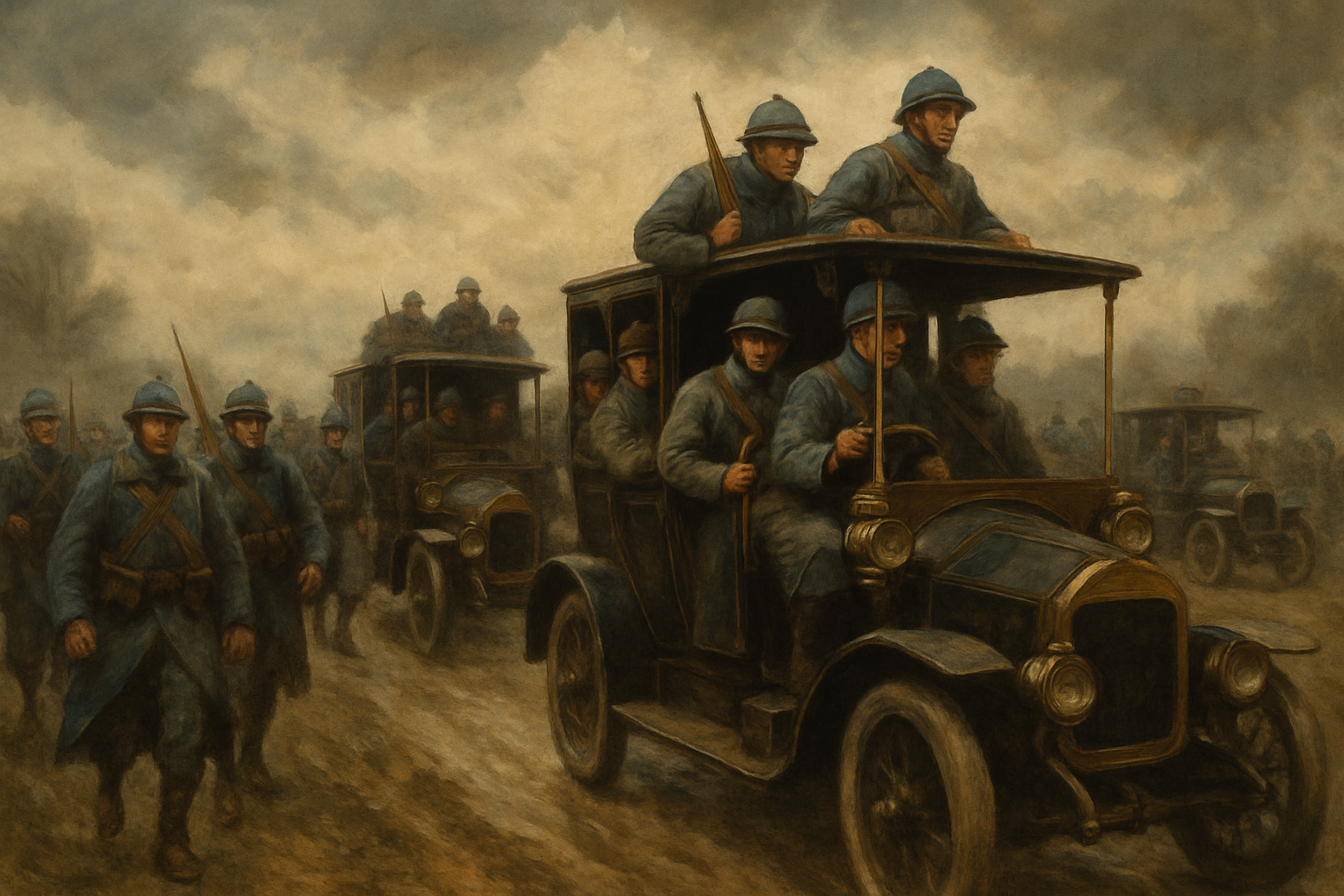
On the evening of 6 September 1914, something completely unprecedented in the history of warfare was unfolding on the streets of Paris. Hundreds of ordinary taxicabs — the familiar red-and-black Renault AG1s that carried businessmen to meetings and couples to dinner — were lining up outside Les Invalides, their meters ticking over for one last civilian moment before they became instruments of war. The soldiers cramming into their back seats carried rifles, not briefcases. Their destination was not a restaurant but a battlefield.
The Night Paris Sent Its Taxis to War
The convoy that assembled in those September hours was unlike anything the world had ever seen. Each cab carried five infantrymen, pressed into seats still faintly warm from the civilians who had ridden in them just hours before. The drivers were not soldiers — they were working men, many of them middle-aged, the younger generation already having marched off in the August mobilisation.
They had been stopped in the streets by military police and officers acting under requisition orders, handed their instructions with little ceremony, and told to report to Les Invalides. The route ahead stretched roughly 50 to 60 kilometres through the dark French countryside toward the front near Nanteuil-le-Haudouin. It remains one of the most extraordinary logistics operations in the history of modern warfare — improvised, improbable, and immortal.
France on the Brink: The Summer of 1914
To understand why France was sending taxis to war, you need to understand how close to catastrophe the country had come in just six weeks. Germany's Schlieffen Plan called for a rapid, overwhelming blow against France in the west — knock France out before Russia could mobilise in the east. Speed was the entire point.
By late August 1914, it was working. German forces had swept through Belgium and driven deep into northern France, pushing both the French Army and the British Expeditionary Force into a punishing fighting retreat. Paris itself seemed about to fall. The French government evacuated to Bordeaux on 2 September 1914, leaving the capital in a state of barely suppressed panic.
French Commander-in-Chief General Joseph Joffre was reorganising frantically. On 25 August he created the new Sixth Army under General Michel-Joseph Maunoury, scraping together divisions from other parts of the front. Joffre told his officers with stark honesty that he did not know if they would fight another major battle, but if they did, it would be on the Marne. He was about to be proven right — and the manner of that battle's opening would pass into legend.
The German Mistake That Opened a Door
The opportunity that would eventually save France came from a German miscalculation. General Alexander von Kluck, commanding the German First Army, made a fateful decision in early September: rather than swinging west of Paris as the Schlieffen Plan intended, he turned his forces south-east, passing to the east of the capital. It was a move driven by the pressure of pursuit and the desire to keep the retreating French forces from escaping — but it left his right flank dangerously exposed.
French aerial reconnaissance — one of the first truly decisive uses of aircraft for battlefield intelligence in history — spotted the gap on 3 September 1914. General Joseph Gallieni, Military Governor of Paris, grasped the significance immediately. Here was a chance to strike von Kluck's open flank with the forces assembling around the capital.
Gallieni pressed Joffre urgently. Joffre, characteristically methodical but capable of decisive action when the moment demanded it, gave the order on 4 September 1914. The French Sixth Army would attack von Kluck's exposed flank. The First Battle of the Marne was about to begin — and with it, the race to get enough men to the right place in time.
Gallieni's Gamble: The Decision to Requisition the Taxis
Gallieni needed to move the 7th Division of the French IV Corps — approximately 6,000 men — to reinforce Maunoury's Sixth Army at the front, and he needed to do it fast. The problem was the French rail network was already groaning under the weight of massive troop movements across hundreds of kilometres of front. There were simply not enough trains available for this urgent mission.
When the taxi solution was proposed, Gallieni reportedly responded with characteristic dry wit: 'Eh bien, voilà au moins qui n'est pas banal' — 'Well, at least this is not ordinary.' On the evening of 6 September 1914, military police and officers fanned out across Paris, stopping taxis in the streets and issuing requisition orders under the state of siege that had been declared on 2 August 1914.
Drivers were told to report to Les Invalides. Crucially, the government would pay — the fare would be settled at the standard rate plus 27 per cent above the metered amount. The French state had commandeered its citizens' cabs, but it kept its word about the bill. That practical detail mattered: it was requisition, not conscription, and Paris's working drivers responded accordingly.
The Convoy: What Actually Happened on the Road
Around 600 Renault AG1 taxis assembled and departed in two waves on the nights of 6–7 and 7–8 September 1914, headlamps cutting through the dark roads north-east of Paris. Each cab carried five soldiers plus the driver; with roughly 600 vehicles running two trips, the total number of troops transported was approximately 3,000 to 4,000 men — not the entire 6,000-strong division.
This is an important distinction that history has sometimes blurred. The taxis were a supplement to other means of movement, not the sole transport. The remainder of the troops marched or were carried by whatever other vehicles could be pressed into service. Military police were stationed at intervals along the route to keep the convoy moving; the procession stretched for several kilometres along the roads leading toward the front.
The troops arrived on 8 September 1914, joining the Sixth Army just as the Battle of the Ourcq — the flanking engagement that formed a critical part of the broader Marne battle — was reaching its most intense phase. They came not a moment too soon. Maunoury's army was under severe pressure, and every fresh soldier counted.
The First Battle of the Marne: Holding the Line
The First Battle of the Marne lasted from 5 to 12 September 1914 and involved approximately two million men along a front stretching nearly 300 kilometres. It is one of the decisive battles of the twentieth century — the moment the German dream of a quick western victory died.
The gap between the German First and Second Armies — at points up to 50 kilometres wide — was cautiously but consequentially exploited by British forces under Field Marshal Sir John French, who advanced through the opening and threatened to split the German line entirely. Faced with the prospect of catastrophic envelopment, the German armies began their retreat to the Aisne on 9 September 1914.
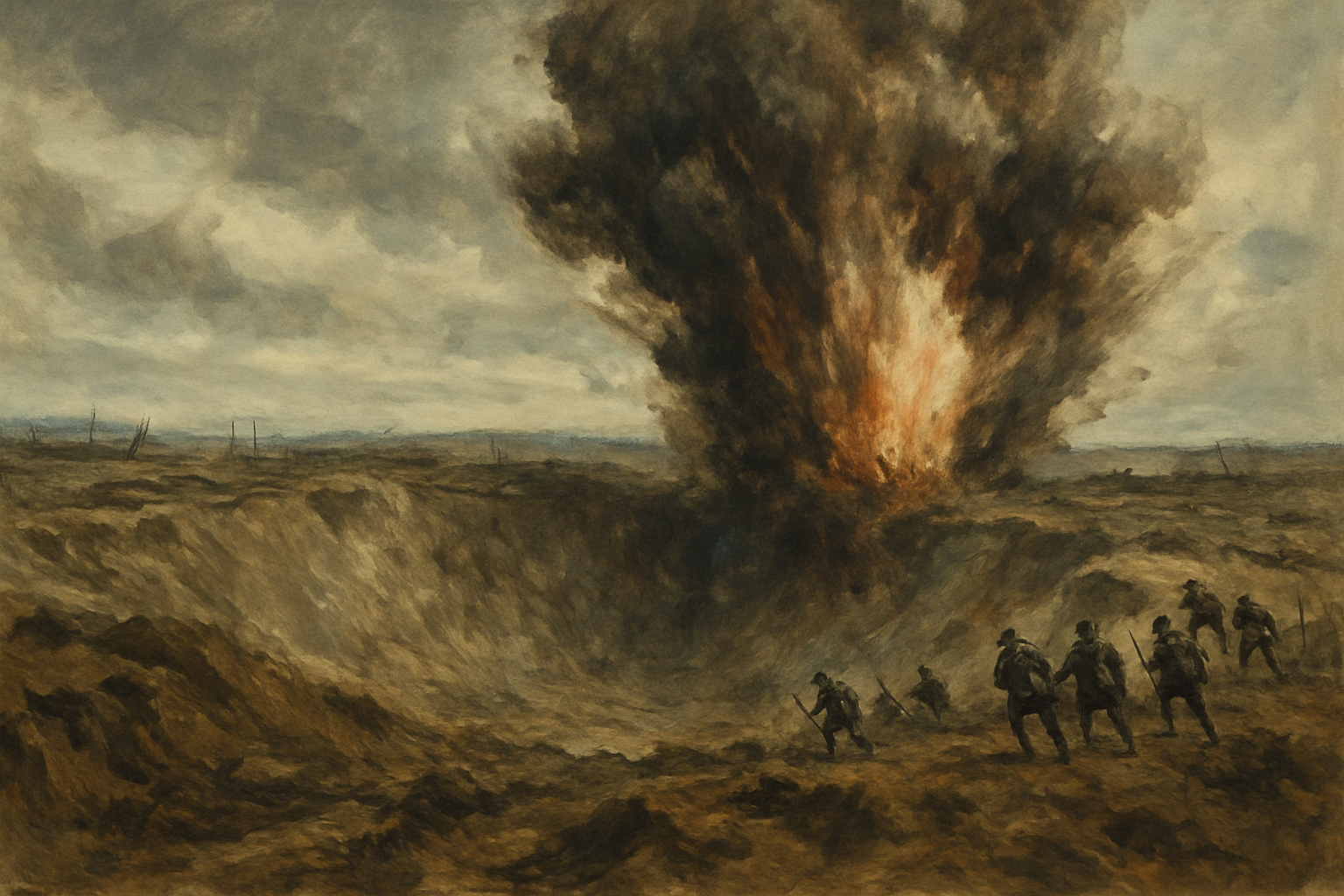
German Chief of Staff Helmuth von Moltke was shattered by the failure of the great offensive. The retreat to the Aisne meant digging in on the high ground — trenches that would define the Western Front for the next four years. The 'Miracle of the Marne' had halted the German advance and, with it, the prospect of a short war. Von Kluck's flanking mistake, Gallieni's sharp eye, and the response of two million soldiers — and 600 taxi drivers — had changed the shape of the entire conflict.
The Men Behind the Wheel: The Taxi Drivers of Paris
The drivers of the Renault AG1s were civilian employees of Paris's main taxi companies. The AG1 itself was a sturdy, reliable two-cylinder vehicle that had been working the Paris streets since 1905 — not glamorous, but dependable, which was exactly what the night required. Many of the drivers at the wheel that September were older men; the younger ones had long since been called up in the August mobilisation.
They received no military honours, no medals, no formal recognition at the time. They were paid their fares — the government kept that promise — and they went back to their lives. Some accounts record that soldiers, understanding the strange historic nature of their journey, tipped their drivers generously before stepping out at the front. It is the kind of human detail that feels entirely right.
Decades later, the drivers and their descendants became celebrated figures in French national memory. One original Renault AG1 taxi, restored and honoured, is preserved at Les Invalides in Paris to this day — a small red-and-black vehicle carrying the weight of an entire national myth.
Myth vs. Reality: How Much Did the Taxis Actually Matter?
Military historians have wrestled honestly with this question. The 3,000 to 4,000 men delivered by the taxis represented a small fraction of the 150,000 troops engaged on the French Sixth Army's front. General Joffre himself was notably cool on the subject in his memoirs, writing that the taxis 'contributed' to the battle but were not decisive — the outcome, he argued, was determined by the broader strategic situation and the exploitation of the gap between the German armies.
General Gallieni, naturally, saw things differently. The taxi story became closely associated with his reputation and his legacy. He was posthumously made a Marshal of France in 1921 — an honour that recognised his role in setting the Marne counter-attack in motion. Historians including John Keegan have emphasised that the real turning point was the British advance through the gap between von Kluck and von Bülow's armies, not the arrival of a few thousand fresh infantrymen on the Ourcq.
Yet to dismiss the taxis entirely misses something genuinely significant. The episode represents the first mass motorised troop movement in military history — a moment when the automobile shifted from civilian convenience to military necessity. That transition foreshadowed the mechanised warfare that would define every major conflict of the twentieth century, from the tank battles of the Second World War to the armoured operations of more recent decades.
Why the Taxis of the Marne Still Matter a Century Later
The story became an instant symbol of French national resilience, and it has never really let go. Ordinary Parisians — cab drivers, working men with no military rank or training — had literally driven their city's defenders to battle. French newspapers seized on the image within days of the event; paintings followed, then films, then textbooks. It was the kind of story a nation under existential pressure desperately needs.
The requisitioned Renault AG1 on display at the Musée de l'Armée at Les Invalides remains one of the most visited objects in that extraordinary collection. It is a tangible, physical link to a September night in 1914 when the fate of France genuinely hung in the balance. Visitors who know the story stand in front of it differently — not just looking at an old car, but at a symbol.
For students of military history, the Taxis of the Marne mark a pivotal moment of transition: from the horse-drawn logistics of Napoleon's era to the motorised, industrial warfare that would shape the century ahead. The horses didn't disappear overnight — they would serve in enormous numbers throughout the First World War — but the direction of travel was set on those dark roads north-east of Paris in September 1914.
The episode is still taught in French schools as a foundational national moment — the day Paris rose to save itself and, in doing so, helped save France. Whether the taxis were militarily decisive or gloriously symbolic, that story has earned its place in history.
If you found this story as compelling as we did, we'd love to hear from you. Do you have a favourite moment from the First Battle of the Marne, or a family connection to the events of September 1914? Share your thoughts in the comments below, and pass this article on to anyone who loves the real stories behind the headlines of history.
Further Reading
- Imperial War Museum (IWM), London — extensive collections on the First World War, the Western Front, and the 1914 campaigns
- Musée de l'Armée, Les Invalides, Paris — home to one of the original Renault AG1 Marne taxis and major First World War holdings
- The National Archives, Kew — British Expeditionary Force operational records from the Marne campaign, September 1914
- Service Historique de la Défense (SHD), Vincennes — the principal French military archive, holding records of the Sixth Army and the Marne operations
- In Flanders Fields Museum, Ieper (Ypres) — broader Western Front context and research resources covering the opening campaigns of 1914