The Quiz Question
Which Royal Navy destroyer boarded the German tanker Altmark in a Norwegian fjord in February 1940 to free British prisoners, giving rise to the cry, the Navy's here?
- A. HMS Cossack
- B. HMS Jervis Bay
- C. HMS Ivanhoe
- D. HMS Kelly
The answer is A. HMS Cossack. Here is the full story.
On the night of 16 February 1940, in a narrow Norwegian fjord surrounded by sheer black cliffs, a Royal Navy boarding party scrambled across icy steel deck plates with cutlasses drawn. Below them, locked in converted oil tanks in the dark, nearly three hundred British merchant seamen had been waiting — some of them for almost three months. When the hatch finally opened and light flooded in, the shout that came down changed everything: "The Navy's here." It was the first electrifying moment of a war that had so far offered precious little to cheer about.
A Cry in the Dark: The Night the Navy Came
The date was 16 February 1940, and the place was Jøssingfjord, a cliff-sided inlet on the southwest coast of Norway near the town of Egersund. The Royal Navy destroyer HMS Cossack had just forced her way past two Norwegian gunboats and into the fjord in near-total darkness, hunting a German vessel called the Altmark.
What happened next — a boarding action with edged weapons — was the last time the Royal Navy would board an enemy vessel using cutlasses. Lieutenant Bradwell Turner led around thirty men across onto Altmark's deck in a brief, violent struggle that left seven German crew members dead. Not a single British sailor was killed.
When the locked holds were opened and the 299 men inside heard those words — "The Navy's here!" — the phrase instantly entered British legend. It appeared in newspapers, newsreels and parliamentary speeches, giving a war-weary public its first real naval triumph of the conflict. Winston Churchill, then First Lord of the Admiralty, had personally authorised the operation. It would do much to cement his reputation as a man of action in the months before he became Prime Minister.
The Graf Spee's Deadly Harvest: How the Prisoners Came to Be
The story begins not in a Norwegian fjord but in the wide reaches of the South Atlantic, where the German pocket battleship Admiral Graf Spee had been loose since August 1939. Over four months, she hunted and sank nine British merchant vessels totalling some 50,089 tons — among them SS Clement, SS Newton Beech, SS Huntsman, and SS Doric Star.
Rather than leave survivors to be picked up and report his position, Graf Spee's captain, Hans Langsdorff, took the merchant crews prisoner aboard his own ship. It was a calculated tactical decision — keep the Allies guessing about where the raider was operating. The captive men were then transferred at sea to the Altmark, Graf Spee's dedicated supply and prison ship, commanded by the stubborn and evasive Captain Heinrich Dau.
The prisoners were held in converted oil storage tanks and cargo holds — dark, foul-smelling spaces with minimal food, no natural light, and temperatures that plunged as the ship moved south and then north again. Officers and engineers in their fifties found themselves alongside young able seamen, all confined in what survivors would later describe as conditions resembling a medieval dungeon.
On 13 December 1939, Graf Spee met her end. Cornered by three British cruisers at the Battle of the River Plate off the coast of Uruguay, she was damaged, driven into Montevideo, and scuttled by Langsdorff in the River Plate estuary. But the Altmark and her hidden cargo of prisoners slipped away undetected, beginning a desperate run for home.
The Altmark's Audacious Run for Home
With Graf Spee gone, Captain Dau set course for Germany on a route of almost 10,000 miles — looping deep into the South Atlantic before heading north through the Denmark Strait, skirting Iceland, and eventually pushing south along the Norwegian coastline inside that country's three-mile territorial waters.
Norwegian neutrality gave Dau cover — or so he believed. When Norwegian naval vessels boarded Altmark twice in early February 1940 for routine inspections, Dau flatly declared there were no prisoners aboard and no weapons. The Norwegians accepted his word both times. The locked holds beneath their feet went unchecked.
British intelligence, tracking Altmark through signals intercepts and agent reports, knew something very different. On 14 February, an RAF reconnaissance aircraft spotted the ship steaming south along the Norwegian coast. Churchill moved quickly. He ordered the Royal Navy's 4th Destroyer Flotilla, operating in the North Sea, to intercept — with explicit instructions that Norwegian territorial waters were not to be treated as an obstacle.
HMS Cossack: The Ship and Her Captain
The vessel chosen to lead the interception was HMS Cossack (F03), a Tribal-class destroyer launched in 1937 at Vickers-Armstrongs in Barrow-in-Furness. At 1,870 tons displacement and capable of 36 knots, she was one of the most powerful British destroyers afloat — armed with eight 4.7-inch guns and four torpedo tubes. The Tribal class had been built specifically for aggressive action, and Cossack was about to prove the point.
Her commanding officer was Captain Philip Vian, 46 years old, a career naval officer with a reputation for decisive — occasionally abrasive — command. Vian received Churchill's direct signal on 16 February: board the Altmark, release the prisoners, and use only minimum force if Norwegian warships intervened. It was an order that left little room for hesitation.
Cossack was not alone. She was accompanied by four other destroyers — HMS Intrepid, Ivanhoe, Brazen, and Bedouin — forming a formidable flotilla as they closed on the Norwegian coast in the gathering darkness of a February evening.
Into Jøssingfjord: The Boarding Action
The Altmark had taken shelter in Jøssingfjord, tucking herself in behind two Norwegian gunboats — HNoMS Kjell and Skarv — whose presence was intended to signal that Norwegian neutrality was being observed. Vian first attempted a diplomatic resolution, requesting that Norwegian escorts accompany him to conduct a joint inspection of Altmark. The Norwegians refused, citing their neutral obligations.
At approximately 22:00, Churchill's unambiguous order arrived: board the ship regardless. Vian pushed Cossack past the gunboats and into the narrow fjord. Captain Dau, realising what was coming, attempted to ram Cossack with his larger vessel — but misjudged and ran Altmark hard aground on a shoal trying to evade her.
With Altmark beached and listing, Lieutenant Bradwell Turner led his boarding party across. The German crew resisted; the fight was short and brutal. Seven Germans were killed and several wounded in the struggle for control of the deck. None of the British sailors died. Within minutes, Turner's men were moving through the ship's locked compartments, forcing open hatches and calling into the darkness below.
'The Navy's Here': Freeing the Prisoners
What the boarding party found below decks confirmed the worst of British intelligence reports. Men had been sealed into converted oil storage tanks — spaces never designed for human habitation, reeking, lightless, and bitterly cold. Some prisoners had been confined for nearly three months. They were weakened, many were injured from their original sinkings, and all had endured weeks of uncertainty about whether they would ever be found.
When Lieutenant Turner called down into one of the holds, the answering cry — "The Navy's here!" — became the defining sound of the entire operation. Whether it came first from a sailor above or a prisoner below has been debated ever since, but the phrase needed no clarification. It said everything.
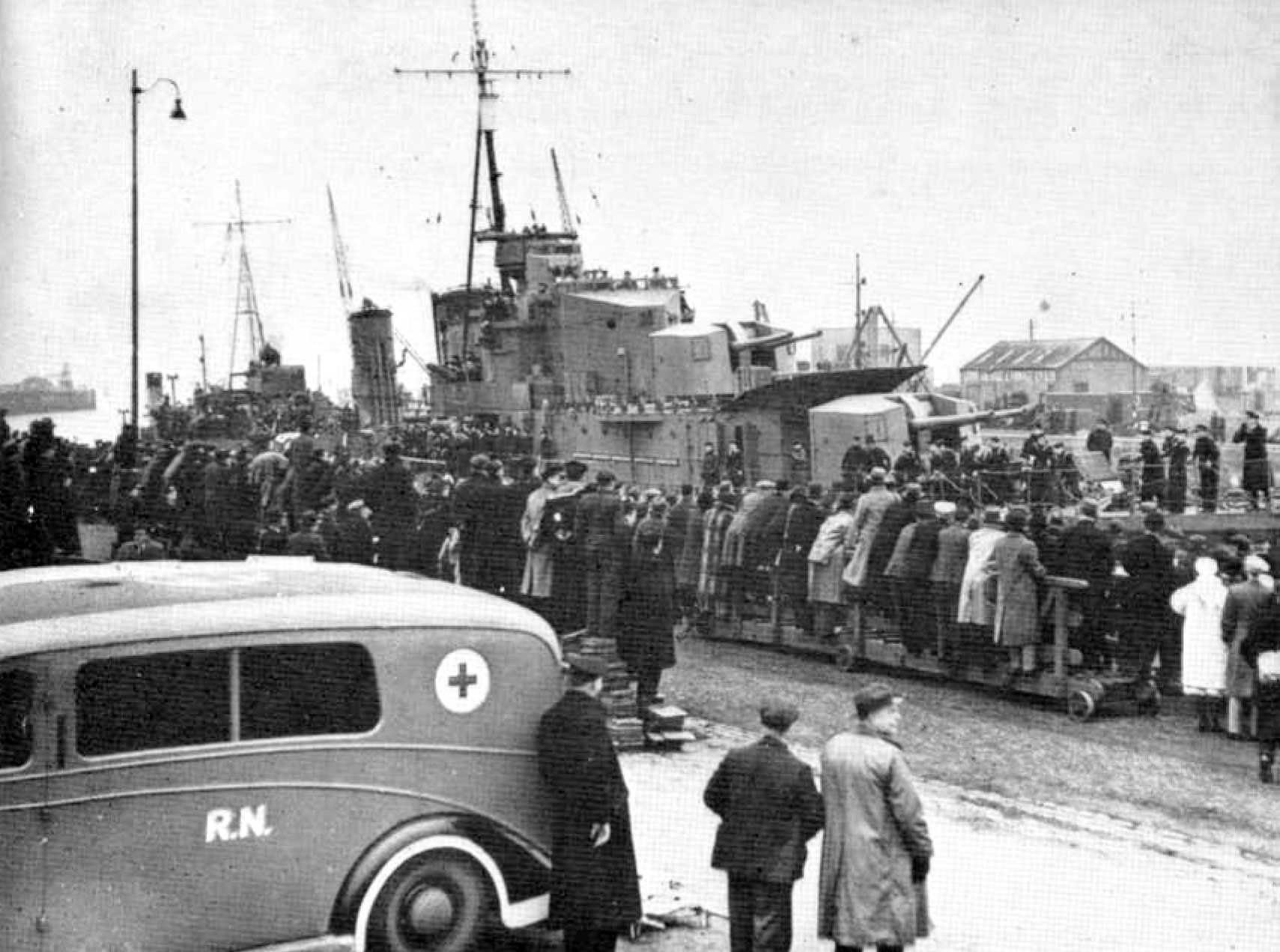
In total, 299 merchant seamen were brought out of Altmark's holds — men representing the crews of at least six different ships, ranging from young ordinary seamen to experienced officers and engineers in their fifties and sixties. Cossack turned for Scotland immediately, arriving at Leith on 17 February 1940 to scenes of extraordinary public jubilation. The rescued men were greeted on the dockside as heroes, and news of the rescue spread across Britain within hours.
Churchill, Diplomacy, and the Norwegian Fallout
Norway's government lodged a formal diplomatic protest almost immediately, arguing that Britain had violated its territorial waters and attacked a vessel under Norwegian protection. Churchill and the War Cabinet rejected the complaint entirely. Their legal argument rested on the claim that Altmark was not a civilian vessel but an auxiliary warship — she had served Graf Spee as a naval support ship — and was therefore not entitled to neutral protection. The argument was contested, but it was workable, and Britain pressed it without apology.
The incident exposed Norway's impossible position in stark terms. Unable or unwilling to resist German vessels using its waters as a corridor — and now shown to have accepted Captain Dau's lies at face value — Norway had effectively become, in British eyes, a passive enabler of German operations. It was a humiliating moment for Oslo, and it placed Churchill in the unusual position of being both the aggressor and the moral victor simultaneously.
In Berlin, Hitler was furious. The Altmark incident accelerated his decision to approve Operation Weserübung — the German invasion of Norway and Denmark. That invasion was launched just 53 days later, on 9 April 1940, transforming the strategic landscape of the entire war. Historians including Correlli Barnett have argued persuasively that Vian's raid in Jøssingfjord was one of the direct triggers for the Norwegian campaign, making it one of the most consequential small-unit actions of the entire conflict.
The Men Behind the Mission: Vian, Turner, and the Cossack's Crew
Captain Philip Vian was awarded the Distinguished Service Order for the Jøssingfjord operation. He went on to one of the most distinguished careers in the Royal Navy, eventually commanding the naval forces covering the Normandy landings in June 1944, and rising to Admiral of the Fleet. Lieutenant Bradwell Turner received the Distinguished Service Cross for leading the boarding party; several ratings were awarded the Distinguished Service Medal.
There was particular resonance in the composition of Cossack's crew. Many of her sailors were peacetime merchant seamen serving as naval reservists — the same world as the men they had just freed. They knew exactly what those locked holds meant.
HMS Cossack herself did not survive the war. On 23 October 1941, she was torpedoed by the German submarine U-563 west of Gibraltar. Taken under tow, she sank four days later on 27 October 1941, with the loss of 159 men — more than half her complement. Captain Dau of the Altmark, by contrast, was repatriated to Germany and faced no serious consequences for his deceptions. He remained a figure of controversy in post-war German naval histories.
Legacy: Why the Altmark Incident Still Matters
"The Navy's here" became one of the most powerful propaganda phrases of the entire Second World War. In the months that followed — with Dunkirk, the fall of France, and the Blitz still to come — the memory of that shout in a Norwegian fjord was invoked again and again as evidence that Britain was still fighting, still capable of bold action.
In international law, the incident remains a live case study. The legality of boarding a neutral vessel in neutral waters — even one engaged in what Britain argued was an unneutral act — is still examined in maritime law courses and academic journals today. It sits at a permanent intersection of military necessity, diplomatic pragmatism, and legal ambiguity.
For the rescued men themselves, the return to Leith was not an ending but a pause. Many went back to sea almost immediately, rejoining the merchant fleet that was already absorbing catastrophic losses on the Atlantic convoys. They had survived the Altmark; the war had years left to run.
At Jøssingfjord today, a commemorative plaque marks the spot where Cossack's boarding party crossed onto Altmark's deck. The local community embraced the event so completely that the word jøssing — derived from the fjord's name — became Norwegian slang during the German occupation for a patriot or Allied sympathiser. In a country that would spend five years under Nazi rule, the memory of the night the Navy came carried its own quiet defiance.
If you found this story as gripping as we do, share it with a fellow history enthusiast — and let us know in the comments: had you heard the phrase "The Navy's here" before, and did you know the story behind it?
Further Reading
- Imperial War Museum, London — collections and research resources on Royal Navy operations 1939–1945
- The National Archives, Kew — Admiralty and War Cabinet papers covering the Altmark incident and Norwegian operations
- National Museum of the Royal Navy, Portsmouth — records and artefacts relating to HMS Cossack and the Tribal-class destroyers
- Riksarkivet (Norwegian National Archives), Oslo — Norwegian government and naval records from the neutrality period 1939–1940
- Naval History and Heritage Command, Washington DC — research holdings on Allied naval operations and maritime law in the Second World War