The Quiz Question
The Victoria Cross, Britain's highest award for valour, was instituted by Queen Victoria in 1856 specifically to recognise gallantry in which conflict?
- A. The Indian Mutiny
- B. The Anglo Zulu War
- C. The Napoleonic Wars
- D. The Crimean War
The answer is D. The Crimean War. Here is the full story.
On 29 January 1856, Queen Victoria signed a Royal Warrant that would change British military history forever. It created a medal so plain it could be mistaken for a church ornament — a simple bronze Maltese cross, barely an inch and a half wide. Yet that plainness was the point. The Victoria Cross was designed to say one thing and one thing only: this person did something extraordinary in the face of the enemy. No rank. No wealth. No connections. Just courage.
A Medal Born in the Mud of Crimea
Before 1856, Britain had no single gallantry medal that recognised outstanding bravery across all ranks. Officers could receive campaign medals and honours through the existing system. But ordinary infantrymen and sailors — the men doing the most dangerous work — had almost nothing to show for acts of breathtaking heroism. The Crimean War made that gap impossible to ignore.
The Victoria Cross was officially instituted by Royal Warrant on 29 January 1856, with its founding motto cast directly into every medal: For Valour. Three words. The first 62 VCs were awarded retrospectively to men who had fought in Crimea, backdated to 1854, acknowledging that the courage being honoured had already been spent before the medal even existed.
The simplicity of the design was deliberate. Queen Victoria herself insisted that valour — not wealth, not rank, not family connections — would be the only qualification. A Victoria Cross earned by a private soldier and one earned by a colonel would look identical. That was the point.
Britain Goes to War: The Crimean Conflict Explained
The Crimean War (1853–1856) pitched Britain, France, and the Ottoman Empire against an expansionist Russia, fought primarily on the Crimean Peninsula in what is today Ukraine. The conflict erupted over Russian pressure on Ottoman territories and a dispute over control of Christian holy sites in Jerusalem — a combination of imperial ambition and religious politics that drew the European powers into a bloody confrontation.
British forces landed at Calamita Bay on 14 September 1854, beginning a campaign that would be defined as much by mismanagement as by heroism. The siege of Sevastopol lasted 349 days — close-quarters fighting in freezing winters, with supply chains that collapsed catastrophically. An estimated 21,000 British soldiers died during the war, the majority not from Russian bullets but from cholera, dysentery, and exposure. That figure shocked a British public just beginning to receive real-time reporting from the front.
Why the Army Had No Medal for Bravery
In the early 19th century, British gallantry awards were largely the preserve of officers. Enlisted men could receive the Meritorious Service Medal, but it was not specifically a bravery award. The structural assumption was that officers led and were therefore recognised; other ranks fought and were expected to get on with it.
The Crimean War cracked that assumption open. It was the first major British conflict covered extensively by war correspondents — most notably William Howard Russell of The Times, whose dispatches brought the realities of frontline life directly into British homes. Roger Fenton's photographs — among the earliest war photographs ever taken — added a visual dimension that made the suffering of ordinary soldiers impossible to abstract away.
Public outrage at conditions in Crimea, combined with genuine admiration for the courage of ordinary fighting men, created political pressure on the government and on the Queen personally. Prince Albert is widely credited as a driving force behind the design and founding principles of the VC, pushing hard for the medal to be open to all ranks equally. For Victorian Britain, that was a genuinely radical idea.
Queen Victoria and the Making of the Medal
Victoria's engagement with her Crimean soldiers was not purely ceremonial. She visited wounded men at Chatham in March 1855 and maintained a correspondence with Florence Nightingale. Her concern was personal and sustained.
The Royal Warrant of 29 January 1856 set out strict criteria: the act must be performed "in the presence of the enemy" and must display the most conspicuous bravery or some daring or pre-eminent act of valour or self-sacrifice. Early debate within government circles focused on whether the VC should be limited to officers. Victoria firmly opposed any such restriction, insisting it extend equally to sailors of the Royal Navy and to men of all ranks in the Army.
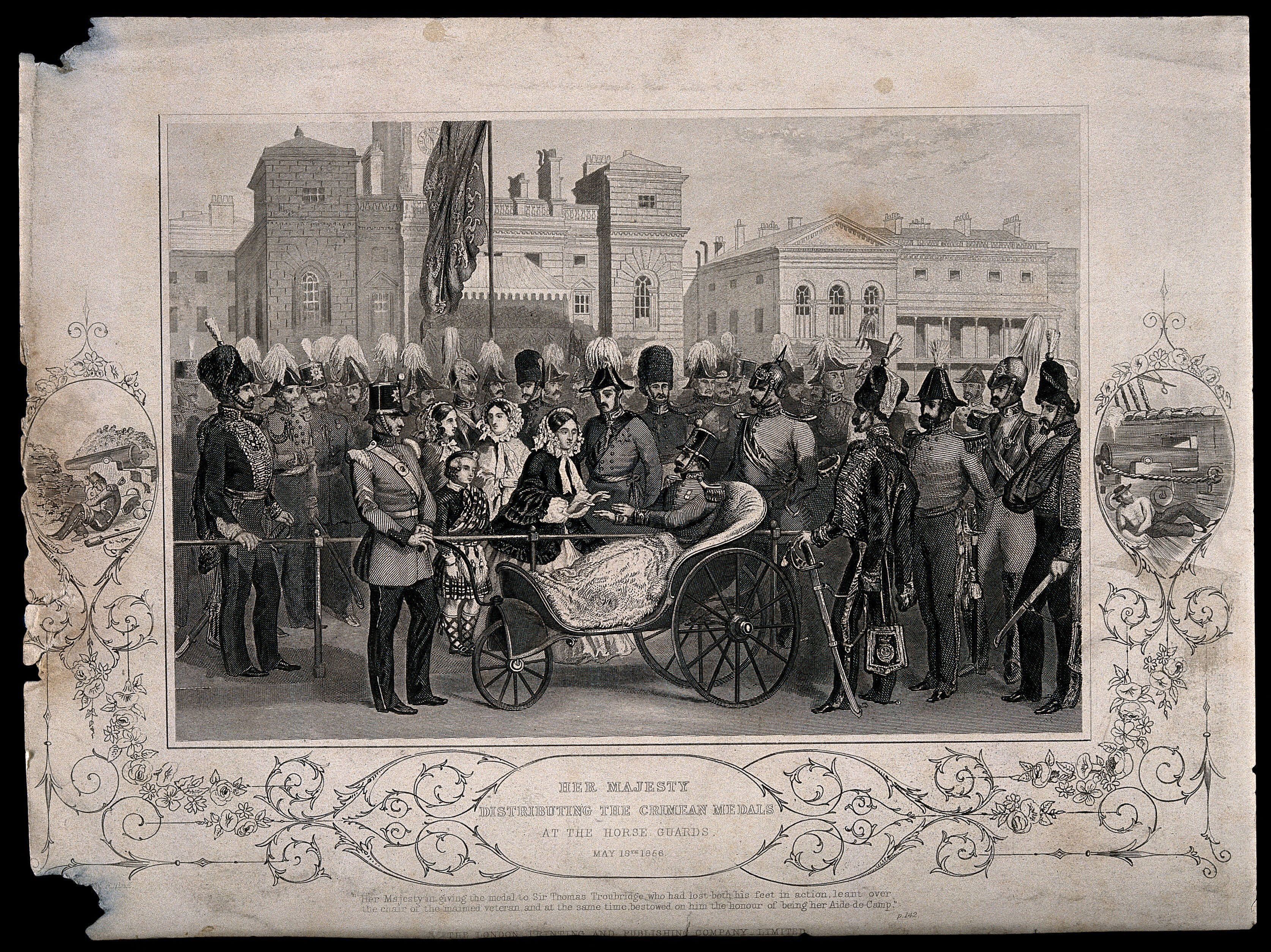
The bronze used to cast the original VCs is traditionally said to have come from Russian cannon captured at the siege of Sevastopol — a piece of symbolism so perfect it became part of the medal's mythology. Historians have debated exactly which guns were melted down, but the tradition has been maintained to this day. On 26 June 1857, Queen Victoria personally pinned the VC onto 62 recipients in Hyde Park before enormous crowds, in a ceremony that announced to the nation that its fighting men would not be forgotten.
The First Heroes: Crimea's Victoria Cross Recipients
Midshipman Charles Lucas of the Royal Navy performed the first act that would be recognised by the VC on 21 June 1854 — before the medal even existed. During the bombardment of Bomarsund, a live enemy shell landed on the deck of HMS Hecla with its fuse still burning. Lucas picked it up and threw it overboard. The shell exploded in the water. His crew survived. He was 20 years old.
On land, the Battle of the Alma on 20 September 1854 — one of the war's first major engagements — produced multiple early recipients. The assault on the Redan on 8 September 1855, one of the most heavily defended Russian positions outside Sevastopol, saw further VCs awarded, including to Lieutenant Colonel Henry Lysons.
Of the 111 VCs ultimately awarded for the Crimean campaign, recipients ranged from teenage midshipmen to seasoned infantry sergeants. The spread fulfilled exactly what Victoria had intended: a classless honour, given on merit alone.
The Charge of the Light Brigade and the Fog of Gallantry
No single event of the Crimean War captured public imagination more completely than the Charge of the Light Brigade on 25 October 1854 at Balaclava. Some 673 men rode into the Valley of Death under withering fire from three sides. In under 20 minutes, 278 were killed or wounded and hundreds of horses were lost — the result of a catastrophically miscommunicated order that sent cavalry charging directly at Russian artillery.
Lord Cardigan, commanding the charge, emerged unscathed and returned to his private yacht anchored in Balaclava harbour that evening. The contrast with the suffering of his men intensified public sympathy for ordinary soldiers — and reinforced the argument for a medal that recognised their courage rather than their commanders' comfort.
Private Samuel Parkes of the 4th Light Dragoons earned the VC at Balaclava for saving the life of Trumpet-Major Crawford under direct enemy fire during the chaotic retreat. Acts like his — selfless, instinctive, performed in the middle of disaster — were precisely what the VC was designed to capture.
The same battle produced the equally heroic but less celebrated stand of the 93rd Highlanders under Sir Colin Campbell — the famous Thin Red Line — who held their ground against Russian cavalry without forming the traditional defensive square, relying on disciplined volley fire. Tennyson immortalised the Light Brigade. History has been slower to celebrate the Highlanders who held when everything around them was breaking.
Aftermath: Peace, Pride, and a Changed British Army
The Treaty of Paris, signed on 30 March 1856, ended the Crimean War just weeks after the Victoria Cross was instituted. The founding of the medal and the end of the conflict it was designed to honour were almost simultaneous — a closing bracket on a war that had changed Britain's relationship with its own Army.
The war's mismanagement had consequences beyond medals. The Cardwell Reforms of the 1870s overhauled the regimental system, abolished the purchase of commissions, and modernised supply and logistics. Florence Nightingale's transformation of nursing standards at Scutari — which reduced mortality rates in military hospitals dramatically — was as direct a legacy of Crimea as the VC itself. Both represent the same underlying shift: Britain being forced, publicly and painfully, to value the lives of ordinary soldiers.
The Crimean War is widely regarded by historians as the first true media war. Russell's dispatches and Fenton's photographs created an emotional connection between the British public and frontline soldiers that had never existed at such scale before. The Victoria Cross was, in part, the government's response to that connection — a public promise, cast in bronze, that the nation was watching and would not forget.
The VC's Extraordinary Journey Through History
Since 1856, only 1,358 Victoria Crosses have ever been awarded — making it one of the rarest military decorations in the world. The number is kept low not by design but by the severity of the standard. Every VC represents an act so extreme that the awarding committees, across 170 years of warfare, have found reasons to say no far more often than yes.
The First World War saw 628 VCs awarded — more than in any other conflict — reflecting four years of sustained industrial-scale combat on the Western Front and beyond. The Second World War produced 182. The Falklands War of 1982 produced two. Afghanistan, across a decade of intense fighting, produced a handful. Johnson Beharry's 2005 VC for actions in Iraq — the first awarded to a living recipient since 1965 — and Mark Donaldson's 2009 VC in Afghanistan represent the medal's continuing, unbroken relevance.
Since 1920, the VC can be awarded posthumously — a change that recognised the obvious injustice of excluding the fallen. Australia, Canada, and New Zealand have since established their own Victoria Cross equivalents, modelled on the original, reflecting both the Commonwealth's military heritage and each nation's pride in its own fighting traditions.
Why the Victoria Cross Still Matters Today
The VC's founding principle — that bravery transcends rank, class, and background — was genuinely revolutionary in 1856. In a society structured around deference and hierarchy, creating a decoration that placed a private soldier and a field marshal on equal footing was not a small thing. It was a statement about what kind of courage a nation chooses to honour.
The unbroken tradition of casting each VC from the same bronze — sourced from captured Russian cannon, maintained as a living historical thread — means that every medal awarded today carries a physical connection to the guns of Sevastopol. The Imperial War Museum and the National Army Museum both hold significant VC collections, and individual medals regularly sell at auction for hundreds of thousands of pounds, reflecting a cultural significance that goes far beyond military history.
The rarity is inseparable from the power. In an era saturated with awards, certifications, and public recognition, a decoration given to just 1,358 people across 170 years of warfare commands a different kind of respect. It does not need explanation. It does not need context. The three words on the back say everything.
Queen Victoria's instinct in 1856 — to name Britain's highest honour after its own monarch, cast from an enemy's defeated guns, and award it on merit alone — created something that has outlasted every political argument of her age. That is not a small legacy for a plain bronze cross.
If the story of the Victoria Cross and the men who earned it resonates with you, we'd love to hear your thoughts in the comments below. And if you know someone who'd find this piece of history as moving as we do, please share it with them.
Further reading
- Imperial War Museum — holds one of the world's most significant collections of Victoria Cross medals and related archives
- National Army Museum, London — extensive Crimean War and VC collections, including regimental records
- The National Archives, Kew — holds original Royal Warrants, Army service records, and official Crimean War documentation
- The Victorian Web — academic resource covering Victorian military history, press coverage of the Crimean War, and the cultural history of the VC
- The Crimean War Research Society — specialist organisation dedicated to the study and preservation of Crimean War history