Frank Loesser's 1945 ballad "The Ballad of Rodger Young" painted a picture of an innocent young soldier reluctantly thrust into battle. The song became a wartime anthem, but it got the story completely wrong. Rodger Young wasn't some frightened kid—he was a 23-year-old combat veteran who fought tooth and nail just to get into the fight.
The real story is far more complex and compelling than any Hollywood songwriter could imagine.
The Song That Got It Wrong
Loesser's famous ballad described Young as reluctant and young, creating an image that stuck in America's collective memory. The lyrics spoke of a soldier who "didn't wanna go" but answered duty's call anyway. This narrative fit perfectly with wartime propaganda—the everyman hero rising to the occasion.
But Young was neither reluctant nor particularly young by infantry standards. At 23, he'd already seen enough of life to know exactly what he was choosing. He wasn't drafted into heroism; he volunteered for it, repeatedly.
Popular culture has always preferred sanitized war stories. Clean narratives sell better than messy truths, and Young's real story was decidedly messy.
Classified 4-F: The Army Didn't Want Him
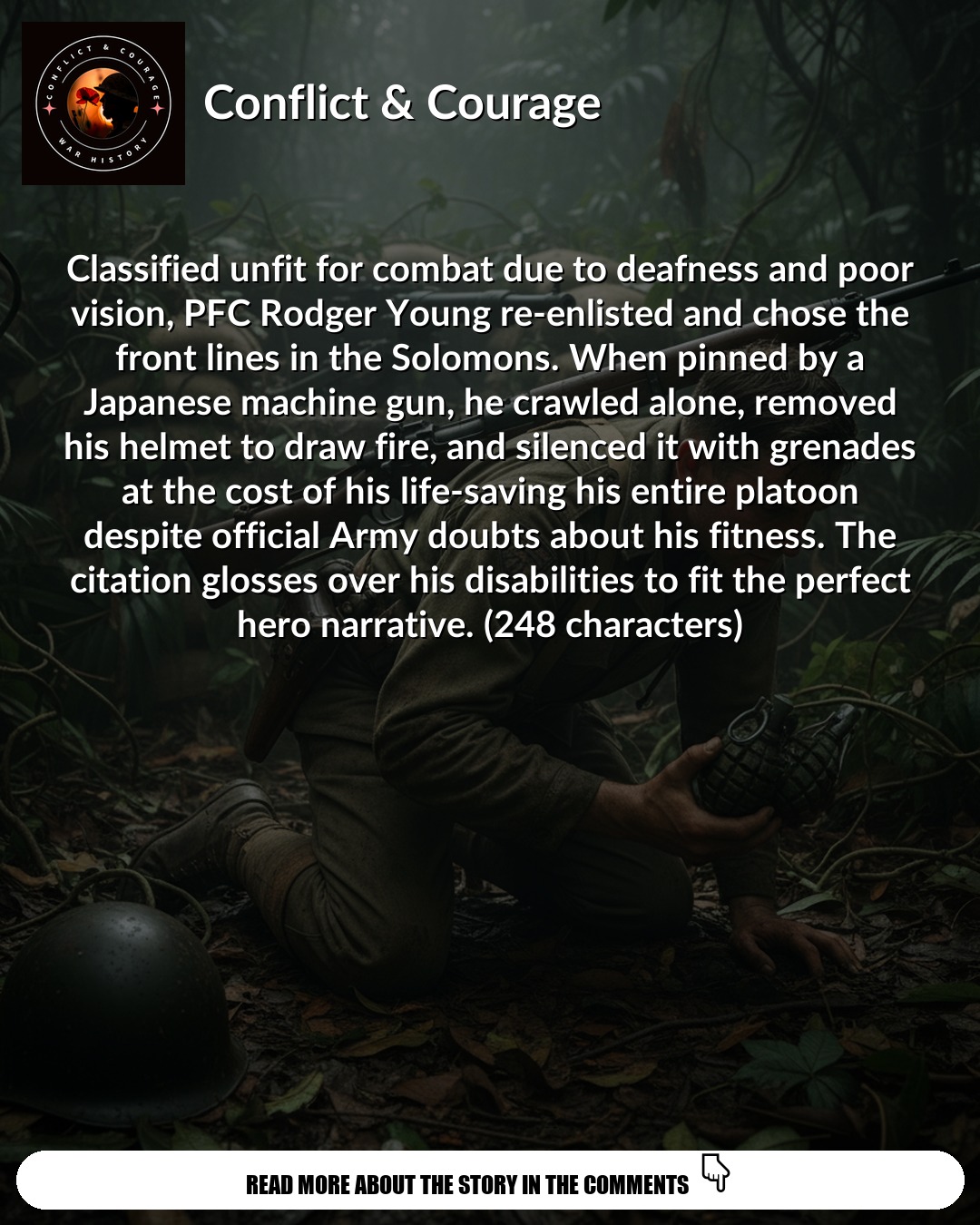
A head injury had left Young partially deaf, earning him a 4-F classification—unfit for military service. In World War II, this designation meant you were done, finished, sent home to sit out the war. Most men would have accepted this verdict gratefully.
Young wouldn't take no for an answer. He re-enlisted, somehow passing the physical examination despite his hearing loss. When offered safer rear-echelon positions, he specifically requested infantry duty.
This wasn't patriotic fervor overcoming common sense. Young understood exactly what he was choosing, and he chose it anyway. That makes his sacrifice even more remarkable than the sanitized version suggests.
Solomon Islands: Hell in the Pacific
The Solomon Islands campaign was a grinding nightmare of jungle warfare. Dense vegetation turned every engagement into close-quarters combat, where a machine gun nest could pin down entire platoons indefinitely.
Japanese defenders had perfected the art of camouflaged positions, creating interlocking fields of fire that turned advances into suicide missions. Radio communications failed regularly in the humid, dense canopy.
Infantry units suffered psychological casualties almost as heavily as physical ones. The constant threat, combined with the oppressive environment, broke men who'd seemed unbreakable. In this hellscape, Young's unit found itself trapped by enemy fire on New Georgia Island in July 1943.
The Final Assault: A Deaf Hero's Last Stand
When the machine gun nest opened fire, Young's platoon hit the dirt and stayed there. Standard procedure called for coordinated suppression and flanking maneuvers, but the terrain made such tactics impossible.
Young removed his helmet—making himself an easier target to draw fire away from his squadmates—and began crawling forward alone. He lobbed grenades steadily, methodically working closer to the Japanese position.
His sergeant screamed orders to fall back, but Young's partial deafness meant he couldn't hear the command. Or perhaps he chose not to hear it. Either way, he continued his solo assault until a fatal bullet found its mark.
His final grenade silenced the machine gun nest, allowing his platoon to advance and secure their objective.
What the Medal of Honor Citation Didn't Say
Young's official Medal of Honor citation praised his "conspicuous gallantry and intrepidity" but omitted crucial details. There's no mention of his 4-F classification, his hearing loss, or the fact that he'd been deemed unfit for service.
Eyewitness accounts tell a more complete story, describing a man who'd already proven his determination by fighting his way into combat. The Army's version focused on the heroic action while carefully editing out anything that might complicate the narrative.
This sanitization served multiple purposes, protecting both Young's heroic image and the military's screening procedures. But it also robbed his story of its most inspiring elements—his determination to serve despite official rejection.
The Cover-Up Question: Protecting Heroes or Systems?
Why hide Young's "unfit" classification? The answer likely involves protecting military recruitment standards and maintaining public confidence in the Army's screening process. If unfit soldiers could become heroes, what did that say about the fitness requirements?
The omission also had consequences for other disabled veterans seeking to serve. Young's story could have inspired policy changes, opening doors for others who wanted to contribute despite physical limitations.
Instead, World War II propaganda machinery chose the safer narrative, one that wouldn't raise uncomfortable questions about who deserves the chance to serve. Similar tensions between authenticity and image control continue in military storytelling today, much like the complex narratives we see in stories of other heroes such as Lt. John Bobo.
Remembering the Real Rodger Young
The authentic Rodger Young story is more powerful than any sanitized version. Here was a man who refused to let bureaucracy or physical limitations keep him from serving his country and his fellow soldiers.
His deafness, rather than being a liability, may have been his secret weapon—allowing him to ignore retreat orders and complete his mission. His "unfitness" became the foundation of extraordinary fitness for purpose.
Young's legacy deserves the complete truth, not the comfortable myth. Real heroes are always more inspiring than perfect ones, and his determination to fight despite official rejection speaks to something fundamental about courage and character.
What do you think about the Army's decision to sanitize Young's story? Should military heroes' complete stories be told, even when they complicate official narratives? Share your thoughts below—these conversations help ensure that authentic stories of courage like Young's aren't forgotten or oversimplified.