The Quiz Question
Which decorated British officer and war poet, having already been awarded the Military Cross, threw its ribbon into the River Mersey and issued a public 'Soldier's Declaration' in 1917 condemning the war's prolongation?
- A. Rupert Brooke
- B. Siegfried Sassoon
- C. Wilfred Owen
- D. Robert Graves
The answer is B. Siegfried Sassoon. Here is the full story.
The Officer Who Dared to Say 'Enough'
In June 1917, at the bloodiest midpoint of the Great War, a decorated British officer did something almost unthinkable: he publicly declared the war a deliberate prolongation of suffering — and put his name to it. Siegfried Sassoon was no pacifist coward hiding from the trenches. He had already earned the Military Cross for gallantry on the Western Front and was nicknamed 'Mad Jack' by his men for reckless, almost suicidal bravery.
His protest came not from fear but from fury — a deep moral revulsion at what he saw as politicians and generals sacrificing ordinary soldiers for nothing. The story involves a famous river, a discarded medal ribbon, a landmark letter read aloud in Parliament, and a friendship with a young poet named Wilfred Owen that would change English literature forever. Understanding Sassoon's stand helps us grasp the enormous tension between duty, conscience, and dissent in wartime Britain — a tension that never fully goes away.
Who Was Siegfried Sassoon? The Man Behind the Medal
Born on 8 September 1886 in Matfield, Kent, Sassoon came from a wealthy Anglo-Jewish banking family on his father's side and a genteel English artistic family on his mother's. Before the war he was a fox-hunting, cricket-playing country gentleman with a passion for verse — hardly the profile of a future anti-war icon.
He enlisted in the Sussex Yeomanry on 1 August 1914, the day before Britain formally declared war, and later transferred to the 1st Battalion Royal Welch Fusiliers. His early war poetry was conventionally patriotic. But the death of his close friend Lieutenant David Thomas in March 1916 began a bitter transformation. By 1916, Sassoon was writing savage, ironic poems skewering generals and home-front cheerleaders — a sharp contrast to the heroic verse expected of an officer and gentleman.
'Mad Jack' at the Front: Courage Under Fire
Sassoon earned the Military Cross in June 1916 for bringing back a wounded lance-corporal under heavy fire near Mametz on the Somme. He then became famous among fellow officers for staging solo grenade raids into German trenches — acts so reckless they bordered on a death wish, fuelled by grief over David Thomas.
In April 1917 at the Battle of Arras, he single-handedly captured a section of German trench, then reportedly sat reading poetry while under fire — earning a recommendation for the Victoria Cross that was ultimately not awarded. His commanding officers repeatedly noted his extraordinary courage. It was precisely this record that gave his 1917 declaration its explosive power. Nobody could call 'Mad Jack' Sassoon a shirker.
The Making of a Protest: Sassoon's Crisis of Conscience, 1917
Returning to England in April 1917 on sick leave with a shoulder wound, Sassoon came under the influence of the philosopher Bertrand Russell and the Cambridge-based pacifist network gathering around him. His close friend and literary mentor Robert Graves, already alarmed by Sassoon's increasingly radical thinking, tried desperately to talk him out of making a public statement.
Sassoon's anti-war circle also included Lady Ottoline Morrell of Garsington Manor, a well-known pacifist salon hostess who encouraged his convictions through the spring of 1917. The catastrophic failure of the Nivelle Offensive in April–May 1917 and the subsequent French Army mutinies — in which as many as 54 divisions were affected — hardened his conviction that continuing the war was not strategy but criminal negligence. By June 1917 he had drafted a formal written statement: polished, deliberate, and fully expecting it to result in a court martial.
The Declaration Itself: What Sassoon Actually Said
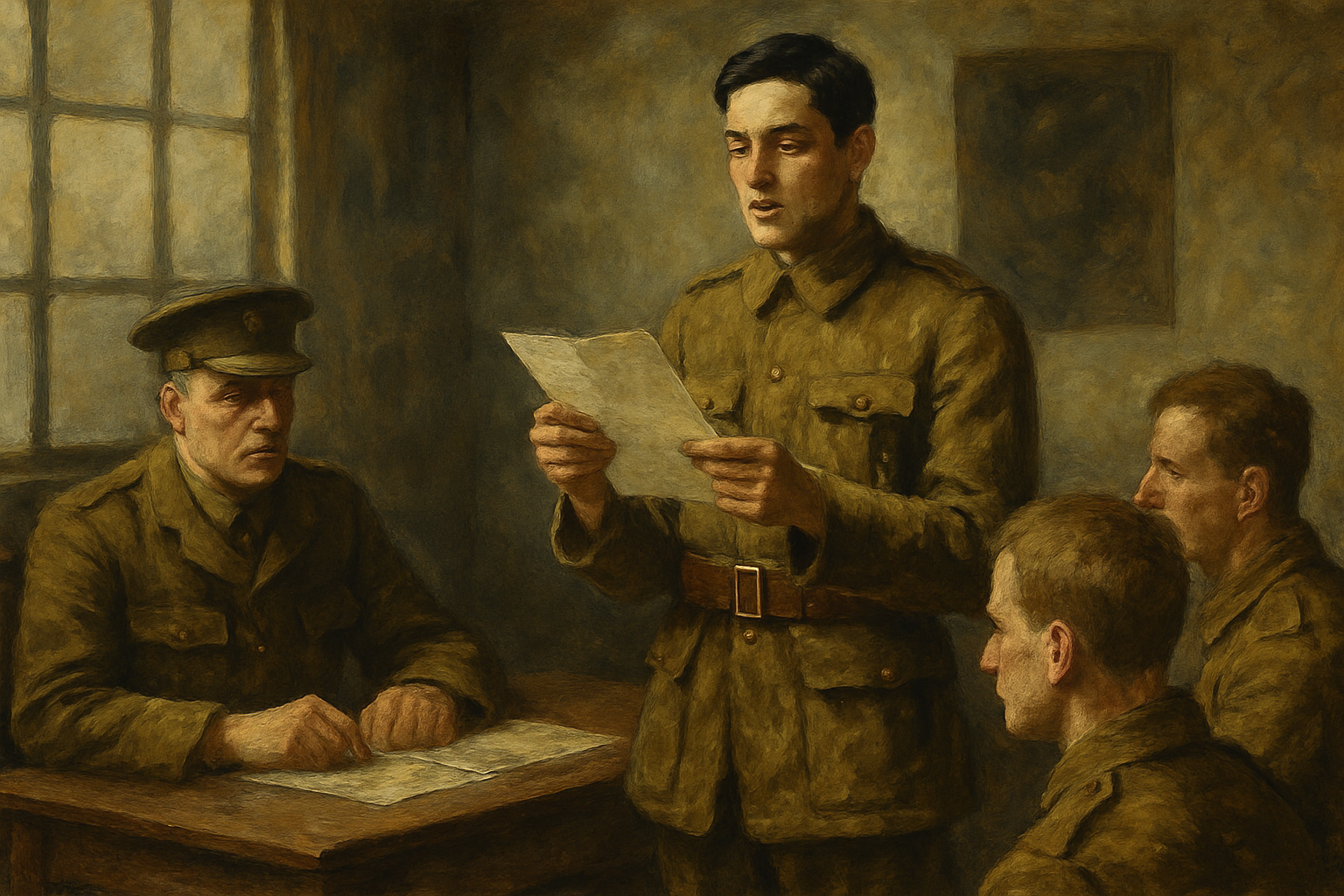
Titled Finished with the War: A Soldier's Declaration, the statement was dated June 1917. Sassoon sent it to his commanding officer, distributed it to the press, and it was read aloud in Parliament by Liberal MP Hastings Lees-Smith on 30 July 1917.
Its central charge was unambiguous: 'I am making this statement as an act of wilful defiance of military authority, because I believe the war is being deliberately prolonged by those who have the power to end it.' He accused the war's political and military leadership of refusing a negotiated peace and thereby inflicting unnecessary suffering on fighting men. Crucially, he drew a sharp distinction between the soldiers he honoured and the decision-makers he condemned — reflecting his genuine, deep affection for the men under his command.
As a symbolic act of rejection, he threw his Military Cross ribbon into the River Mersey from the Liverpool Pierhead. It is worth noting that it was the ribbon, not the medal itself — in the field, officers wore ribbons as a practical stand-in for their actual decorations. The gesture was nonetheless unmistakable in its meaning.
The Establishment's Response: Court Martial or Craiglockhart?
The War Office faced an uncomfortable dilemma. Court-martialling Sassoon would create a public martyr and hand the anti-war movement a celebrated platform. It would also mean putting a genuinely decorated war hero — a man recommended for the Victoria Cross — in the dock before the press and public.
Robert Graves intervened directly with the military authorities. He argued — by his own later admission, with some dishonesty — that Sassoon was suffering from shell shock and could not be held fully responsible for his actions. A Medical Board at Chester in July 1917 concluded that Sassoon was suffering from neurasthenia, the period's clinical term for shell shock, and ordered him to Craiglockhart War Hospital near Edinburgh rather than to prison.
Craiglockhart had opened in 1916 specifically to treat officer shell shock cases, and it was run by the progressive Dr William Rivers, a Cambridge anthropologist turned military psychiatrist. Rivers became one of the most important relationships of Sassoon's life. The army's decision to medicalise rather than punish Sassoon was a calculated move: it quietly implied he was mentally unwell rather than morally courageous, effectively neutralising the public impact of his protest.
Craiglockhart and the Meeting That Changed Poetry Forever
In August 1917 at Craiglockhart, Sassoon met a young, relatively unknown officer-poet named Wilfred Owen — a meeting that would reshape 20th-century literature. Owen, who edited the hospital's in-house magazine The Hydra, approached Sassoon nervously, clutching a copy of his recently published poetry collection The Old Huntsman.
Sassoon mentored Owen intensively over the following weeks: marking up his drafts, introducing him to London literary contacts including the editor Eddie Marsh, and pushing him toward the brutal, unflinching honesty that defines Owen's greatest work. Owen's Dulce et Decorum Est and Anthem for Doomed Youth — arguably the most famous anti-war poems in the English language — were substantially shaped during and immediately after this Craiglockhart period.
Dr Rivers, meanwhile, used talking therapy with Sassoon — a radical approach for the era, when electric shock treatment was still widely employed. Rivers encouraged Sassoon to confront his experiences rather than suppress them. Their sessions were later fictionalised with great care and imagination in Pat Barker's Booker Prize-winning Regeneration trilogy, published between 1991 and 1995, which introduced this extraordinary story to a new generation of readers.
Return to the Front: Why Sassoon Went Back
By late 1917, torn between his continuing moral convictions and an overwhelming loyalty to his men still suffering in France, Sassoon agreed to return to active duty. The decision puzzled and disappointed some of his pacifist allies, who saw it as a retreat. Sassoon himself explained it differently: he felt he had no moral right to protest from the safety of a Scottish hospital while his fellow soldiers remained in the trenches.
He served in Palestine with the 25th Royal Welch Fusiliers in early 1918 before being transferred back to the Western Front in France. In July 1918, near Henin-sur-Cojeul, he was accidentally shot in the head by a British sentry — a friendly fire incident — and was invalided home, ending his active war for good.
His return to duty was not a recantation. His poetry from 1917–18 remained uncompromisingly bitter. Base Details, Does It Matter?, and Glory of Women are all savage, direct attacks on home-front complacency and the comfortable distance of those who sent men to die. The fury never left him.
Legacy: Why Sassoon's Protest Still Matters Over a Century On
Sassoon lived until 1 September 1967, dying aged 80 at Heytesbury House in Wiltshire — long enough to see his wartime stand reassessed, from an embarrassing scandal to a recognised moral landmark. He converted to Catholicism in 1957 and spent much of his later life in relative seclusion, but his literary reputation grew steadily throughout.
His Soldier's Declaration is now studied as a pivotal document of wartime dissent — one of the first occasions a serving, decorated officer publicly challenged a government's war policy in writing and refused to be silenced. His fictionalised memoir trilogy — Memoirs of a Fox-Hunting Man (1928), Memoirs of an Infantry Officer (1930), and Sherston's Progress (1936) — are regarded as classics of First World War literature, praised for their clear-eyed honesty and elegiac quality.
The Craiglockhart building still stands in Edinburgh, now part of Edinburgh Napier University. A permanent exhibition dedicated to Wilfred Owen and Siegfried Sassoon is maintained on site, drawing visitors from around the world who come to stand in the corridors where those two remarkable men walked in the autumn of 1917.
Sassoon's protest prefigured later acts of conscientious military dissent across the 20th century and beyond. It reminds us that genuine courage sometimes demands standing up to your own side — that loyalty to the men beside you can, at its most honest, mean refusing to accept the terms under which they are being sacrificed. That truth resonates as powerfully today as it did in the summer of 1917.
If Sassoon's story moves you — or if you have a family connection to the Royal Welch Fusiliers, Craiglockhart, or the poetry of the Great War — we'd love to hear from you in the comments below. Share this article with anyone who believes that moral courage deserves to be remembered alongside battlefield bravery.
Further Reading
- Imperial War Museum, London — holds extensive Sassoon collections including manuscripts, photographs, and personal papers
- The National Archives, Kew — military service records and War Office correspondence relating to the 1917 Medical Board proceedings
- Edinburgh Napier University (Craiglockhart Campus) — home of the permanent Wilfred Owen and Siegfried Sassoon at Craiglockhart exhibition
- The British Library, London — holds first editions and archival literary material relating to Sassoon and his contemporaries
- The Poetry Foundation — biographical and critical resources covering Sassoon's complete published work and his place in the canon of First World War poetry