The Quiz Question
In the week around Christmas 1914, British and German soldiers on the Western Front climbed out of their trenches to exchange gifts, sing carols and reportedly play an impromptu game in no man's land. What was that game?
- A. Cricket
- B. Football
- C. Rugby
- D. Cards
The answer is B. Football. Here is the full story.
On the night of 24 December 1914, something happened on the Western Front that no general had ordered and no government would sanction. Along miles of frozen, waterlogged trench, men who had been trying to kill each other for months put down their rifles, lit candles, and sang. Within hours, they would be shaking hands in the mud between the lines. Within days, some of them would be playing football.
A Silent Night on the Western Front
By Christmas Eve 1914, the Western Front had stretched into a continuous line of trenches running more than 400 miles — from the Belgian coast near Nieuport all the way south to the Swiss border. It was a landscape of shattered trees, rusted wire, and frozen mud that swallowed men whole.
British and German soldiers had been fighting since August 1914, many of them volunteers who had enlisted expecting a quick, decisive war. Instead, they found themselves standing in waterlogged trenches just 50 to 100 yards apart as the temperatures in Flanders dropped below freezing in late December.
Then, on the evening of 24 December, something changed. German troops along multiple sectors began placing candles and small Christmas trees — Tannenbaum — along their parapet walls. The flickering light was visible across no man's land. British soldiers in their opposing trenches heard it before they fully understood it: the sound of Stille Nacht — Silent Night — drifting across the frozen ground. Men on both sides stopped what they were doing and simply listened.
How the Truce Began: No Orders, No Permission
The Christmas Truce was entirely unofficial. No commander on either side ordered it. No government permitted it. Pope Benedict XV had appealed for a formal Christmas ceasefire in December 1914, but every government involved flatly refused. What happened instead came from the soldiers themselves.
The truce began piecemeal. In some sectors it started on Christmas Eve; in others, Christmas Day itself. It spread through cautious gestures — a shouted greeting, a sign held above the parapet, a pause in firing that the other side chose to match rather than exploit.
German soldiers, many of whom had lived or worked in Britain before the war, sometimes called out in English, which helped break the ice quickly in several sectors. The language was familiar. So was the cold, the hunger, and the exhaustion. The shared misery of the trenches turned out to be a more powerful bond than either side's high command would have wished.
Climbing Out of the Trenches: The First Handshakes
On Christmas morning, 25 December 1914, German soldiers near Ypres in Belgium began climbing out of their trenches, waving and calling across to British lines. It was an act of extraordinary trust — any one of those men could have been shot.
British troops of the Royal Welch Fusiliers, the Scots Guards, and the London Rifle Brigade were among the first to venture into no man's land to meet them. What followed was a scene almost impossible to imagine against the backdrop of industrial slaughter: men exchanging cigarettes, buttons, badges, and food. German soldiers offered sausages and black bread; British troops produced corned beef and plum pudding.
In the sector near Plugstreet Wood — Ploegsteert, in Flemish — soldiers of both sides gathered together to bury the dead who had lain unrecovered in no man's land for weeks. Lieutenant Johannes Niemann of the 133rd Royal Saxon Regiment later recalled shaking hands with a Scottish officer and sharing a flask of whisky in the frost. It was, he wrote, a moment of almost dreamlike unreality.
The Football Match: Boots, Helmets, and a Makeshift Ball
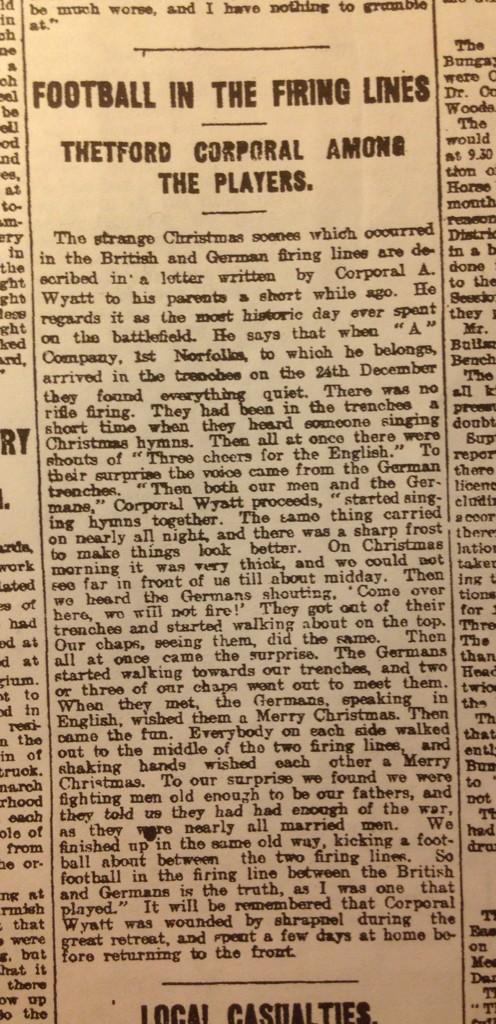
Multiple eyewitness accounts and soldiers' letters describe impromptu football matches taking place in no man's land on 25 and 26 December 1914. This was not an organised fixture — it was something far more spontaneous and, because of that, far more remarkable.
Soldiers of the Norfolk Regiment and the Cheshire Regiment left detailed accounts of kicking a ball between the two sides, though in many cases the "ball" was a ration tin or a bundled sandbag. Private Albert Moren of the 2nd Queens Regiment wrote home describing what he called "a regular football match," admitting that the pitch was shell-cratered and the goalposts were caps and helmets pushed into the ground.
The most frequently cited match occurred near Ploegsteert, where British and German soldiers played an informal game that ended, according to several accounts, in a 3–2 German victory. Historian Malcolm Brown, co-author of Christmas Truce (1994), cross-referenced dozens of soldiers' letters and confirmed that football was played in multiple sectors, though exact scorelines and details varied considerably from one account to another.
What is beyond doubt is the spirit of it. These were men who, days earlier, had been under orders to kill each other. Now they were arguing cheerfully about offside decisions in the mud of Flanders.
The Men Behind the Moment: Soldiers Who Left the Record
The Christmas Truce survives in history because the men who lived it wrote about it — urgently, in letters home that they somehow knew were recording something that needed to be remembered.
Captain Sir Edward Hulse of the Scots Guards wrote a 4,000-word letter to his mother on 28 December 1914, detailing the truce, the singing, the handshakes, and the football. It remains one of the most complete firsthand accounts in existence, held today at the Imperial War Museum in London. Hulse did not survive the war — he was killed at Neuve Chapelle in March 1915, making his Christmas letter a poignant and final testament.
Private Henry Williamson, who would later become famous as the author of Tarka the Otter, served on the Western Front in 1914 and witnessed the truce firsthand. He wrote about it throughout his long life, describing the experience as one that never left him.
On the German side, Lieutenant Kurt Zehmisch of the 134th Saxons kept a diary recording the football game and describing the British soldiers he had met as "friendly and decent fellows." His diary, like dozens of similar accounts from both sides, helps confirm that the truce was not a localised rumour but a widespread, documented reality.
How Wide Did the Truce Spread — And Where Did It Not?
Estimates suggest the Christmas Truce involved up to 100,000 British and German soldiers across dozens of sectors of the front. But it was far from universal. In sectors held by French and Belgian forces, the truce was far less common. French troops, fighting on their own occupied soil, were generally far less willing to fraternise with an enemy that had invaded and was occupying their country.
Some British commanders actively prohibited any contact. General Horace Smith-Dorrien issued explicit orders against fraternisation, and at least one British officer threatened his men with courts-martial for crossing into no man's land.
In areas where fighting had been particularly savage — around Arras, for example — no truce occurred at all. Christmas Day 1914 passed there with continued shelling and casualties. The truce lasted anywhere from a few hours to several days depending on the sector, with some areas maintaining informal ceasefires well into January 1915.
The Reaction Back Home — and from High Command
When soldiers' letters describing the truce were published in British newspapers in early January 1915, the public reaction was a mixture of wonder, pride, and deep controversy. The Times and the Daily Mirror both ran photographs showing British and German troops standing together in no man's land, and the images caused a sensation across the country.
General Sir John French, Commander-in-Chief of the British Expeditionary Force, was furious. He issued a directive condemning fraternisation as damaging to military discipline and morale. The War Office moved quickly to censor future accounts and issued strict orders that any repeat of the truce in subsequent years would result in court-martial proceedings.
Kaiser Wilhelm II was reportedly equally displeased. Senior German commanders viewed the truce as a dangerous softening of fighting spirit at exactly the moment when the war was hardening into a test of national endurance. Both high commands understood, perhaps more clearly than the soldiers themselves, that a war could not be sustained if the men fighting it kept recognising each other as human beings.
Did the Christmas Truce Ever Happen Again?
In December 1915, some informal ceasefires occurred in isolated sectors, but they were far less widespread. Officers on both sides, under strict orders from above, actively suppressed any signs of fraternisation. The spirit of 1914 proved impossible to repeat.
By Christmas 1916, the war had been utterly transformed. The Somme offensive, which ran from July to November 1916, had killed and wounded over one million men on both sides. The mutual humanity that had made the 1914 truce possible had largely been consumed by grief, rage, and exhaustion. The introduction of poison gas from April 1915, mass artillery bombardment on an industrial scale, and the sheer accumulation of loss had hardened attitudes beyond the point of spontaneous goodwill.
Veterans who survived to tell the story consistently described the 1914 Christmas Truce as something uniquely possible only in the war's opening months — before the full weight of what was coming had fallen on them, and before hatred had taken the place of simple human recognition.
Why the Christmas Truce Still Matters 110 Years On
The Christmas Truce of 1914 is now remembered as one of the most extraordinary acts of shared humanity in the history of modern warfare. It is studied in schools across Britain and commemorated at memorials throughout Belgium — where the trenches once ran, and where the men once played football in the frost.
A permanent memorial at Saint-Yvon near Ploegsteert — known as the Football Memorial — was unveiled in 1999 to mark the spot where the most celebrated match reportedly took place. In December 2014, the centenary was marked jointly by the Football Association and the British and German governments with a commemorative match at the National Memorial Arboretum in Staffordshire.
Historians debate whether the truce was politically naive, historically significant, or simply an extraordinary footnote. But the letters, the diaries, the photographs, and the testimony of the men who were there leave no doubt that it happened — and that it mattered deeply to those who lived it. For one brief, improbable Christmas, ordinary men on both sides refused to be only soldiers.
The football match in no man's land was not a grand gesture. It was not planned, or filmed, or reported live. It was just men, a makeshift ball, and a few hours of peace in the middle of a war that had no end in sight. That may be precisely why, more than a century later, it still moves us so deeply.
If this story means something to you, we'd love to hear why — leave a comment below and share this article with anyone who loves history and believes that the human stories behind the headlines are the ones worth keeping alive.
Further Reading
- Imperial War Museum, London — holds original letters, diaries, and photographs from soldiers who witnessed the Christmas Truce, including the Edward Hulse correspondence
- The National Archives, Kew — home to British Expeditionary Force war diaries and official military records from the Western Front, 1914–1918
- In Flanders Fields Museum, Ypres, Belgium — dedicated to the First World War in the Ypres Salient, with extensive material on the Christmas Truce and trench life
- The National Army Museum, London — collections covering British Army history including personal accounts and artefacts from the First World War
- Commonwealth War Graves Commission — maintains the cemeteries and records for the men of the Western Front, many of whom participated in the truce and did not survive 1915