When Americans think of naval heroics during the Barbary Wars, one name dominates: Stephen Decatur. His daring raid to burn the captured USS Philadelphia in Tripoli Harbor earned him eternal fame and the nickname "the most bold and daring act of the age." But three months before Decatur's celebrated mission, another young officer attempted an even more desperate gamble that history has largely forgotten.
Lieutenant Richard Somers volunteered for what amounted to a suicide mission, steering a powder-packed fire ship toward the heart of the Tripolitan fleet. Unlike Decatur's successful raid, Somers' mission ended in tragedy — yet his sacrifice reveals truths about courage and sacrifice that Decatur's triumph cannot.
The Shadow Before the Fame
The Barbary Wars represented America's first major overseas military engagement, pitting the young republic against the pirate states of North Africa. These corsairs had been capturing American merchant ships and enslaving their crews, demanding tribute payments that drained the national treasury.
By 1804, Commodore Edward Preble's squadron had established a blockade of Tripoli, but the war had reached a bloody stalemate. The Americans needed a decisive blow to force the Pasha to terms. That's when Lieutenant Richard Somers stepped forward with a plan that would either break the enemy's will or cost him everything.
While Decatur's February 1804 raid captured headlines and imagination, Somers' September mission represented the kind of calculated desperation that defines true naval courage. Yet because it ended in apparent failure, history relegated it to footnotes.
Lieutenant Richard Somers: The Man Behind the Mission
Richard Somers came from solid New Jersey stock, born in 1778 to a family that valued duty above comfort. Unlike many naval officers who came from wealthy merchant families, Somers worked his way up through merit and an unshakeable sense of honor.
He formed close friendships with fellow officers Stephen Decatur and Charles Stewart, bonds forged in the crucible of naval training and shared danger. These weren't just professional relationships — they were brothers-in-arms who understood that their chosen profession might demand the ultimate sacrifice.
What set Somers apart was his willingness to volunteer for missions others considered impossible. When Preble called for officers to lead desperate attacks, Somers always stepped forward. This wasn't recklessness — it was the calculated courage of a man who understood that sometimes victory requires someone willing to die for it.
The Intrepid's Deadly Cargo
The fire ship Intrepid had already served one dangerous mission, carrying Decatur to burn the Philadelphia. Now Somers would transform her into something far more deadly — a floating bomb designed to devastate the Tripolitan fleet.
Naval engineers packed her hold with 15,000 pounds of gunpowder, along with 150 fixed shells arranged to create maximum devastation. The idea was simple in concept, terrifying in execution: sail into the heart of the enemy anchorage and detonate the ship among their vessels.
Fire ships had terrorized naval forces for centuries, but they required crews willing to get close enough to enemy vessels before lighting the fuses and escaping in small boats. The margin for error was virtually nonexistent, especially in a hostile harbor bristling with shore batteries.
Into the Lion's Den: The Night of September 4, 1804
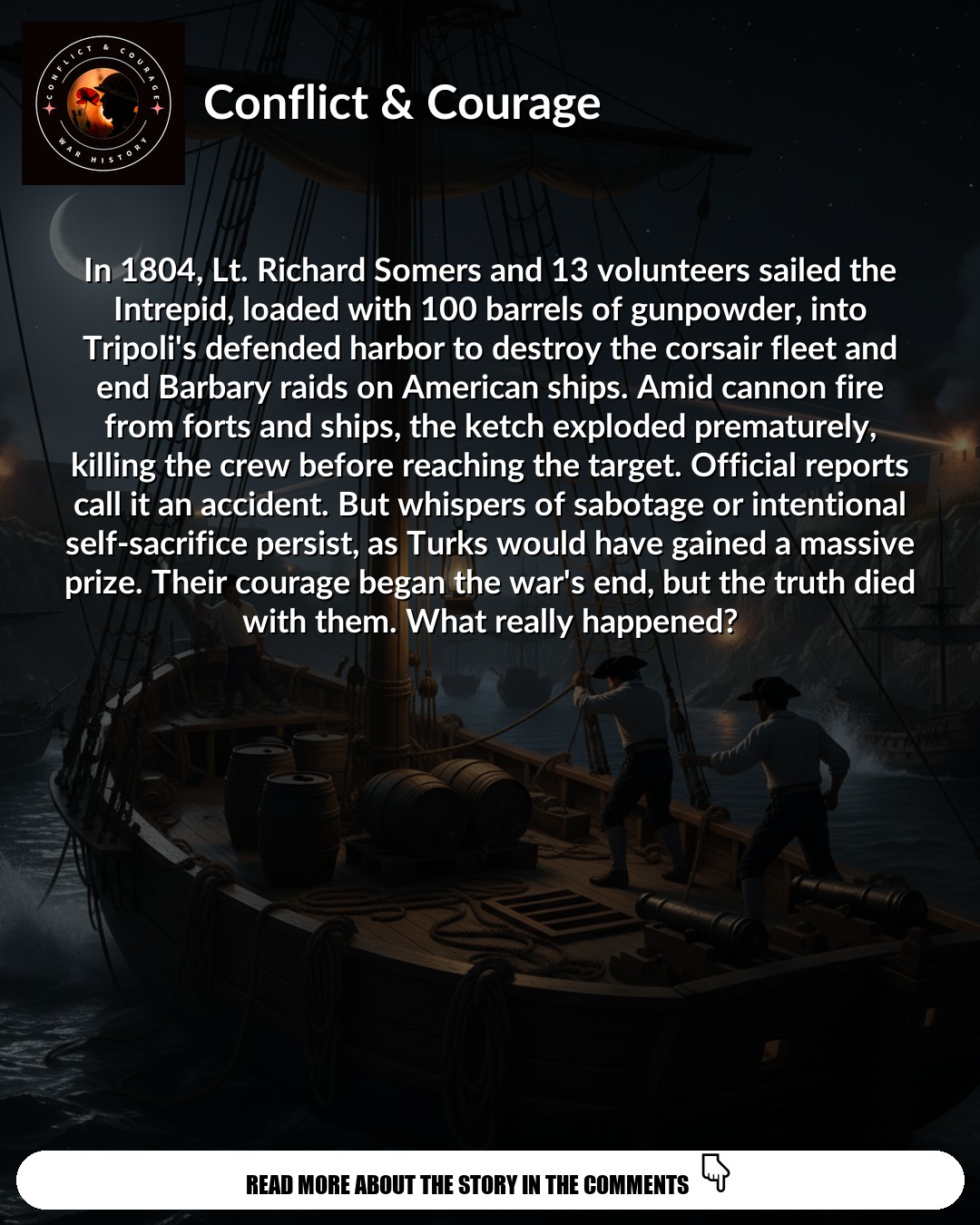
Under moonless skies, Somers and his thirteen volunteers sailed the Intrepid toward Tripoli Harbor. They knew the odds — capture would mean torture and slavery, while failure could doom the American squadron to continued stalemate.
The harbor defenses had been alerted by previous American attacks. Shore batteries scanned the darkness while armed boats patrolled the approaches. Every shadow could hide an enemy vessel, every sound might trigger a devastating barrage.
As the Intrepid approached the anchored Tripolitan fleet, Somers faced the ultimate test of naval leadership. His crew trusted him completely, following him toward almost certain death because they believed in both their cause and their commander.
The Mystery Explosion: Heroism or Treachery?
At approximately 10 PM, a massive explosion lit up Tripoli Harbor. The Intrepid had detonated prematurely, killing all fourteen Americans aboard and failing to damage the enemy fleet. But what caused the explosion remains one of naval history's enduring mysteries.
Did Somers deliberately trigger the charges when capture seemed imminent? Naval officers of the era knew that falling into Barbary hands meant torture, and denying the enemy a propaganda victory would have been consistent with his character. The explosion's timing suggests this possibility.
Alternative theories include enemy gunfire hitting the powder magazine or possible sabotage by crew members facing the reality of their situation. The naval records frustratingly provide no definitive answers, leaving Somers' final moments shrouded in uncertainty.
The Price of Being Second
History favors successful heroes over tragic ones, and Decatur's triumph inevitably overshadowed Somers' sacrifice. The Philadelphia raid became the stuff of legend, while the Intrepid mission faded into obscurity despite involving greater risk and sacrifice.
The families left behind faced years of bureaucratic battles for pensions and recognition. America's relationship with its naval martyrs has always been complicated — we honor them in speeches while sometimes forgetting them in practice.
This pattern of forgotten sacrifice echoes through military history, from unrecognized heroes of World War I to forgotten Korean War veterans who gave everything for their country.
Remembering the Forgotten: Somers' True Legacy
Richard Somers' mission helped establish a tradition of American naval courage that would inspire generations. His willingness to attempt the impossible, even knowing the likely cost, embodied the spirit that would carry the U.S. Navy through two centuries of challenges.
Several towns, including Somers Point, New Jersey, bear his name, and multiple naval vessels have honored his memory. But his true legacy lies in demonstrating that sometimes the greatest courage is found not in victory, but in the willingness to risk everything for duty.
Like other forgotten heroes throughout military history, Somers reminds us that courage under fire often goes unrecognized, but never unfelt by those who follow in their footsteps.
What do you think drove Richard Somers to volunteer for such a dangerous mission? Share your thoughts on this forgotten hero's sacrifice, and help us keep these important stories alive for future generations.