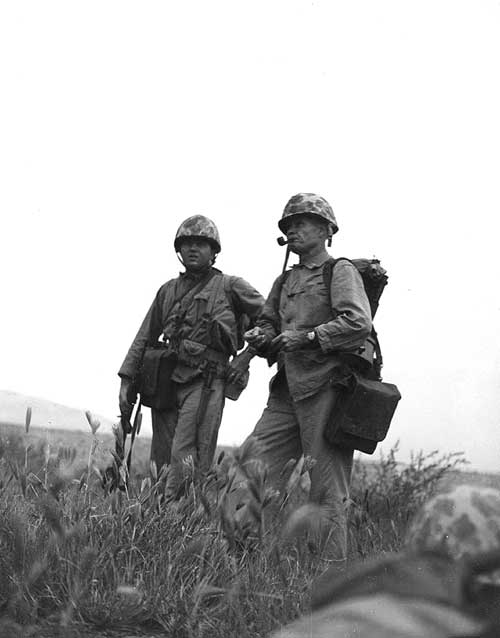
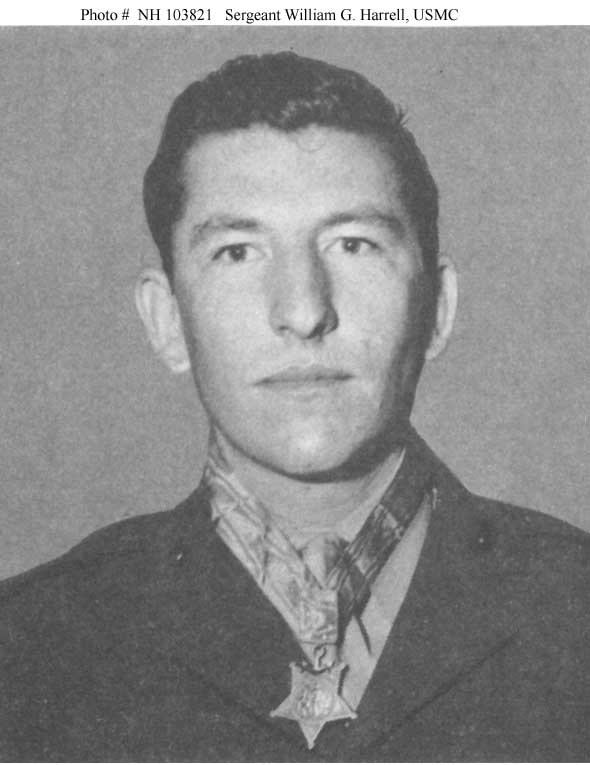
In the early hours of 3 March 1945, on the northern end of Iwo Jima, Sergeant William George Harrell of the 1st Battalion, 28th Marines fought a night-long battle from a single foxhole. By the time the sun rose he had lost both hands, and twelve Japanese soldiers lay dead around his position. His Medal of Honor citation records that at least five of them were killed by Harrell himself.
The 28th Marines After Suribachi
Harrell's regiment is best remembered for raising the flag over Mount Suribachi on 23 February 1945. But for the 28th Marines the battle was far from over. The regiment turned north into the island's volcanic ridges, where the fighting settled into a grinding pattern: advances measured in yards by day, and Japanese infiltration attacks by night.
Those night attacks were not the massed banzai charges of earlier Pacific battles. On Iwo Jima the Japanese came in small groups, quietly, probing for gaps in the Marine lines and trying to slip grenades into foxholes. Perimeter positions like Harrell's existed to stop exactly that.
The Night of 2–3 March
Harrell, a 22-year-old from Rio Grande City, Texas, was sharing a two-man foxhole guarding the approaches to his battalion's lines. In the pre-dawn darkness, Japanese troops crept up on the position and attacked with grenades and small arms.
Harrell killed the first two attackers with his rifle. Moments later a grenade exploded in the hole, severing his left hand and fracturing his thigh. His foxhole companion's weapon had been knocked out of action, and Harrell ordered him back to the lines to find another and bring help — leaving Harrell alone, one-handed, in the dark.
What followed is set out plainly in his citation. A Japanese officer rushed the foxhole with a sabre; Harrell shot him with his pistol. Another soldier reached the hole and placed a grenade near Harrell's head. With his remaining hand, Harrell grabbed the grenade and shoved it back toward his attacker. The blast killed the man — and took Harrell's right hand with it.
Dawn
When relief reached the position at first light, they found Harrell still alive amid twelve enemy dead. He was evacuated, and both of his arms were amputated below the elbow. He was 22 years old, and his war was over.
On 5 October 1945, President Harry Truman presented Harrell with the Medal of Honor at the White House, in a mass ceremony honouring fourteen servicemen. His citation credits his "unyielding devotion to duty" with saving his comrades and halting the infiltration of the line.
A Second Act of Service
Harrell was fitted with mechanical hooks and became known for how completely he mastered them. He went to work for the Veterans Administration in San Antonio, Texas, in its prosthetics programme — a Medal of Honor recipient and double amputee spending his career helping other amputee veterans learn to live and work with artificial limbs.
He died in August 1964, at just 42, and is buried at Fort Sam Houston National Cemetery in San Antonio.
Why the Story Gets Told Wrong
Harrell's action is sometimes misplaced to Okinawa, and versions of the story circulate with invented details. The documented record — his citation, and the Marine Corps and Navy historical registers — is specific: Iwo Jima, 3 March 1945, a perimeter foxhole, a night defence that cost him both hands. The plain facts need no embellishment.