History remembers General Philip Sheridan's legendary 20-mile ride to rally Union forces at Cedar Creek. But while Sheridan galloped through the Virginia countryside, a forgotten 15-year-old boy was single-handedly holding a critical artillery position against a Confederate assault that should have overwhelmed him.
His name was lost to bureaucratic confusion for decades. His heroism nearly vanished from the historical record entirely. Yet on that fog-shrouded morning in October 1864, this young laborer's courage may have saved the entire Union left flank.
When Dawn Brought Death at Cedar Creek
October 19, 1864 began with Confederate General Jubal Early's forces moving like ghosts through the thick morning fog. The surprise attack caught Union troops completely off-guard in their camps along Cedar Creek, Virginia.
The 8th Battery found itself directly in the path of the Confederate surge. Within minutes, most of the experienced gunners lay dead or wounded, their artillery pieces seemingly abandoned to the advancing gray ranks.
What Early's men didn't see through the swirling mist was a teenage laborer who refused to abandon his post. While chaos erupted around him, the boy made a split-second decision that would echo through military history.
A Boy Among Men
The 15-year-old had no formal military training—just eager eyes and willing hands. Attached to the artillery battery as a laborer, he'd spent weeks watching veteran gunners work their deadly craft.
He learned how to swab the barrel clean after each shot. He memorized the precise movements needed to ram home powder charges and canister rounds. Most importantly, he understood that artillery crews worked as seamless teams.
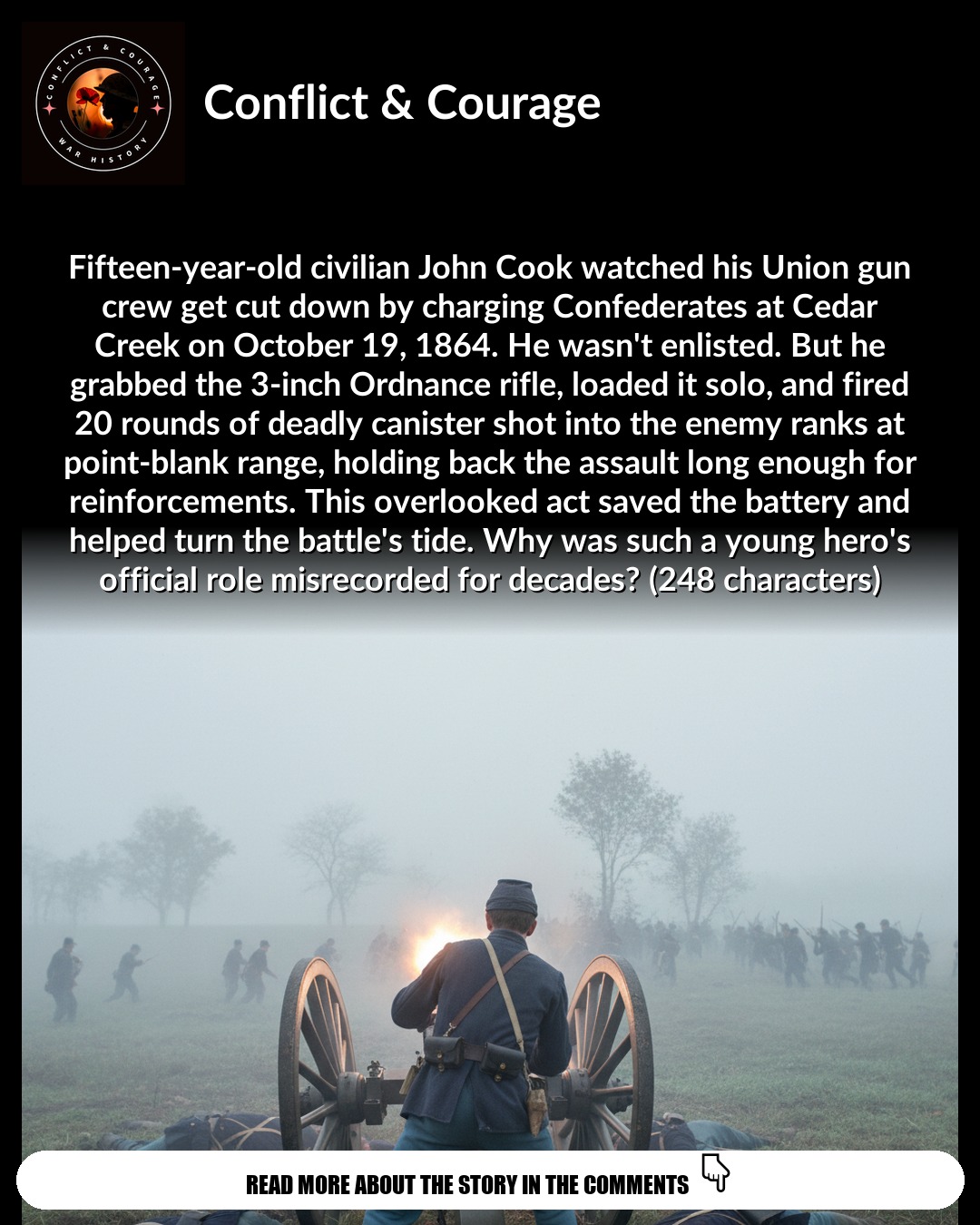
But teams require living members. When Confederate bullets cut down his companions, the boy found himself alone with a 12-pounder Napoleon cannon and an impossible choice: flee or fight.
Alone Against the Gray Tide
Confederate infantry surged toward the gun position, their rebel yells cutting through the morning air. The boy grabbed a canister round—essentially turning his cannon into a massive shotgun loaded with dozens of iron balls.
At point-blank range, he fired into the advancing enemy ranks. The canister shot tore gaps in the Confederate line, but more soldiers kept coming. Again and again, he loaded, aimed, and fired the heavy artillery piece.
What normally required a crew of six, he accomplished alone through sheer determination and adrenaline. Each shot bought precious time for Union forces to regroup and establish defensive positions.
The Science of Survival
Civil War artillery demanded precise coordination under the best circumstances. A typical gun crew included a gunner, two cannoneers to load and ram, a ventsman to clear the barrel, and men to handle ammunition and move the piece.
Canister rounds transformed field guns into giant shotguns, devastating at close range but requiring quick, accurate loading. The physical demands were enormous—canister shots weighed several pounds, and the recoil from each blast could shift the entire cannon.
For a 15-year-old to operate such equipment single-handedly while under enemy fire defied both military doctrine and physical possibility. Yet eyewitness accounts confirm it happened.
While Sheridan Rode
Twenty miles away in Winchester, General Sheridan heard the distant thunder of artillery and began his famous ride. His dramatic arrival and rally cry—"We'll whip them or they'll whip us!"—became the stuff of American legend.
But legends often overshadow the smaller acts of courage that make larger victories possible. While Sheridan galloped toward glory, unknown heroes like the teenage gunner held critical positions against overwhelming odds.
The boy's desperate defense gave Sheridan precious time to reorganize the scattered Union forces. Like other unsung heroes of the Civil War, his contribution proved vital to the final outcome.
Lost in the Paperwork
Military record-keeping during the Civil War was notoriously chaotic. Units kept multiple rosters, paperwork got lost in transit, and civilian laborers often appeared inconsistently in official documents.
The 15-year-old somehow ended up listed as a private rather than a civilian laborer. His original enlistment papers vanished entirely, leaving historians to piece together his story from scattered eyewitness accounts and unit records.
For years, his heroism remained buried in bureaucratic confusion—a reminder of how easily individual courage can disappear from the historical record.
Forgotten No More
Modern Civil War historians work tirelessly to recover these lost stories, scouring pension records, unit histories, and personal letters for clues. Like other forgotten heroes, the teenage gunner's tale survived thanks to a few veterans who remembered his courage.
These personal stories matter because they remind us that history's great moments often depend on ordinary people making extraordinary choices. Behind every famous battle lie dozens of individual acts of heroism that never made the textbooks.
The boy at Cedar Creek didn't seek recognition or glory. He simply saw his duty and performed it, regardless of his age or training. His story deserves to stand alongside Sheridan's ride as part of Cedar Creek's legacy.
What forgotten heroes from your family's military history deserve recognition? Share their stories in the comments below, or tell us about other young people who showed remarkable courage under fire. These tales of everyday heroism remind us that courage knows no age limit.