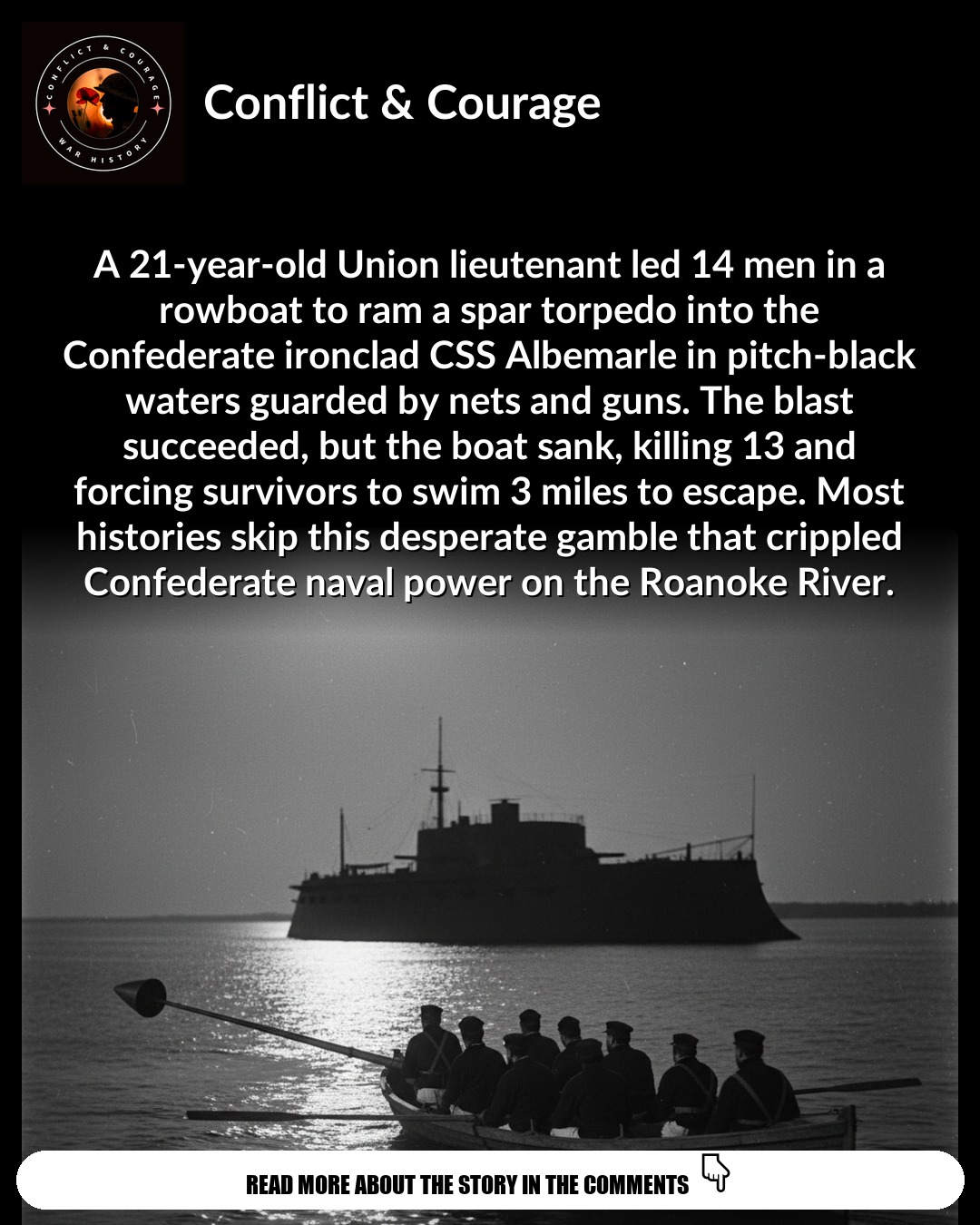
Picture this: It's October 1864, and a single Confederate ironclad is strangling Union victory in North Carolina. The CSS Albemarle sits like a sleeping dragon in the Roanoke River, her iron armor deflecting everything the Union Navy throws at her. Then a 21-year-old lieutenant volunteers for what everyone knows is a suicide mission—armed with nothing but a rowboat and a homemade torpedo.
What happened next became one of the most daring raids in naval history.
The Ironclad Terror Blocking Union Victory
The CSS Albemarle wasn't just another Confederate warship—she was a floating fortress that had already sent two Union vessels to the bottom of the Roanoke River. Her sloped iron armor shrugged off cannonballs like raindrops, and her presence effectively sealed off crucial Union supply lines into North Carolina's interior.
For months, Union naval commanders watched helplessly as conventional attacks failed. Artillery bounced off her hull, ramming attempts proved futile, and direct naval engagement was tantamount to suicide. The ironclad controlled a strategic waterway that the Union desperately needed to maintain their grip on occupied Confederate territory.
Previous attempts to neutralize this armored beast had failed spectacularly. The Confederates had positioned her perfectly—protected by river defenses, supported by shore batteries, and nearly impossible to approach undetected. Something radical was needed, and time was running out.
Enter William Cushing: The Navy's Young Daredevil
Lieutenant William Barker Cushing was exactly the kind of officer who made his superiors nervous. At just 21, he'd already earned a reputation for taking impossible risks and somehow surviving them. Where other officers saw certain death, Cushing saw opportunity.
The Navy's choice of such an inexperienced officer for this critical mission might seem puzzling, but Cushing's psychological profile was perfect for suicide missions. He possessed that rare combination of tactical brilliance and reckless courage that conventional warfare couldn't utilize—but unconventional warfare desperately needed.
His previous exploits had proven he could think on his feet under extreme pressure. More importantly, he volunteered knowing full well he probably wouldn't return. This young naval hero embodied the kind of desperate courage that desperate times demanded.
Planning the Impossible: A Rowboat vs An Ironclad
The plan was audacious in its simplicity—and terrifying in its likely outcome. Cushing would approach the Albemarle in darkness using a small steam launch equipped with a spar torpedo, essentially a large explosive charge mounted on a long pole.
Why choose such primitive equipment against an ironclad? Conventional weapons had failed, and stealth was their only advantage. A small boat could potentially slip past Confederate defenses where larger vessels couldn't. The homemade torpedo, while crude, packed enough punch to breach the ironclad's hull below the waterline.
The technical challenges were immense. The spar torpedo had to be positioned precisely against the hull, armed at exactly the right moment, and detonated while Cushing's boat was dangerously close to the explosion. One mistake meant death for everyone involved.
October 27, 1864: Into the Darkness
On that moonless night, Cushing and his handpicked crew of fourteen men began their journey up the treacherous Roanoke River. They navigated by feel and instinct, avoiding Confederate picket boats and river obstacles that could end their mission before it began.
As they approached Plymouth, North Carolina, where the Albemarle lay moored, the tension became unbearable. Every splash of their paddle wheels, every creak of the boat seemed loud enough to wake the dead. Confederate sentries patrolled the shores, and discovery meant certain death.
Then they saw her—the massive silhouette of the CSS Albemarle, protected by a boom of logs floating around her hull. This was the moment of truth, and Cushing made a split-second decision that would determine everything.
Explosion in the Night: Mission Success at Terrible Cost
Cushing drove his launch directly at the log boom, using the boat's momentum to ride up and over it. Confederate lookouts spotted them, and rifle fire erupted from the ironclad's deck as Cushing positioned the spar torpedo against the Albemarle's hull.
The explosion was devastating. The torpedo blew a hole in the ironclad's bottom while simultaneously destroying Cushing's boat. Most of his crew died in that terrible moment—some from the blast, others cut down by Confederate gunfire as they struggled in the dark water.
Cushing himself faced an impossible situation: wounded, surrounded by enemies, and miles from safety. Yet somehow, he managed to swim through Confederate-controlled waters, evading capture for hours until reaching Union lines. Only one other crew member survived the mission.
The Mystery Behind the Mission
Why did Union naval command approve such a desperate, untested plan? Official records reveal the strategic pressures but leave many questions unanswered. The political cost of losing North Carolina's coastal regions was becoming unbearable, and conventional military options had been exhausted.
The brutal mathematics of Civil War strategy demanded desperate measures. Sometimes, a single ironclad could influence an entire campaign, making extreme risks seem reasonable. Yet the Navy never fully explained why they chose a plan with such low survival odds over other alternatives.
What we do know is that military innovation often emerges from desperation, and conventional thinking rarely wins unconventional wars.
Legacy of a Night That Changed Everything
The sinking of the CSS Albemarle immediately reopened Union supply lines and restored naval control of the Roanoke River. Cushing's success proved that courage, creativity, and careful planning could overcome seemingly impossible odds.
The young lieutenant received the Medal of Honor and continued his naval career, though he never again attempted anything quite so suicidal. His raid demonstrated how small actions can have massive strategic consequences—a lesson that resonates throughout military history.
Like other heroes who took extraordinary risks, Cushing's story reminds us that warfare often depends on individuals willing to attempt the impossible when everything else has failed.
What do you think drove a 21-year-old to volunteer for such a mission? Share your thoughts about Cushing's incredible raid and how desperate times create unlikely heroes. Your insights help bring these remarkable stories to life for fellow history enthusiasts.