On a frozen mountainside in North Korea, two Navy pilots made decisions that would define brotherhood, heroism, and the complicated legacy of courage in America's forgotten war. Their story reveals both the best of military camaraderie and the worst of institutional memory.
When Heroes Fall Behind Enemy Lines: December 4, 1950
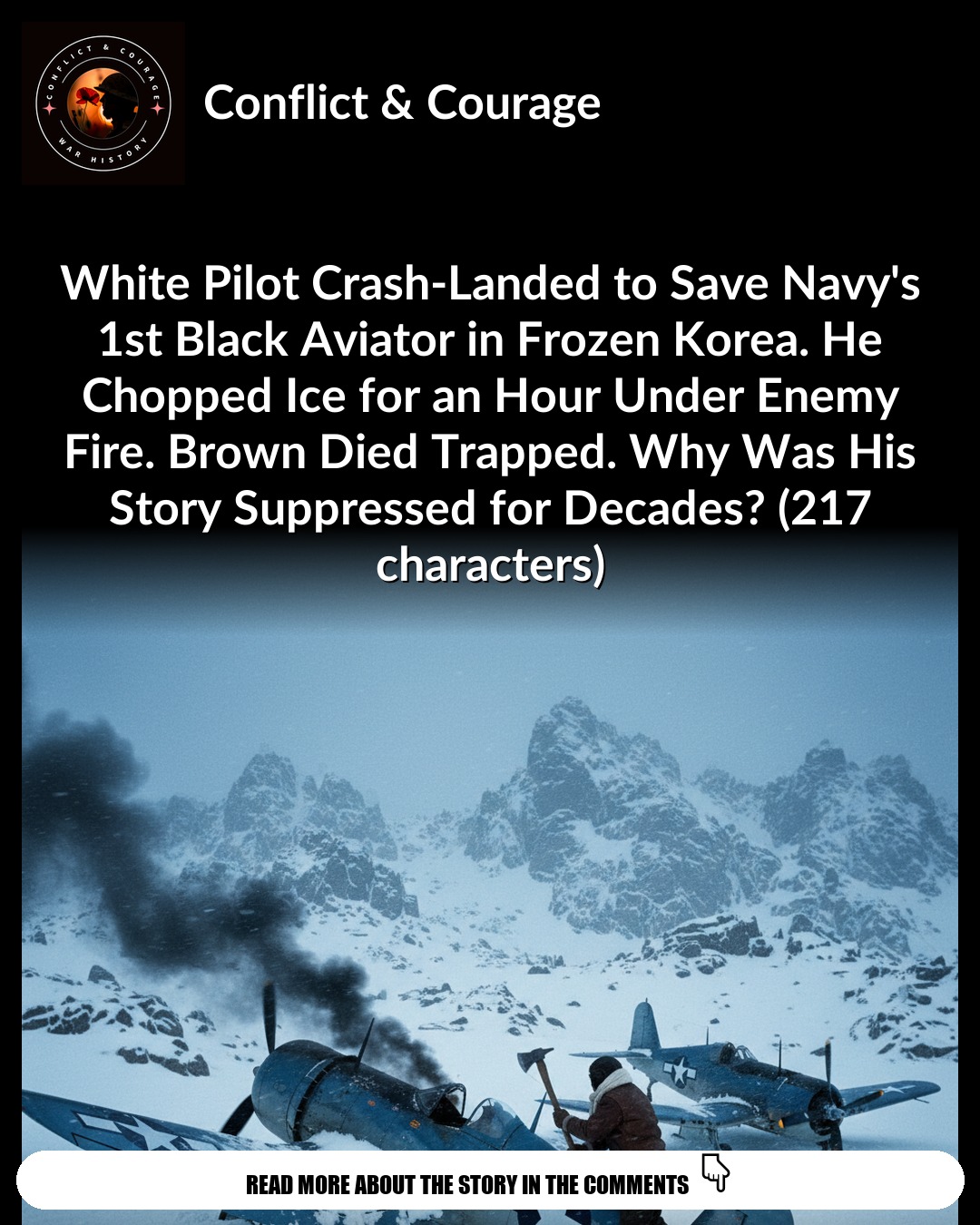
Jesse Brown's F4U Corsair slammed into the mountainside near the Chosin Reservoir with a sickening crunch of twisted metal. Flames immediately erupted from the engine, licking at the cockpit where Brown sat trapped, his leg pinned beneath the wreckage.
The temperature was twenty degrees below zero. Chinese forces were advancing through the valleys below. And circling overhead, Tom Hudner watched his wingman's plane burn, knowing that help was hours away—if it came at all.
In that moment, Hudner faced a choice that would echo through history. He could follow protocol, radio for help, and hope for the best. Or he could do something that violated every rule of engagement and common sense.
Jesse Brown: Breaking Barriers in the Sky
Jesse LeRoy Brown had already done the impossible once. Born in Mississippi in 1926, he became the first African American naval aviator in U.S. Navy history—a feat that required not just exceptional skill, but extraordinary determination to overcome a system designed to exclude him.
Flying dangerous ground support missions in his F4U Corsair, Brown proved himself repeatedly over Korean skies. He wasn't just making history; he was earning the respect of his squadron mates through sheer competence and courage under fire.
Like other barrier-breaking heroes such as the forgotten Black medic hero of D-Day's bloodiest beach, Brown faced the double burden of proving himself worthy while carrying the weight of representing his entire race.
The Impossible Decision: Crash Landing to Save a Friend
Tom Hudner ignored the frantic radio warnings from above. His wingman was down, trapped, and burning. The book said to circle, mark the position, and call for rescue.
Instead, Hudner lined up his own Corsair for a controlled crash landing on the snow-covered slope. It was aviation suicide—a deliberate attempt to destroy his own aircraft in terrain that offered no hope of takeoff.
His Corsair hit hard, the landing gear collapsing as the plane skidded to a stop just yards from Brown's burning wreckage. Hudner grabbed his survival axe and stumbled through the snow toward his friend.
![[U.S. Army Medal of Honor with neck band]](https://pub-1a77e7db170042adb48eb7b660a445d6.r2.dev/pd-library/US_Army_Medal_of_Honor_with_neck_band_7e463d597a.jpg)
An Hour of Desperation in Frozen Hell
With hands already going numb from the cold, Hudner began chopping frantically at the ice and twisted metal pinning Brown's leg. The cockpit smoldered ominously, threatening to explode at any moment.
Brown remained conscious but weakening. He spoke quietly to Hudner about his wife Daisy, about the life he'd built against all odds. The two men had transcended the racial barriers of 1950s America to become genuine friends—and now one was dying while the other fought desperately to save him.
For over an hour, Hudner worked with frozen fingers, his efforts growing weaker as hypothermia set in. The axe became heavier with each swing. Brown's voice grew fainter.
The Rescue That Almost Wasn't
When the rescue helicopter finally arrived, it couldn't land safely on the treacherous slope. The pilot hovered as close as possible while darkness began to fall and enemy forces moved closer through the valleys.
Hudner faced another impossible choice: stay with Brown and likely die alongside him, or leave his friend behind. Brown made the decision for him, whispering that Hudner should go—that his family needed him alive.
The helicopter extraction was harrowing, lifting off just as Chinese forces appeared in the distance. Jesse Brown remained in his frozen cockpit, becoming another casualty of America's "police action" in Korea.
Medals, Memory, and the Stories We Bury
Tom Hudner received the Medal of Honor for his actions—the first naval aviator so honored in the Korean War. The ceremony was swift and well-publicized, celebrating American heroism in a difficult war.
But Jesse Brown's story largely disappeared from official narratives. His barrier-breaking achievements and ultimate sacrifice were downplayed for decades, buried in the Navy's uncomfortable relationship with its racial past.
Like many heroes whose stories challenged conventional narratives, Brown's family fought for recognition that was long overdue. The Navy that had reluctantly accepted its first Black aviator was slow to properly honor his sacrifice.
Brotherhood Beyond Colour: Lessons from Chosin
In 1950s segregated America, the friendship between Jesse Brown and Tom Hudner was remarkable in itself. Their bond transcended the racial divisions that defined their era, proving that courage and character recognize no color lines.
Their story challenges how we remember military history. Too often, the contributions of minority service members like Brown get overshadowed or forgotten entirely. Heroes like Sammy Davis in Vietnam faced similar struggles for recognition.
The brotherhood forged between Brown and Hudner reminds us that heroism comes in many forms—not just the Medal of Honor recipient, but the barrier-breaker who paved the way for others. Their sacrifice on that frozen Korean mountainside represents the best of American military tradition: soldiers who fight not just for country, but for each other.
What stories of forgotten military brotherhood have touched your heart? Share your thoughts in the comments below, and help us continue honoring the heroes whose sacrifices shaped our freedom.